Showing posts with label TN. Show all posts

Monday, December 7, 2020

LIGHT IN A GLASS ROOM

Glass porch in the morning


The glass porch in our Louisiana home is my favorite room. True, the glass is smudged with bayou country grime from lack of care during the months we are away. Or perhaps the glass is cloudy because the porch is a place friends have visited to tell some dark stories about broken relationships, illnesses, quarrels — the glass porch has often housed usual and unusual tales of human tragedies.

However, this four-season indoor/outdoor room also holds the hopes for new perspective…it is a living room with a better view. Sometimes I go there to write, but the room doesn’t invite labor or action. I frequently fall asleep sitting in a comfortable wicker chair while the sunlight beams through on my winter-pale face.

The room also houses a few of the glass pieces created by Karen Bourque, a talented Church Point, Louisiana artist, and adds to the idea of inspiring joy in this life, albeit smudged with our tragic stories.

All homes should have such a room, perhaps now more than ever in this time of Covid. I went into the glass sanctuary this morning to share in the grief of my dear friend, Kathy, who lives in Sewanee, Tennessee, and who just lost her sister, Mary Kay, to the dread Covid disease.

Wicker chair on glass porch


The glass porch is also a place of prayer. Another smudge has appeared on the glass, and another prayer goes up for Kathy’s release from suffering. The sun fills Karen’s pieces with light in this small blessed space, and I ponder the idea of glassing in our little front porch at Sewanee. However, the porch faces dark woods and only collects shadows…and spiders.

Vickie Sullivan’s photographs capture the essence of this space on a cold winter morning, and I wish that I could say, “Come and sit awhile,” but this open-to-sunlight room doesn’t tolerate masked visitors!


Thursday, August 22, 2019

HISTORIC HOMESTEADING

CCC Homestead Water Tower

“It would be great if a program like the New Deal Subsistence Project of Homestead Communities could be instituted today,” I told the docent at the Homestead Tower in Crossville, TN after watching a documentary at the Tower. She was a descendant of one of the original Homestead families and agreed with me but added, “I’m not sure anyone wants to work that hard anymore.”

Under the regime of Franklin Delano Roosevelt, and with the encouragement of his wife, Eleanor, The National Industrial Recovery Act of 1933 had created a progressive program called the Subsistence Homestead Communities. It provided an opportunity for families who were permanently unemployed or displaced to purchase small equipped farms. One-hundred homestead projects were scattered across the U.S., and one highly successful one was centered in Cumberland County, Tennessee which had experienced massive flooding during the Depression of 1929.

The Homestead Project was an experiment in community living from which 233 families were selected to participate. They included 30 percent stranded farmers; 30 percent textile workers; 30 percent stranded coal miners, 10 percent labor leaders, teachers, a physician, a nurse, and two sociologists.

In the beginning years of the project, the Homesteaders were paid one-third in cash and two-thirds in credit hours. The credit hours were to be applied to the purchase price of their farms. The Homesteaders worked together toward a goal of creating their own homes from wilderness and becoming self-supporting. The houses built, one of which is featured below, were cottage style homes with 12-inch mason walls and siding of either sandstone or stone. Walls and ceilings were paneled with pine, floored with oak and heated with fireplaces. They were also plumbed and wired for electricity, eventually delivered by TVA. Many of the homes were built before roads and driveways reached them.

Home Built for Homesteader

The program wasn’t a hand-out program and is detailed in depth in a magazine published by The Crossville Chronicle which we picked up at the Homestead Tower, shown above. The Tower, built in 1938, is an octagonal stone tower that housed a 50,000-gallon water tank with a lookout tower at its peak. We didn’t climb the Tower, but we examined the exhibits of photographs and artifacts used during the Homestead Project. The Cumberland County Homestead Project in Crossville, TN gained national notice as the “Showplace of the New Deal.” 

Fifty percent of the original Homesteaders eventually owned their homes, and homeowners had learned valuable construction, farming, and business skills. They had been trained by experts in agriculture, engineering, and construction and assisted by FDR’s boys, CCC and WPA workers (both programs in which my father participated in Louisiana).

FDR once said that there was only one objection he had to the whole Homesteads Initiative, and that was the word “subsistence.” “I wish we could come up with a new term to take its place. This work we are doing is not a matter of subsistence…we want more for these families than that…it is the thing that we have called ‘the more abundant life."* 

The Homestead Project in Cumberland County, and nationwide, ended in 1946, but descendants of the Project still occupy many of the Crossville cottages erected during the era of the New Deal. Of interest to me: Of the 1500 applicants to this program, 233 were selected for “high character, ability, honesty, willingness to work and cooperate.” If participants didn’t measure up under a probation contract of two years, they were asked to leave.  

*Reference from Crossville Chronicle, “The Cumberland Homesteads.”


Photographs by Victoria I. Sullivan


Friday, July 19, 2019

INUNDATIONS AND SUNLIGHT


Spring Annunciation, glasswork by Karen Bourque

During the recent disaster of the Storm Barry that inundated parts of Iberia Parish and brought wind and water to Louisiana, my home in New Iberia was spared significant damage. While the storm raged, friends sent messages that I was lucky to be living on The Mountain at Sewanee, TN instead of the storm-ravaged parts of my native state. Many of my friends thought that at 2000 feet, Sewanee was safe from floods that could have inundated my residence at a 25- foot elevation in New Iberia. 

However, if I had been living on The Mountain in February of this year, I’d have put on high boots because southeast Tennessee received 12 inches of rain. Although flooding occurred on the Cumberland Plateau and drained off The Mountain into area coves and communities surrounding Sewanee, no damage to my home here occurred. When we arrived in March, we were appalled at the sight of a flooded corn field near Cowan, TN where we had bought and enjoyed the #1 sweetest corn grown anywhere in the U.S. That flooded area finally dried last month, but only through evaporation and the grace of God because there were no coves or rivers into which it could have drained. Fortunately, the Amish farmer had planted a crop in another spot on higher ground, and we’re now enjoying fresh, sweet corn daily.

Lapp's flooded corn field, Cowan, TN

The year 2018 was the wettest year on record at Sewanee, according to a report in The Sewanee Purple, the student newspaper at the University of the South. Despite naysayers about “climate change,” flooding has become a widespread problem in the United States, and friends in Iberia Parish, Louisiana, say “another 1927 flood may become a reality.” They refer to the wall of water that reached the Bayou Teche from Port Barre to Arnaudville and crossed the ridges of the Bayou Teche, smashing a protection levee in St. Martinville and rushing into Spanish Lake while the bayou filled with water from the east side. Over 4,000 people in Iberia Parish became refugees in camps on a ridge overlooking Spanish Lake. These camps were set up in May 1927 and did not close until July 1927.

Amid gray days of recent heavy rain on The Mountain and news of the inundations in New Iberia, I received a package containing The Consolation of Gardens, my newest book of poetry, and a ray of sunlight arrived at our home here. The cover of this book features a photograph of a beautiful glass piece rendered by Karen Bourque, glass artist from Church Point, Louisiana (shown at the top of this blog). Gold and yellow hues brought immediate sunlight into the house, and a dragonfly in the center of the glass piece affirms the joy viewers will feel when they look at the photograph on the cover. It’s a vibrant glass piece that radiates positive signals, a sacred work that captured the essence of the poetry in which I attempted to connect with nature’s contemplative and nurturing presence. Karen entitled the piece “Spring Annunciation,” and she could have subtitled it “Hope,” as it is a piece of healing art.

Beneath the Surface, glasswork by Karen Bourque

In A Slow Moving Stream, a book of poetry that I read at the Louisiana Book Festival a few years ago, I wrote of floods in Louisiana and the tenacity of the Acadians when water becomes a spring ritual. As I read one of the poems now, I’m reminded of how enduring my Cajun friends are:
Although the water behaved
as if nothing would ever hold it back
and they did not know
how much terror they could withstand,
they would not turn away.
This land of palmetto, cattail,
willows and elderberry;
swamp and wetland wilderness,
was the abundance of a higher realm
constantly lit they had discovered
where bayou and river conjoined,
a place where the deceitful water
had tried to take them away
but everything had been revealed to them
in the catastrophes of their belonging.

Another photograph of one of Karen’s glass pieces, "Beneath the Surface," appears on the cover of this book, one in which a field of yellow ranunculus is featured — again, a beautiful piece of healing art.


Friday, June 21, 2019

THE CONSOLATION OF GARDENS


Border Press announces the July publication of The Consolation of Gardens by Diane Marquart Moore, a poet living in New Iberia, Louisiana and Sewanee, Tennessee, with photography by Dr. Victoria Sullivan. The duet of poet and plant photographer, Moore and Sullivan, has produced another book featuring their pursuits of plant life scattered throughout the southeastern United States and as far afield as the Mideast.

Poet Diane Marquart Moore observes humanistic elements in the diversity of plant forms, from mayapples to the everlasting rose; and Sullivan’s trained eye records the color and structure of typical and atypical forms of leaf and flower.

A special page in Consolation of Gardens, derived from drawings delineated by the poet’s mother, Dorothy Greenlaw Marquart, in 1926, lends interest to this volume.

Poems about those living forms that provide beauty as the principal adornments in garden and field provide botanical bounty for plant collectors, explorers, and lovers of gardens.

The cover of this volume is a photograph of a beautiful glass piece, Spring Annunciation, rendered by Karen Bourque, glass artist in Church Point, Louisiana and designed by Martin Romero, Vice-President of Landscape Design for Mullin Landscape Associates, St. Rose, Louisiana.


Available by July 15, 2019 from amazon.com or order from Border Press Books, P. O. Box 3124, Sewanee, TN 37375


Thursday, May 9, 2019

BETWEEN THE ROCKS

Savage Falls Trail by Andy Gay

Andy Gay of Cowan, Tennessee wears a lot of hats — musician, minister, photographer, writer, painter… I was introduced to him at St. Mary’s Convent, Sewanee, Tennessee when he and his wife Mary Ann began attending services in the chapel there. A former Presbyterian minister, Andy began playing his guitar in the Convent’s special programs about environmental issues, and he’s been a guest preacher at several St. Mary Sunday services. At breakfast in the refectory, we often talk with him about Ghost Ranch, New Mexico where he and Mary Ann have been vacationing for over thirty years. We only recently discovered that he has been creating paintings of Orphan Mesa, Canyon de Chelly and other sites near Ghost Ranch, which is, of course, the territory of the famed artist, Georgia O’Keefe. 

Andy’s passion for painting the natural landscapes of southern middle Tennessee; Alaska; the Isle of Skye, Scotland; Ghost Ranch, and other areas, worldwide, has resulted in a fascinating exhibit at the Artisan Depot Gallery in Cowan, Tennessee. There, we learned that he has also exhibited his art in the Tennessee All State Exhibit at the Parthenon Gallery in Nashville, Tennessee. As a retired minister, he claims time to paint, pursuing work in transparent watercolors after exploring the art of acrylic and pastel chalk painting. 

Andy’s exhibit at Artisan Depot Gallery was inspired by places he’d often visited or lived and dates back to the 1990’s; however, his venue at the Gallery is a “first.” Viewers learn that whatever the setting, Andy says he looks Between the Rocks (the title of his exhibit) where “the great and tiny, the hard and the delicate, the momentary and ancient, co-exist in beauty and are illumined by the multifarious moments of changing light and texture…”

Readers can see that the commentary accompanying paintings in this exhibit is as poetic as Andy’s paintings and reveals Andy’s writing talents; e.g., a description of “Into the Light” on the Savage Falls Trail in the Savage Gulf Natural Area, Tennessee : “On this trail to the falls one passes through masses of light filtered through rhododendron, and laurel stands bracketed by shaded passages. This bridge carries us from one issue of light into another. Every bend harbors some kind of mystery, no matter how many times you have been there…” The eloquent text reminds me of John Muir’s Wilderness Essays and, like Muir, it reflects the writer’s passion for places of endless variety that inspire wonder — natural formations, weather changes, light shows…

Andy’s description of the painting, “Sundance:” expresses his fascination with scenes of his New Mexico visits: “During the monsoon season, when clouds tower and sift the sky over Chimney Rock, light dances. Celestial celebrations go into the night in the forked lightnings over Pedernal, and to the east, the Milky Way unfolds itself, spilling stars now and again into our world…”

Andy reports that he has probably been inspired to paint more Shake Rag Hollow scenes in Sewanee, Tennessee through the years than any other region he’s visited. He writes that “the sun, in the last hour of the day, finds a path, here and there, to penetrate to the forest floor, spilling out in pools of light in the darkening wood. At the last, especially in September and October, the light becomes golden. You may step into these little pools of gold and bathe in them…”

Between the Rocks is a show that lovers of outstanding landscape art will appreciate. Whether Andy is writing songs and playing them, indulging his passion for watercolor painting, nature writing, or preaching an eloquent sermon, in my lexicon he’s a Renaissance man whose art shows “beauty in all its forms, both novel and familiar.”* 

*From Wilderness Essays by John Muir


See the Artisan Depot Gallery website for hours, exhibit announcements, and events scheduled.


Monday, May 6, 2019

LEAVE A LITTLE SPARKLE WHEREVER YOU GO!

By Frances Perea

That headline is the leitmotif of the artist Frances Perea, and visitors to the Artisan Depot Gallery in Cowan, Tennessee would agree that her newest collages reflect a whimsical spirit and strong interest in mythical/magical subjects; e.g., folklore surrounding fairies. Perea has captured the spirit of these creatures in various art forms, but one glimpse of her trading cards of fairy collages made me laugh aloud. I also thought of my mother who believed that these magical  beings could tell fortunes, prophesy births, foretell deaths, and intervene in household “goings-on.”

Perea also paints religious icons and attributes her inspirations for folk art to Latin American artists like Frida Kahlo of Mexico whom she regards as her most serious Muse. However, her latest creations reflect a whimsical spirit just on the edge of being mischievous. She’s also written a pamphlet that relates How the Fairies of Lullymore Came To Live in America and features a poem by Yeats on the back cover that begins with the lines: “Fairies, come take me/out of this dull world…” 

In antithesis to former stories about sinister fairies in folklore, Perea’s creatures are more well-intentioned and are generally protective beings who dance on household hearths. Actually  my mother claimed they danced in the flames of various space heaters in our home before central heating put them out of business.

by Frances Perea

Frances Perea is a native of Santa Fe, New Mexico and became involved in art at San Jose City College in San Jose, California. She began to exhibit in El Gatito Gallery in Los Gatos, California, then returned to Santa Fe and painted designs on furniture and pottery. She relates that one of her pieces was bought by Bono from the Band U2 and shipped to Ireland. Later, she initiated a line of religious icons and sold them through various museums, including the famous Smithsonian Institute, and through shops and galleries throughout the U.S. After she and her husband moved to Winchester, Tennessee, she began exhibiting through the Franklin County Arts Guild at the Artisan Depot Gallery. Perea also has a site called My Art Place on Etsy showcasing her collages, fabric art, recycled and digital art, and jewelry.


by Frances Perea

I’m trying to find frames small enough for the fairy trading cards shown on this blog and named the two I purchased after my two daughters who often read my blogs. I’m wondering if they can identify themselves in the pictures shown. The cards “leave a little sparkle” in my mornings, and I’m transported by Perea’s depictions of the diminutive sprites that inhabit her Tennessee fairyland.


Wednesday, May 1, 2019

BEACH YEARNINGS

The Beach by Diane M. Moore

The above picture is one of the very few pictures I’ve painted during my lifetime and, of course, is in the rank of "very amateur art.” Now that summer is approaching, it represents my envee (desire, yearning, etc., in Cajun French) for beach life. The picture was executed on a visit to Gulf Shores, Alabama, and my visit there actually occurred in late spring almost twenty years ago. 

I recorded this experience in a journal, then painted the picture. A week spent in sun and sand engendered a feeling of peace, which being near the ocean often does, and I was unencumbered enough not to care if my art “got out there,” as we often say about the dissemination of artistic effort. I wrote: “The umbrella lady comes at high tide, unlocks a painted white box, and many umbrellas, royal blue, spill out, accompanied by matching chairs. Set up, they represent linear thought, each bather’s pole placed in the sand in line with neighboring umbrella, plumb bob straight. A grove of blue palms under which lobster red legs jet toward the sea becomes visible. Waves vibrate monotonously… the sands are heavy with leisurely thought…On the beach everyone searches for something…gifts of the tides.”

This part of the calendar year I live on The Mountain, as it is called here at Sewanee, Tennessee (April 1to October 15) and develop a yearning for water and beach every year. However, we’re likely to schedule leisure time at other elevations; e.g., this weekend in a state park called Pickwick Landing on Pickwick Lake, not too far from the Shiloh National Military Park where my great-grandfather fought as a captain in a Tennessee regiment.

One of the recreational perks Tennessee offers is its state park system—56 of them located in all corners of this wide state. We’ve visited only four of them during our eleven-year sojourn. Many were built by members of the CCC and WPA who were part of programs instituted by President Franklin Roosevelt. Roosevelt established both programs in an effort to provide employment for indigent young men who needed jobs following the Great Depression.
Anyway, I won’t get to the beach this early in the season…and probably not at all…but we’ll enjoy a few days near a lake in a 1516-acre state park a few miles away from historic Savannah, Tennessee and the Tennessee National Wildlife Refuge. I doubt if any art will result from the experience, but the thought of relaxing near a grand body of water is enough to satisfy my yen for sun and sandy beaches…for awhile.


Friday, April 26, 2019

REMEMBERING ANNE BOYKIN


April blossoms of Wild Azalea at Convent of St. Mary

Yesterday I received word that Anne Boykin, wife of a former Episcopal minister who once served in New Iberia, Louisiana had died. In 2009, shortly after we moved to The Mountain here at Sewanee, Tennessee, I wrote a blog about Anne, and the message is one of fond remembrance that needs repeating because it speaks of a better time in Anne’s life. The message is also repeated for her many friends in New Iberia, Louisiana. “Give rest, O Christ, to your servant Anne with your saints, where sorrow and pain are no more, neither sighing, but life everlasting” (From The Book of Common Prayer).

Posting from 2009:
Yesterday, temps on The Mountain hovered near 40 degrees, and a fine mist and rain fell most of the day. It could have been a gloomy time, but our long-time friend, Anne Boykin, invited us to have lunch with her in Tracy City to brighten the day. Tracy City is a small town at the end of a road that winds through the hills northeast of Sewanee and has lately become noted for its restaurant, “Tea On the Mountain.” The building that houses this eating place is a nondescript, white-plastered building with scant windows, and when we drove up and looked at the bland exterior, I thought “uh-oh.” However, we opened the door and stepped into a fine dining facility — white linen table cloths, fine china and silver atop antique tables scattered throughout several rooms, the walls lined with regional art and sets of fine china displayed on tables in every room — some sets for sale, some on exhibit only.

We were served hot tea as soon as we sat down and given a menu that featured a range of entrees from crab cakes to quiche, with accompanying green salad and French bread. The appetizer was an almond-stuffed date wrapped with bacon, and the piece de resistance was a tiny chess pie for dessert. The owner came to our table and told us a story about the pie’s name being derived from the wife of Andrew Jackson referring, off-handedly, to her dessert as “jes pie.” “Tea on the Mountain” was a real dining experience on a cold March day in the hills of Tennessee, and the hospitality within the square white building made me ashamed that I had misjudged the restaurant on the basis of its exterior.


Anne, who is our food guide on The Mountain, could open a restaurant at Sewanee had she an envee to do so, which she doesn’t have. She’s one of Sewanee’s finest chefs and a model of southern hospitality. I’ve put my feet under her table many times, enjoying delectable dishes prepared according to directions from neatly typed recipes passed on to Anne by her mother, who lived on a huge farm near Murfreesboro.


When Anne and Elmer (former rector of Epiphany in New Iberia) lived in New Iberia, Anne hosted weekly church luncheons and dinners in her home, even outdoor “feeds” in the rectory’s side yard, such as the one she hosted when I left New Iberia for our sojourn in Iran during the late 70’s. At 80, Anne says she has retired, but she’s noted for providing food and shelter for people who come to The Mountain for brief stays and find “no room at the Inn.” Last summer when a Vietnamese student graduated, he invited his family (who spoke no English) to the Commencement and searched vainly for rooms to accommodate them. Anne opened her home to them, and says they parleyed quite well without either speaking the other’s language. The Vietnamese family’s favorite meal while staying with Anne was breakfast, my favorite meal at her table. They were served a Tennessee farm breakfast, complete with tiny homemade biscuits, grits, sausage…the full complement of breakfast fare.


I’ve threatened to publish the small book of Anne’s recipes taken from her mother’s repertoire, but she insists she has retired and her kitchen is closed — and she doesn’t want the publicity… until someone shows up and needs food and shelter, that is. One of the reasons we retired to The Mountain is that we anticipated everyone at Sewanee being as hospitable as Anne Boykin. However, she’s still undisputed #1 gracious hostess on The Mountain — or anywhere else she has lived in the South.


Photograph by Victoria I. Sullivan

Thursday, March 7, 2019

TRAINS IN THE NIGHT

Train engine at Chattanooga Choo Choo

As we prepare for an exodus to Sewanee, Tennessee, I realize that one of the sounds I’ll miss when we leave New Iberia, Louisiana is that of the many trains that pass through the town during the night — those long, shrieking whistles that annoy light sleepers. At one time, the sound made me feel lonely, but at 83 it’s a song that tells me all is well; the trains are still running. 

When I was working on a book that called for researching a history of trains in the South, I came across a section in Railroads of the Old South about the many interest groups that tangled with railroad officials during the 19th century. These groups caused a ruckus in small southern towns because the trains ran on Sundays, and railroad workers missed church. The group called itself “The Sabbatarians,” members of which placed high value on Sunday attendance and who wanted to enforce that vision on the then-modern technology. In Richmond, Virginia, a minister complained that the private consumer “couldn’t get wares untouched by the sacrilegious hand of the Sabbath breaker.” 

Word from the pulpit was so effective that a railroad worker in North Carolina resigned his job because he felt he was sinning on Sunday. Most of the petitions to southern railroad officials were advanced by preachers who lambasted stockbrokers as well as governing bodies of railroads. Condemnation included one argument by a Protestant Episcopal Church representative at a stockholders meeting: “The trains traverse great distances (on Sundays)…attracting great attention and exciting curiosity wherever they go…” Further complaints included the “hustle and bustle of business, properly belonging only to the working days of the week…”

Twenty years passed before the Sabbatarians were able to get railroad officials to reduce their Sunday service to a bare minimum; however, officials endured the criticisms and were finally praised for offering reliable and regular transportation. For many years, the Sabbatarians demonstrated that railroad companies weren’t in control of their own time due to the moral pressure from special interest groups.

Today, railway service is available seven days of the week and offers a plethora of schedules and time tables, running through towns like New Iberia throughout the night, and are a part of the social fabric that connects all of us who appreciate their services.

In 2018, I published Destinations, a book of poetry about trains, accompanied by photographs that Victoria Sullivan snapped in various locales of the South and including one poem about the trains that rumble through New Iberia at night:

NIGHT FLYERS

I miss hearing them at night,
trains carrying grave histories,
doing ghostly runs through New Iberia,
making sounds that once brought melancholy;

As I age, they become gifts
exploring places I don’t know,
good friends holding me close
yet keeping their distance,

their thunder an escape from bad dreams,
voices saying goodbye while I lie in bed,
move toward a world away,
out there in the storm,


bell ringing in an untroubled dawn.


Friday, March 1, 2019

ABOUT BOOKS


Today marks the birthday of my great-granddaughters, Kate and Lillian, and tomorrow I'll travel to Baton Rouge to celebrate the occasion with them. This morning, in a telephone conversation with my daughter Stephanie, before I thought about what I was saying, I commented apologetically, "I'm just giving them books."

My mother probably turned over in her grave when I made this remark since she believed that books were the most valued possessions in any home. During WWII, she regarded them as more precious than rationed food.

In the introduction to my now out-of-print book, Their Adventurous Will, a volume about Louisiana women, I wrote that she read aloud to us every night and related how that nightly reading contributed to my development as a writer: "When I was three years old, she'd seat me, cross-legged in the middle of our small kitchen, and open for me giant editions of Mother Goose, A Child’s Garden of Verse, and Marigold Garden…She read aloud the entire series of Uncle Wiggly in the Cabbage Patch, The Little Colonel, Raggedy Ann and Andy, Greek Legends, Black Beauty and Grimm's Fairy Tales, even after all the children in our family had learned to read…"

In that same introduction, I wrote about another family member, my Godmother Dora, who built a library of books that would challenge my own 2,000-and-more book collection. "Books by mystics, theologians, poets, and Christian apologists crowded the bookshelves in her home," I wrote. "A visitor might be engaged in intent conversation with her, and she'd suddenly scurry away on her tiny feet, select a book from a shelf nearby and begin reading some lengthy passage. On the flyleaf of a small, yellow-gold volume entitled The Fruits of the Spirit by Evelyn Underhill, which Dora gave me in 1963, she inscribed in her elegant but often-illegible handwriting: "For Diane, for whom we wish the fruits of the spirit above all else…"

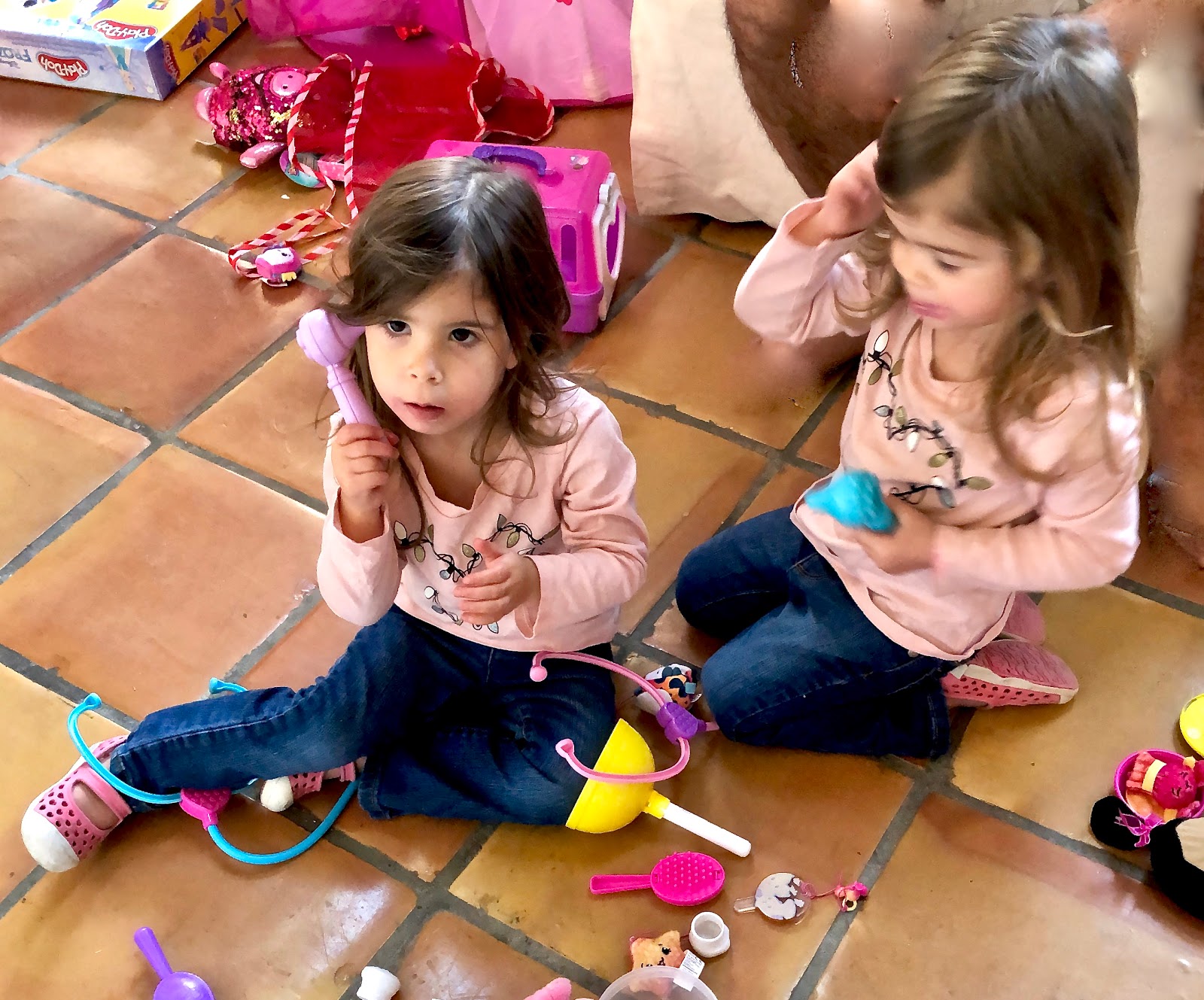
Lillian and Kate with Christmas toys, 2018

Dora was a stern critic of literature and had she lived to read my books, she would've referred me to those disciplined writers who put in their 10,000 hours before calling themselves poets. However, a friend recently told me that her band leader in high school often admonished, "practice won't make you a great musician if you practice wrong." 

Recently I loaned a copy of Their Adventurous Will to a friend and when she returned the book, I found a message on a sticky note within telling me that as she read the introduction about my mother, she journeyed back to her own childhood and the times her Mama had read to the family long after they could read themselves. "It was a special bonding time," she added.

Just yesterday, when I visited a funeral home to pay respects to an old friend, her daughter told me that in her mother's demise, she often requested that "someone read aloud to her." Her daughter would protest that there were mostly children's books available in the house. "I don't care," her mother had said. "Just read to me!" And the implication was that, like my mother, she probably enjoyed children's books as much as any contemporary novel or tome.

When Sister Elizabeth came down to New Iberia from the Convent of St. Mary in Sewanee, Tennessee last year, she did a "walk through" of my home and gave us her candid appraisal. "I always go into a home and find myself thinking about what their major interests are," she said. (Now there are many crosses scattered about and I'm a deacon, but she didn't list them as a major interest). 

Instead, she commented, "Books and art…you really value them." She was spot on. So now I'm wondering why I apologized about giving my great-grandchildren "just books," and this blog is an apology for making such a foolish remark.


As Piglet (in Winnie the Pooh) said to Eeyore: "Many happy returns of the day" to precious Kate and Lillian. May you always have an abundance of beloved stories of adventure, friendship, and fun in your home.