Showing posts with label A Slow Moving Stream. Show all posts

Monday, August 5, 2019

THE MIND OF TREES

Live Oak on Bayou in Arnaudville


This morning amidst the continuing news about mass shootings and tragedy of the last few days, and while I pray for peace in our troubled country, I received an email from my dear friend, Karen Bourque, a master of glass artistry who lives in Church Point, Louisiana. She had attached a photograph of her latest glass piece featuring a tree in Cajun Country. Like many of Karen’s glass pieces, the work brought with it a feeling of peace. The piece wasn’t requisitioned by me, but Karen shares images of a lot of her work with me, and I share my poetry with her — an exchange of inspiration, and sometimes synchronicity. She said she was reading a poem each night from my latest, The Consolation of Gardens, and meditating on it, and I was cheered by the thought that, although I’m not on any bestseller list, some of the poems have carried the “consolation of gardens” to cherished friends.


The email with an image of her lovely glass piece reminded me of an oak tree that Karen, Darrell, Vickie, and I viewed after lunch one afternoon in Arnaudville, Louisiana and that Karen used as a model for the cover of my book, A Slow Moving Stream, published in 2016. One of the poems, “The Mind of Trees,” captured my mood and “spoke to my condition” this morning. It is partially excerpted below:

The trees outlasted their language.
No matter who came
the language disappeared into English:
French, Spanish, German, Chitimacha.
English filled the horizon,
the patois of each clan banned,
buried under the oaks, the words waiting.
The trees absorbed all of it
and when hurricanes felled them
they were cut into logs,
the loggers, finding stories in their language
imbedded in the rings,
began to preserve what had been lost.

Word by word they created
an articulation of arriving,
the sound of memory offering itself
from a distant longing. They heard
what they had been told not to hear —
testimonies for their being there.
And they praised the trees
for finding a way without them.

The poem is open to interpretation, but I believe it’s pertinent to what is going on in our country and am glad to repeat it here. Thanks for the “pass along” this morning, Karen Bourque.

Photograph in “The Mind of Trees” by Victoria I. Sullivan and glass piece image on the cover of A Slow Moving Stream by Karen Bourque.


Friday, July 19, 2019

INUNDATIONS AND SUNLIGHT


Spring Annunciation, glasswork by Karen Bourque

During the recent disaster of the Storm Barry that inundated parts of Iberia Parish and brought wind and water to Louisiana, my home in New Iberia was spared significant damage. While the storm raged, friends sent messages that I was lucky to be living on The Mountain at Sewanee, TN instead of the storm-ravaged parts of my native state. Many of my friends thought that at 2000 feet, Sewanee was safe from floods that could have inundated my residence at a 25- foot elevation in New Iberia. 

However, if I had been living on The Mountain in February of this year, I’d have put on high boots because southeast Tennessee received 12 inches of rain. Although flooding occurred on the Cumberland Plateau and drained off The Mountain into area coves and communities surrounding Sewanee, no damage to my home here occurred. When we arrived in March, we were appalled at the sight of a flooded corn field near Cowan, TN where we had bought and enjoyed the #1 sweetest corn grown anywhere in the U.S. That flooded area finally dried last month, but only through evaporation and the grace of God because there were no coves or rivers into which it could have drained. Fortunately, the Amish farmer had planted a crop in another spot on higher ground, and we’re now enjoying fresh, sweet corn daily.

Lapp's flooded corn field, Cowan, TN

The year 2018 was the wettest year on record at Sewanee, according to a report in The Sewanee Purple, the student newspaper at the University of the South. Despite naysayers about “climate change,” flooding has become a widespread problem in the United States, and friends in Iberia Parish, Louisiana, say “another 1927 flood may become a reality.” They refer to the wall of water that reached the Bayou Teche from Port Barre to Arnaudville and crossed the ridges of the Bayou Teche, smashing a protection levee in St. Martinville and rushing into Spanish Lake while the bayou filled with water from the east side. Over 4,000 people in Iberia Parish became refugees in camps on a ridge overlooking Spanish Lake. These camps were set up in May 1927 and did not close until July 1927.

Amid gray days of recent heavy rain on The Mountain and news of the inundations in New Iberia, I received a package containing The Consolation of Gardens, my newest book of poetry, and a ray of sunlight arrived at our home here. The cover of this book features a photograph of a beautiful glass piece rendered by Karen Bourque, glass artist from Church Point, Louisiana (shown at the top of this blog). Gold and yellow hues brought immediate sunlight into the house, and a dragonfly in the center of the glass piece affirms the joy viewers will feel when they look at the photograph on the cover. It’s a vibrant glass piece that radiates positive signals, a sacred work that captured the essence of the poetry in which I attempted to connect with nature’s contemplative and nurturing presence. Karen entitled the piece “Spring Annunciation,” and she could have subtitled it “Hope,” as it is a piece of healing art.

Beneath the Surface, glasswork by Karen Bourque

In A Slow Moving Stream, a book of poetry that I read at the Louisiana Book Festival a few years ago, I wrote of floods in Louisiana and the tenacity of the Acadians when water becomes a spring ritual. As I read one of the poems now, I’m reminded of how enduring my Cajun friends are:
Although the water behaved
as if nothing would ever hold it back
and they did not know
how much terror they could withstand,
they would not turn away.
This land of palmetto, cattail,
willows and elderberry;
swamp and wetland wilderness,
was the abundance of a higher realm
constantly lit they had discovered
where bayou and river conjoined,
a place where the deceitful water
had tried to take them away
but everything had been revealed to them
in the catastrophes of their belonging.

Another photograph of one of Karen’s glass pieces, "Beneath the Surface," appears on the cover of this book, one in which a field of yellow ranunculus is featured — again, a beautiful piece of healing art.


Saturday, September 15, 2018

"BENEATH THE SURFACE"*


This morning as I watch the flickering images of flooding in North Carolina and South Carolina on television, I remember the catastrophic storms that have inundated parts of my home town, New Iberia, Louisiana, throughout the years. Two years ago I published a book of poetry entitled A Slow Moving Stream (the Bayou Teche that flows through New Iberia and southwest Louisiana) and included a poem about the great flood of 1927 that inundated Acadiana. Since that time, New Iberia has endured many hurricanes and floods, but this 20th century storm caused incalculable deaths and damage in Teche country.

Karen Bourque, master glass artist in Church Point, Louisiana, captured in glass the cover for A Slow Moving Stream, the Bayou Teche near Arnaudville, Louisiana, which became a torrent of water during the flood of 1927. I acquired the glass piece entitled “Beneath the Surface,” and it now hangs in one of the dining room windows of our home in Sewanee, Tennessee. 

Karen always provides a text to accompany her glasswork, but rather than writing a text about the inundations of the Teche, Karen wrote that the glass piece for A Slow Moving Stream symbolizes Spring, “the dominant seasonal reference in the piece…and is symbolic of the time of renewal. Spring, either as time measure or metaphor, marks that time when the soul awakens inside the crossing of a water barrier, that time when unconscious mind and conscious mind surface and co-exist in the balance of renewed beginnings…”

Karen’s words constitute hope this morning. As I look up at the glass piece, her text helps to dispel my angst about the devastation due to storms and floods now battering the Carolinas, and I pray more fervently for those who are enduring this natural disaster.

In the last verse of “The Flood of 1927,” I describe the responses of those Acadians who migrated from Pisiguit, Nova Scotia, site of my ancestors who survived the great inundation of that century:

“They could not believe a levee had existed,

the land returning to a muddy geography

into which they climbed,

marveling at the ease of light,

declaring they’d never go back to Pisiguit

even if rocking tide caused the land to tilt

and the sky to become an ocean.

What had been green would be green again."

*Title of glass piece rendered by Karen Bourque, Church Point, Louisiana glass artist


Photograph by Victoria I. Sullivan


Tuesday, August 29, 2017

A FEW THOUGHTS ABOUT HURRICANE HARVEY

Bayou Teche flooding bananas trees in yard near
Port Barre, Louisiana

I find it difficult to write this blog because here I sit, high and dry on The Mountain at Sewanee, Tennessee while people in New Iberia, Louisiana, my real home, are watching a heavy rain falling, apprehensive about threats of flooding and tornados. I felt proud when I read news stories about the “Cajun Navy” getting into their trucks and pulling their Jo boats and pirogues behind, rushing to help Houston victims of Hurricane Harvey. I also felt humble, remembering that in the lives of Cajuns, no one is left out, an ethic that embraces family and strangers.

I remember Hurricane Andrew and the devastation it caused; how we foolishly sat out the storm when the wind played with the house as if it were an accordion and venerable oaks in New Iberia parks and along city streets fell, roofs were blown away, and we suffered power outage for three weeks. The sun shone the day following the hurricane, and when I went outdoors to survey the damage, I discovered that a tall pine in the front yard had fallen a few feet away from my bedroom window, and the yard was strewn with branches from the tree-lined street. Within hours, a member of the Cajun Army had entered the yard — my neighbor across the way, armed with a chainsaw, sliced into the felled tree, cut it into movable pieces, carried it away, and waved goodbye without speaking a word. He proceeded to Darby Lane, a few blocks away and began clearing the lane so that vehicles could get through to the highway. No one had summoned him.

Later, another neighbor and his son came over and, without a word, picked up branches and began raking my yard. Both acts were performed in silent determination.The man with a chainsaw bore the Cajun name of Olivier; the man who raked the yard was named Viator (once Villatores, a name of Spanish derivation). Both of those men bore the names of early settlers of New Iberia. They represented a gregarious culture that has assimilated French, Spanish, African-Americans, Brits, Germans, Irish… a unique culture that has a strong work ethic and joie de vivre unlike any other diverse group in the U.S.

Cajuns know a lot about hurricanes and floods, and they’re undaunted by water — even those in the Cajun Navy whose boats broke down in Houston and people tried to steal their stalled boats… even though they have been shot at if they were unable to pick up everyone in their Jo boats. I’m not surprised at their tenacity and courage. (I understand that a Gator Squad has also been organized in Houston because alligators seeking higher ground have begun frequenting Houstonians’ yards).

In 2016, I wrote a book of poetry about Bayou Teche entitled A Slow Moving Stream* that documented stories of early Cajun survival in Teche country. I include the last verse of one poem about the flood of 1927 that embodies the spirit of early settlers whose descendants are probably members of the present-day Cajun Navy:

“…The land returned to a muddy geography
into which they climbed
marveling at the ease of light,
declaring they’d never go back to Pisiguit
even if a rocking tide caused the land to tilt
and the sky became an ocean.
What had been green would be green again.”

PHOTOGRAPH BY VICTORIA I. SULLIVAN


*I will lecture and read from this book about the Bayou Teche to the Louisiana Literature class taught by Dr. Mary Ann Wilson, professor of English at University of Louisiana, Lafayette, in November when I return to Louisiana.

Thursday, March 2, 2017

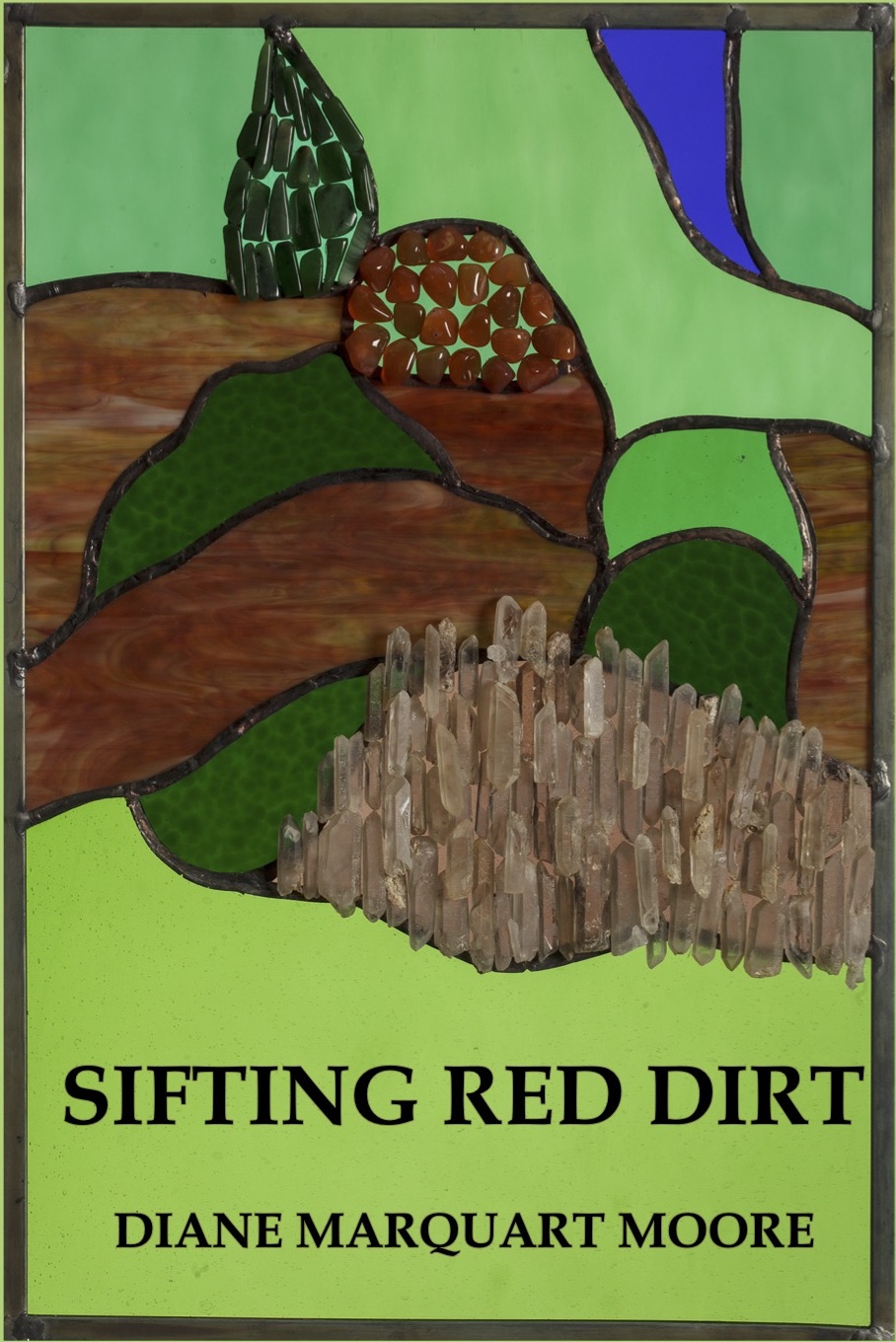
SIFTING RED DIRT

This week, I received the first copies of Sifting Red Dirt, my poetic offering for the year 2017. The cover, as usual, is a photograph of the unique glass work of Karen Bourque, a glass artist in Church Point, Louisiana. When I look at the beautiful glass pieces Karen renders to be photographed for the book covers of my poetry, I feel especially blessed to have her artwork in my home and on the book covers.

In the "Author's Note" of Sifting Red Dirt, I speak of the influence Karen has had on my work, and Border Press felt that the best introduction to this volume would be through the note about Karen's art being so compatible with my books:

"Last year I published a book of poetry featuring my Cajun ancestors about whom I had no knowledge until I reached my forties, and after the book, A Slow Moving Stream, appeared and I gave several readings, my maternal ancestors began to rival those paternal ancestors for inclusion in a book. They appeared in old photographs I had put away, in dreams, and in cogent memories...So I went to Mississippi where my great grandmother, Dora Runnels Greenlaw, was born and photographed a red hill near Brandon, Mississippi, then sent it to Karen Bourque of Church Point, Louisiana, who has rendered many of the wonderful glass pieces for covers of my books of poetry. Almost immediately, I was assailed with doubts about writing a book about them and announced I was finished before I began.

However, when I returned to Louisiana from my spring/summer stay in Sewanee, Tennessee and met for dinner with Karen and her husband, Darrell, former poet laureate of Louisiana, Karen gifted me with Brown Cotton, Red Hills, a wonderful glass piece. Karen gently placed her feet at my back, along with those deceased family members who had appeared in my dreams, and I began writing Sifting Red Dirt. Although it is among 46 books I could not have written without the support of Dr. Victoria I. Sullivan, owner of Border Press, during the last ten years Karen has become an intuitive co-creator in my work. Her glass pieces hang in my home in New Iberia, Louisiana and in the cottage at Sewanee, Tennessee, and one of the poems in Sifting Red Dirt is about her work."

Dr. Mary Ann Wilson, professor of English, University of Louisiana at Lafayette, best describes the poems in Sifting Red Dirt on the back cover as "resist[ing] an easy nostalgia but instead drill down to the core of feeling and memory...the poetry "taking us to the sources of personal and cultural identity — family and place..." Also, Dr. Darrell Bourque endorses the volume with a comment about the poems concerning "our mostly buried lives that shape us and define us in ways that are hardly explicable...Diane's story would not have been complete without those memories rising into language..."

Karen is working on another glass piece to illustrate one poem I've written about Prairie des femmes, Louisiana that will be among photographs of two or three glass pieces she created for my book covers. The photos will be featured alongside several of my poems in the fall/winter issue of Pinyon Review.

One of Karen Bourque's glass pieces is permanently exhibited in the Ernest J. Gaines Center, an international center for scholarship about the work of Gaines at the University of Louisiana at Lafayette; another was featured at the Louisiana Book Festival in Baton Rouge, Louisiana, and many hang in homes and churches throughout Acadiana. Her notes about the photographs of glass work on the covers of my books of poetry have appeared in several volumes and could be classified as "prose poems."


Wednesday, November 9, 2016

THE MIND OF TREES

Early morning here in Teche country is cloudy, one of those somber gray mornings that signals the exodus of fall and the advent of winter (minus the cold temps). If we aren’t careful, we could feel oppressed by the tin color of the sky at 7 a.m. I’m sitting here, looking out at falling oak and pecan leaves and thinking of the winter of my childhood when doomsday talk and arguments at mealtimes were silenced by what I considered to be an inane bit of redirection my father made in the midst of cloudy atmospheres: “Hush now, look at the trees…” We were always puzzled by this cease fire phrase.

The trees in that scenario were tall, cheerful pines right outside the screen porch where we shared meals, and I remember how I looked out at the resinous trees and smelled the sharp, clean scent of pine needles. We’d put down our forks and knives (figuratively speaking), and silence would save the day. Today, I’m in New Iberia, Louisiana where I live near a coulee overhung by water oaks, live oaks, and swamp dogwood and remember my father’s little saying: “Look at the trees.” In retrospect, I figure my father meant for us to observe their wisdom in being silent observers of disagreeable scenes, or, rather, I choose to assign that meaning to his phrase this morning. We’ve had such a long siege of disagreeable political scenes, and psychiatrists have been busy handling victims of stress brought on by the country’s divisiveness for well over a year.

During a session of a self-help course I once took, we were advised to be careful about being a "guy in a diner," a person who often offers opinions just to hear himself talk, and we certainly have had our fill of guys in a diner this past year. However, my father’s words, “look at the trees,” now resound in a room where the television is turned off, and I view the wind ruffling the leaves on my cherished, silent oak and think: It's difficult to be uncivil when you're silent.

Trees peopled my writing when at the age of seven, I wrote my first story that featured a girl who disappeared into a large hole in an oak tree and took up residence. Inside was a room that held furniture similar to the furnishings within the homes of Beatrix Potter’s animals where a table was set for tea. People like Potter and our imminent Louisiana tree hugger, Caroline Dormon (Miss Carrie, now deceased) attributed human and creaturely qualities to trees, but they recognized that their dominant quality was one of being profoundly, wisely silent. The tree in that early story was, for me, a safe place to be. Later, I mutilated a page in my mother's Elbert Hubbard's Scrapbook, scissoring out the phrase: "Silence is a true thing and never betrays" and putting it in a notebook of quotations I liked. 

In A Slow Moving Stream, my most recent book of poetry, I penned a poem about trees inspired by my journey, traveling by car, the length of the Bayou Teche from Port Barre to Morgan City, Louisiana last year. It’s called “The Mind of Trees,” and last week I chose to read it at a poetry reading in Baton Rouge, Louisiana:

“The Mind of Trees”

They were drawn to trees
lining the banks of the Teche,
hanging over the brown water,
wide arms stretched out in welcome.
The live oaks, an enclosure
against a world that had exiled them,
palmetto and Spanish dagger growing close by,
cypress in the swamp becoming their homes.

They liked the sturdiness of lordly oaks
and the water meandering past,
sat under encompassing branches,
eating and drinking.
If the trees could talk, they said,
and made up stories
about what the oaks had heard.

The trees outlasted their language.
No matter who came
the language disappeared into English –
French, Spanish, German, Chitimacha.
English filled the horizon,
the patois of each clan,
buried under oaks, words waiting.

The trees absorbed all of it
and when hurricanes felled them
they were cut into logs,
loggers finding stories in their language
imbedded in the rings,
began to preserve what had been lost.

Word by word, they created
an articulation of arriving,
the sound of memory offering itself
from a distant longing. They heard
what they had been told not to hear—
testimonies for their being there.
And they praised the trees
for finding a way without them.

Photograph by Victoria I. Sullivan appearing in A Slow Moving Stream