Showing posts with label Marigold Garden. Show all posts

Friday, March 1, 2019

ABOUT BOOKS


Today marks the birthday of my great-granddaughters, Kate and Lillian, and tomorrow I'll travel to Baton Rouge to celebrate the occasion with them. This morning, in a telephone conversation with my daughter Stephanie, before I thought about what I was saying, I commented apologetically, "I'm just giving them books."

My mother probably turned over in her grave when I made this remark since she believed that books were the most valued possessions in any home. During WWII, she regarded them as more precious than rationed food.

In the introduction to my now out-of-print book, Their Adventurous Will, a volume about Louisiana women, I wrote that she read aloud to us every night and related how that nightly reading contributed to my development as a writer: "When I was three years old, she'd seat me, cross-legged in the middle of our small kitchen, and open for me giant editions of Mother Goose, A Child’s Garden of Verse, and Marigold Garden…She read aloud the entire series of Uncle Wiggly in the Cabbage Patch, The Little Colonel, Raggedy Ann and Andy, Greek Legends, Black Beauty and Grimm's Fairy Tales, even after all the children in our family had learned to read…"

In that same introduction, I wrote about another family member, my Godmother Dora, who built a library of books that would challenge my own 2,000-and-more book collection. "Books by mystics, theologians, poets, and Christian apologists crowded the bookshelves in her home," I wrote. "A visitor might be engaged in intent conversation with her, and she'd suddenly scurry away on her tiny feet, select a book from a shelf nearby and begin reading some lengthy passage. On the flyleaf of a small, yellow-gold volume entitled The Fruits of the Spirit by Evelyn Underhill, which Dora gave me in 1963, she inscribed in her elegant but often-illegible handwriting: "For Diane, for whom we wish the fruits of the spirit above all else…"
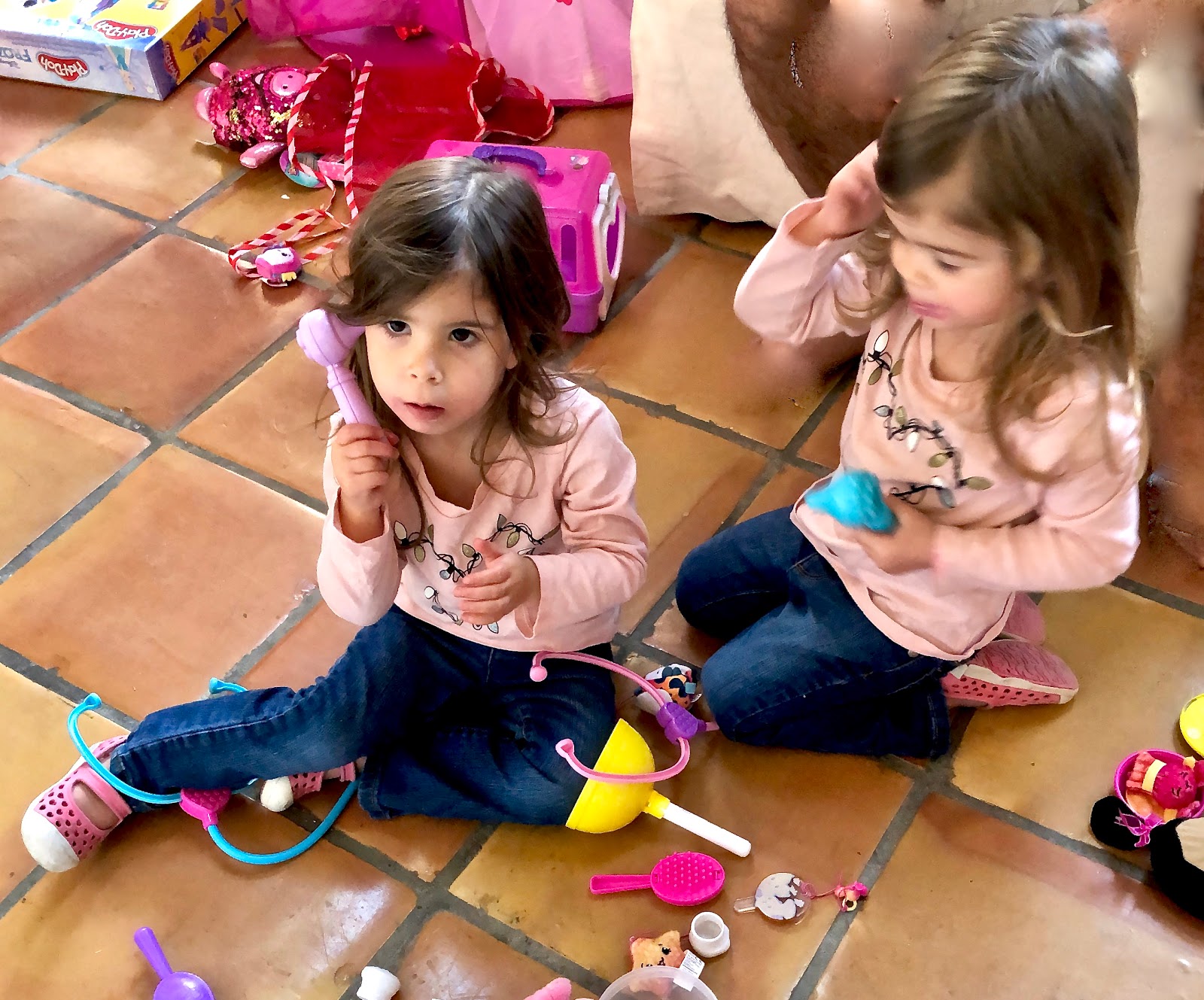
Lillian and Kate with Christmas toys, 2018

Dora was a stern critic of literature and had she lived to read my books, she would've referred me to those disciplined writers who put in their 10,000 hours before calling themselves poets. However, a friend recently told me that her band leader in high school often admonished, "practice won't make you a great musician if you practice wrong." 

Recently I loaned a copy of Their Adventurous Will to a friend and when she returned the book, I found a message on a sticky note within telling me that as she read the introduction about my mother, she journeyed back to her own childhood and the times her Mama had read to the family long after they could read themselves. "It was a special bonding time," she added.

Just yesterday, when I visited a funeral home to pay respects to an old friend, her daughter told me that in her mother's demise, she often requested that "someone read aloud to her." Her daughter would protest that there were mostly children's books available in the house. "I don't care," her mother had said. "Just read to me!" And the implication was that, like my mother, she probably enjoyed children's books as much as any contemporary novel or tome.

When Sister Elizabeth came down to New Iberia from the Convent of St. Mary in Sewanee, Tennessee last year, she did a "walk through" of my home and gave us her candid appraisal. "I always go into a home and find myself thinking about what their major interests are," she said. (Now there are many crosses scattered about and I'm a deacon, but she didn't list them as a major interest). 

Instead, she commented, "Books and art…you really value them." She was spot on. So now I'm wondering why I apologized about giving my great-grandchildren "just books," and this blog is an apology for making such a foolish remark.


As Piglet (in Winnie the Pooh) said to Eeyore: "Many happy returns of the day" to precious Kate and Lillian. May you always have an abundance of beloved stories of adventure, friendship, and fun in your home.


Friday, June 10, 2016

A BITE FROM E.B. WHITE

For those who’re burdened by political news and the state of the world today, I recommend a “time out” with someone like E.B. White, the essayist who wrote for the New Yorker during the mid 20th century. White often turned to farm journals to “escape for a few moments the ominous headlines in the papers…” However, he claims to have found danger even in the agricultural news, and this morning I returned to one of his essays entitled “Plant the Garden Anyway,” in which he talked about his dismay after reading a farm journal article listing dangers in the flower garden.

According to White in Writings from The New Yorker 1927-1976, the journal article warned about poison in a single castor bean that would kill a person… vomiting caused by pinks… sweet pea seeds containing a poison that could keep a person bedridden for months… night blooming jimson with enough substance in the leaves to produce delirium… and daffodil bulbs that, when eaten, cause stomach cramps. Danger in the garden indeed! People “back then” must have had bizarre diets!

White didn’t mention bees, digger wasps, and poison ivy. He may have been threatened by leaves, bulbs, and flowers, but the insects and ivy I just mentioned carry their own brand of poison in the garden. To me, the answer to the dilemma of the poisonous plants highlighted in the farm journal is a simple one: don’t sample the plants! Actually, the author of this article recommended completely doing away with a garden that produced such dangerous plants as the sweet peas, daffodils, etc. and changing the seed! Seems like gardeners in White’s day were either a) hungrier than most gardeners today or b) were experimenting with plants containing exotic substances to see if they would induce some kind of mind alteration.

White also discussed the plant patent business in another essay entitled “Prohibited,” in which a man received a birthday present of an azalea, and tied around the stem of the plant (“like a chastity belt,” White says) was a tag reading “Asexual reproduction of this plant is illegal under the Plant Patent Act.” White’s friend tore off the tag and sent it to another friend with instructions to bed it down next to “an old buck hydrangea.”

Whatever dangers White passed on to those of us who have trouble gardening must be taken with a grain of dirt. We should get our plants in the ground where, for a brief period, they will reward us with their bright faces, every now and then attracting swallowtails, monarchs, skippers, perhaps even a lunar moth.

My love of gardens was inspired by my mother’s nightly readings from books like A Child’s Garden of Verses and Marigold Garden. These books had nothing to do with poisonous seeds, but readings from them actually planted the seeds for my poetry writing today. I was inspired by such poems as Stevenson’s “The Flowers:” “All the names I know from nurse/Gardener’s Garter, Shepherd’s Purse,/Bachelor’s Baths, Lady’s Smocks,/And the Lady Hollyhock…”

The straggly garden pictured above, whose seeds I never saw since I purchased seedlings for my two miniscule beds, contains mostly herbs I can eat without getting sick. The sight of this place where moles and rabbits freely graze would probably cause White to smile. The flowers on one side of the yard are deer proof, so they have a chance of surviving. This is a consideration I gave them rather than worrying about poisonous seeds; however, I didn’t count on the invasions from moles and rabbits.

P.S. I haven’t seen either the asexual azalea or old buck hydrangea in the nurseries here on The Mountain, so I can’t foster any plant coupling.