Showing posts with label Cumberland Plateau. Show all posts

Friday, January 22, 2021

A RAINY DAY RIDE 


A rainy Louisiana day seems to be the ideal time to write about trips most of us can't take because we can't be exposed to people who may have the dreaded coronavirus. However, I pulled out a small stack of old
Ford Times (a now-defunct publication) I'd ordered a few months ago and engaged in a pretend trip via "A Slow Train in Tennessee" that made a round trip to Harriman, Tennessee on the Tennessee Central Railway, circa 1956.

The trip was a full-day, round trip train ride that began on First Avenue in Nashville, Tennessee, cost the traveler $6, chugged through the Cumberland Plateau, slowly, ever so slowly, and stopped only for food since the train had no diner. The painting* that accompanied the
Ford Times article reminded me of a train ride I once made from Ahwaz, Iran, in the southern desert province of Khuzestan to Tehran, Iran. I spent an entire night looking down at deep valleys and wondering if I'd come to a plunging end on the narrow track that snaked through the Elburz Mountains.

I enjoyed the
Ford Times issue that included an article about the Tennessee Central Railway and a sudden stop a TC train made in Baxter, Tennessee back in the mid-1950s. As it chugged into the station at Baxter, an aged Model T pulled up to the station on three screeching tires, and an old-timer climbed out, explaining that he'd had a puncture of a tire that he'd "only used five years," and three tires would do for a while. He ran over to the train and handed a smoked ham to the conductor, who promptly handed the breathless old-timer a sack of plug tobacco in exchange. The train pulled out, resumed its slow speed, and chugged down the mountain on the Cumberland Plateau. I assume the old-timer made his three-tire journey home, probably grumbling about the puncture of a five year old tire but enjoying a good "chaw" along the way.

Although this article refers to the Tennessee Central, I thought about another slow ride I'd made from Atlanta, Georgia to Lynchburg, Virginia on a train that inspired the question, "Have you ever 'rid' the old Southern?" That ride included a group of young adults from Emory University in Atlanta who sang oldies like "Dinah won't you blow" ALL night to entertain my restless daughter who traveled with me.

A slow train ride during a gentle rain would be a prized experience for me right now, and I'm wondering if the old Southern is still operating? Probably not. The latter incident took place when Stephanie, my oldest daughter, was three years old. She's now sixty.

*Painting by Corydon Bell in Ford Times, April 1956


Friday, July 19, 2019

INUNDATIONS AND SUNLIGHT


Spring Annunciation, glasswork by Karen Bourque

During the recent disaster of the Storm Barry that inundated parts of Iberia Parish and brought wind and water to Louisiana, my home in New Iberia was spared significant damage. While the storm raged, friends sent messages that I was lucky to be living on The Mountain at Sewanee, TN instead of the storm-ravaged parts of my native state. Many of my friends thought that at 2000 feet, Sewanee was safe from floods that could have inundated my residence at a 25- foot elevation in New Iberia. 

However, if I had been living on The Mountain in February of this year, I’d have put on high boots because southeast Tennessee received 12 inches of rain. Although flooding occurred on the Cumberland Plateau and drained off The Mountain into area coves and communities surrounding Sewanee, no damage to my home here occurred. When we arrived in March, we were appalled at the sight of a flooded corn field near Cowan, TN where we had bought and enjoyed the #1 sweetest corn grown anywhere in the U.S. That flooded area finally dried last month, but only through evaporation and the grace of God because there were no coves or rivers into which it could have drained. Fortunately, the Amish farmer had planted a crop in another spot on higher ground, and we’re now enjoying fresh, sweet corn daily.

Lapp's flooded corn field, Cowan, TN

The year 2018 was the wettest year on record at Sewanee, according to a report in The Sewanee Purple, the student newspaper at the University of the South. Despite naysayers about “climate change,” flooding has become a widespread problem in the United States, and friends in Iberia Parish, Louisiana, say “another 1927 flood may become a reality.” They refer to the wall of water that reached the Bayou Teche from Port Barre to Arnaudville and crossed the ridges of the Bayou Teche, smashing a protection levee in St. Martinville and rushing into Spanish Lake while the bayou filled with water from the east side. Over 4,000 people in Iberia Parish became refugees in camps on a ridge overlooking Spanish Lake. These camps were set up in May 1927 and did not close until July 1927.

Amid gray days of recent heavy rain on The Mountain and news of the inundations in New Iberia, I received a package containing The Consolation of Gardens, my newest book of poetry, and a ray of sunlight arrived at our home here. The cover of this book features a photograph of a beautiful glass piece rendered by Karen Bourque, glass artist from Church Point, Louisiana (shown at the top of this blog). Gold and yellow hues brought immediate sunlight into the house, and a dragonfly in the center of the glass piece affirms the joy viewers will feel when they look at the photograph on the cover. It’s a vibrant glass piece that radiates positive signals, a sacred work that captured the essence of the poetry in which I attempted to connect with nature’s contemplative and nurturing presence. Karen entitled the piece “Spring Annunciation,” and she could have subtitled it “Hope,” as it is a piece of healing art.

Beneath the Surface, glasswork by Karen Bourque

In A Slow Moving Stream, a book of poetry that I read at the Louisiana Book Festival a few years ago, I wrote of floods in Louisiana and the tenacity of the Acadians when water becomes a spring ritual. As I read one of the poems now, I’m reminded of how enduring my Cajun friends are:
Although the water behaved
as if nothing would ever hold it back
and they did not know
how much terror they could withstand,
they would not turn away.
This land of palmetto, cattail,
willows and elderberry;
swamp and wetland wilderness,
was the abundance of a higher realm
constantly lit they had discovered
where bayou and river conjoined,
a place where the deceitful water
had tried to take them away
but everything had been revealed to them
in the catastrophes of their belonging.

Another photograph of one of Karen’s glass pieces, "Beneath the Surface," appears on the cover of this book, one in which a field of yellow ranunculus is featured — again, a beautiful piece of healing art.


Monday, August 22, 2016

DOWN IN THE VALLEY

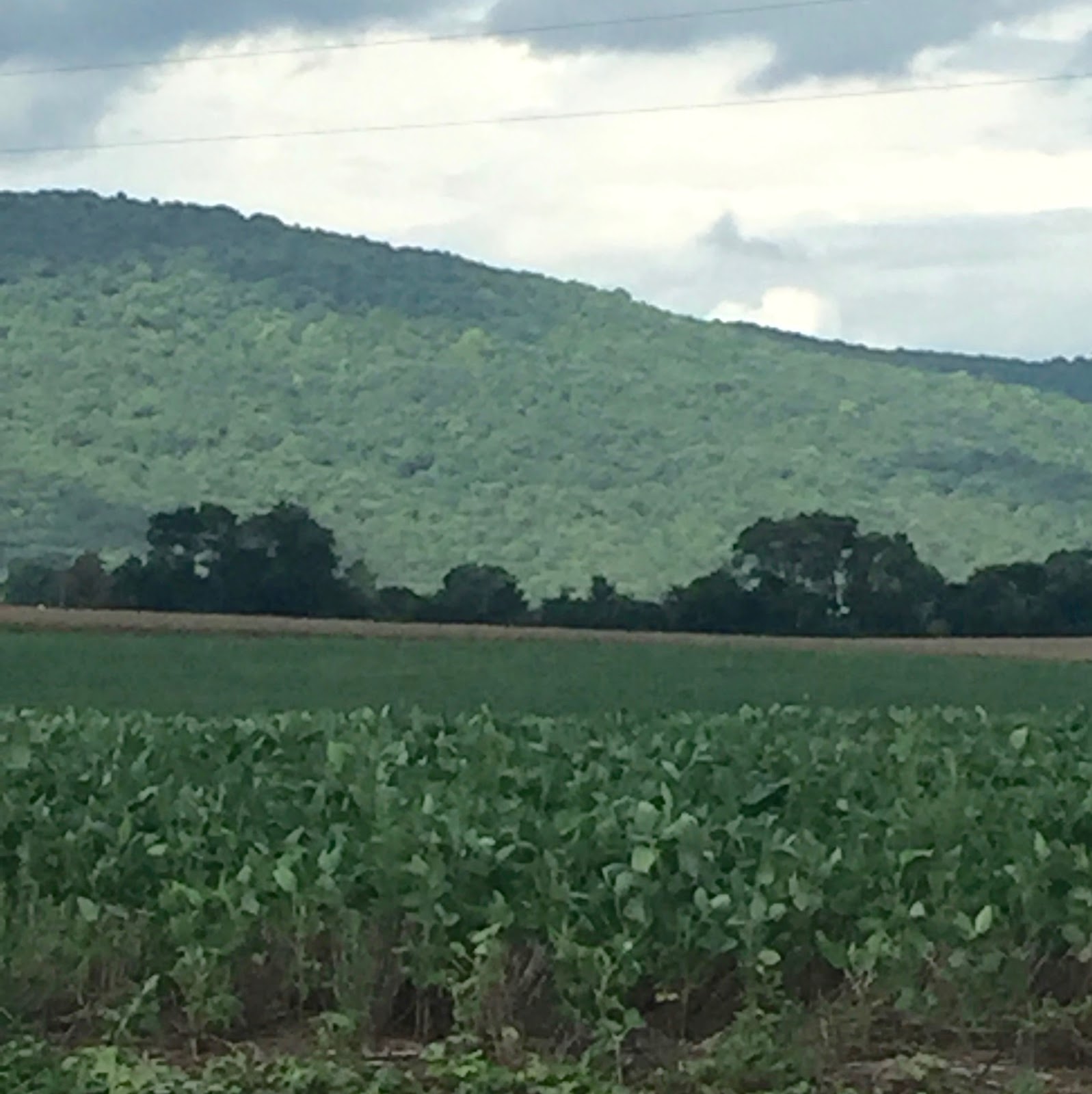
I grew up and have lived in Louisiana most of my life and now live on one of the highest elevations in New Iberia (25 ft.) part of the year and Sewanee, Tennessee (2,000 ft.) the other part. I find it strange when “Sewaneeans” say “I’m going down to the Valley to shop,” and they’re referring to several towns, the peak elevations of which rise 1,000 ft. Now that I live during the spring and summer on The Mountain, the elevation of a town like Cowan, Tennessee, which peaks at 954 ft., doesn't seem to be much of a valley.  

At the western base of the Cumberland Plateau, which juts out in ridges that create small valleys, stands the town of Cowan, which drains via Boiling Fork Creek (a dry bed the first year I glimpsed it), a tributary of the Elk River. I love to drive through the little town on the way to Winchester, Tennessee for groceries, and I don’t ever remember much water running through Boiling Fork. I’ve experienced perhaps two downpours while shopping near Cowan. Many of my poems include the landscape and vegetation of the Valley where corn, soybean crops, pastures of yellow rapeseed, and rolls of hay dot the fields.

Cowan’s claim to fame can be traced to the mid-19th century when it became the site where railway lines met the Nashville to Chattanooga trunk of the Nashville, Chattanooga and St. Louis Railway, and trains traveled through the Cowan Tunnel. Pusher engines assist
ed trains to climb the steep ascent to the Cumberland Plateau, and are still being used today. When I pass the station on my trek to Winchester and see the engines, I wonder if they were the prototypes for The Little Engine That Could, a children’s classic with a moral about what a positive attitude can do for a machine (or a human) wanting to achieve success. It was a book popular during my childhood and is still found in most contemporary libraries.

Last week we stopped at a renovated restaurant renamed “The Valley Cove Bistro” in Cowan and discovered an excellent menu for a restaurant in a small town of 1,770 people, including classic French Onion Soup, the original Corner House (former name of the restaurant and a Tennessee Back Road Heritage property) Gazpacho, Grilled Salmon and Cucumber Wrap, and Apple Rose Puff Pastry (the latter filled with Maple Custard served with Vanilla Bean Ice Cream). I asked about the Chef and was told he’s a native of the Valley area.

Further down the road in the Valley, we stopped at a fruit and vegetable store supplied by Amish farmers from Lawrenceburg, Tennessee and purchased ears of sweet corn, a cantaloupe the size of a watermelon, and home-grown tomatoes. The store was attached to Lapp’s Greenhouse, a nursery where we’d bought herb plantings earlier this summer, and which have survived the drought.

I read that one of the characteristics of a valley is “low land” and that most of them are deep and narrow, but this one must be an old one because it isn’t steep sided like younger valleys  still being uplifted to create mountains.

When we travel home from the Valley, we often try to guess how many degrees cooler the temps are at the higher elevation of The Mountain, and today The Mountain proved to be seven degrees cooler. However, I hasten to mention a major advantage of living in the Valley: real estate is $100,000 cheaper down below than on The Mountain! The main thoroughfare of Hwy. 41A running through Cowan is lined with lovely homes and businesses housed in quaint buildings that were built during the town’s heyday when the railroad came through.

Photographs by Victoria I. Sullivan


Thursday, August 7, 2014

SMALL PLEASURES

My version of "when all else fails, do this..." has altered during the past few years. I was once inclined to say that "when all else fails, take a hot bath," but lately I've changed that sentence to read: "When all else fails, plant a garden," or "stroll through a garden" because I believe that flowers/plants have healing and soothing effects on humans.


Here on the Cumberland Plateau at Sewanee where I spend spring and summer, we have a small garden that would probably seem negligible as far as gardens grow, but it satisfies my sense of aesthetics and is a soothing sight every morning when I open the back door. Only this morning, I opened it and spied a red knockout rose blooming against the grey planks of the back fence. Of course, I have a black thumb and could describe my gardening expertise as much like that to which Ogden Nash laid claim: the skills of a "horticultural ignoramus." However, I do appreciate gardens as avenues for feeding the soul.

When I lived on the desert plains of Khuzestan in Iran for two years, I had a small rose garden, and the first book of poetry by a Persian writer that I bought was the Gulestan (The Rose Garden) by Sa'Di, who wrote:

"Of what use will a dish of roses be to thee?
Take a leaf from my rose garden.
A flower endures but five or six days
But the rose garden is always delightful."

Sa'Di also said that if he had only two loaves of bread, he'd sell one and buy hyacinths because they would feed his soul. Persians love gardens, and during the 1970's when I lived in Ahwaz, Iran, lush gardens enclosed by mud walls were scattered throughout the city of a half million inhabitants. Readers can imagine the vegetation that flourished in Iran by reading a long poem I wrote for The Holy Present and Farda, published in 2009, thirty-four years following my sojourn in this mid-eastern country:

KHUZESTAN COLOR

Touching down on flat Iranian plains,
the aircraft enters another West Texas,
a stark landscape of stone and sand.

"Where did all the flowers go?"
the tune replays in my mind
but it is a fleeting thing
this question about landscape,
some weeks later I have seen
lale', the wild tulip
growing spiritedly at Masjid-I-Suleiman,
blooms of beauty taken to Europe
during the Crusades
and wild garlic with red and green flowers
clustering in flower stalls.

Goats have stripped the stark plateau,
leaving only globe and artichoke thistle,
a few anemones and yellow daisies.
They have bypassed the caper plant,
spicy night bloomer,
its large white flowers wilting in sunlight,
at night its pickled buds
enhancing salads at dinner parties.

Plants within our reach,
wild marigolds at Andimeshk
near Choga Mish,
and farther into the Zagros Mountains
at Hamadan, Iran's red poppy,
closer home, cultivated gardens
of Persian cyclamen
showing off her heart-shaped base.

In my own garden
the yellow rose of Texas struggles
and is the household joke,
that I was lured to Iran by a spouse
who sang at my arrival,
"I didn't promise you a rose garden,"
then grew a neat row
of yellow and pink blooms.

We do not neglect the almond and pistachio
or the tall Lombard poplars favoring Isfahan,
nor can we forget the poisonous oleander,
nemesis of Ahwaz gardeners,
a plant that gave me a case of hayfever
endemic to more tropical climes,
reminding me of home,
Teche country—without walls—
but the same lushness enclosing.


The photograph at the top of this blog is a shot of the miniature garden in my backyard, a space where plants nod good morning every day and speak to my condition "when all else fails."

Tuesday, January 28, 2014

HEMLOCK IN THE SNOW

Hemlock at 65 Fairbanks Circle,
Sewanee TN
We returned from central Florida to discover freezing and below freezing temperatures on The Mountain here at Sewanee, Tennessee, and this morning thirteen-degree weather fostered snow that has been flurrying most of the day. The tall, beautiful hemlock in our backyard, one of the "redwoods of the East," has a dusting of white on its slightly drooping branches, a graceful reminder that we're surrounded by forests—and subject to severe winters.

The towering hemlock in my yard may be over 100 feet tall and stands alone, a giant tree of pyramidal shape that has escaped (so far) the hemlock wooly adelgid that has been attacking sister hemlocks here on the Cumberland Plateau. The Tennessee Division of Forestry predicts that in the next few years all of the hemlocks in Tennessee counties will suffer adelgid invasions. However, one measure of control that has been suggested is the use of predator beetles, and I'm wondering if those ladybugs that continue to hover about in our garage could be put to use. After we returned from Florida, I found a few live ones setting up house in a bedroom and promptly evicted them, but they persist in other places, throwing out an acrid scent when I disturb them.

Another treatment for control of adelgids that attack hemlocks has been the use of chemical control, but this is an effort that should be coordinated with state and federal agencies— e.g., the National Park Service, the Tennessee Hemlock Conservation Partnership, the U.S. Fish and Wildlife Service, Eastman Chemical Company, and the East Tennessee Climbers Coalition.

Meanwhile, I still see nocturnal animals disappearing under the drooping branches of our hemlock in all its unpruned and unsheared expansiveness. It's a hardy conifer and has a long life span, perfectly at home in rocky soil. I hope that it sticks around as long as I live on The Mountain and have threatened to try medicinal tea brewed from its bark but am leaving this to the critters who drink at its feet nightly.

A good friend of mine who has been reading my poetry for decades recently declared that a poem I wrote about the mighty hemlock in my yard was the best poem in my latest book of poetry, In A Convent Garden, and I'm republishing it below to cheer her on in her recovery from a recent surgery:

NOCTURNE FOR A HEMLOCK

Foresters call it a "superlative,"
the 100-foot hemlock tree,
a green cathedral pyramiding in my backyard,
now threatened by the hemlock wooly,
but the traffic I observe
underneath its lower branches
tells me it doesn't have declining health;
I've seen rabbits, coons, skunks, red foxes
emerge from underneath its crown
and wonder if it isn't an all night tavern
where creatures make music,
dance, act out plays on a makeshift stage,
having a desire for entertainment
and happiness not unlike ours,
animals that come out of hiding at dawn
wearing carnival masks,
weaving in the bright beam
of the lighted parking lot,
passing out of view when the world is quiet,
the hemlock keeping their secrets.
A serious matter,
these forest dwellers with nightly passions,
although I sidestep their back rooms,
unwilling to take a look
into the tangled undergrowth
for fear one of them is still there,
leaning on the bar, singing
"Show me the way to go home,"
and I will have to oblige.


Monday, July 8, 2013

MYSTICAL FOREST

While residing in this “mystical forest” in Sewanee, Tennessee, I’ve completed another book of poetry which is now available on amazon.com and, of course, at Border Press. I’m blessed to have the quiet time necessary to write while living on The Mountain, and some of the poems are about my life here. The title poem explores the feelings of an artist (my brother Paul) when he painted his perception of a mystical forest for his wife, Lori.
A section of the book focuses on another chapter in the ongoing “Going to Diddy Wah Diddy” saga, a saga fueled by postcards my mother bought on my childhood journey to California during the 40’s. Other poems focus on everyday life and people in Louisiana and on the Cumberland Plateau, as well as a poet’s struggle with the past and aging.
That’s a brief summary of the book. I’m not so self-aggrandizing as to review my own book, so I include here some of the wonderful affirmations and endorsements of Mystical Forest written by other authors, teachers, and poets:
Mystical Forest is a feast of a book. It finds its spiritual rhymes in poets as various as Donne and Herbert, as various as Hildegard, May Sarton and Mary Oliver. Diane Marquart Moore is a metaphysician who brings the sacred to this world she loves even with the dirt and grit ever in it; even with the hurt and wound ever a part of the mystical pact. Just as she loves and honors the imperfect world in these poems, so too does she love and honor whatever comes before and whatever comes afterward. If you should hear something like the birdsong of Olivier Messiaen and the risings in Arvo Pärt’s compositions when you read these poems, you are not just hearing things. Moore is that good.” –Darrell Bourque, author of Megan’s Guitar and Other Poems from Acadie, and former Louisiana poet laureate.

“‘A small world blooms/at the edge of a disturbed bay’ in numerous poems of Diane Marquart Moore’s newest collection, Mystical Forest. Whether in an affirmation of solidarity out of a history of abuse (‘Barbara’s painting’) in solitary prophecies received on a family pilgrimage by the young poet-to-be, or in a couple’s intimate twirl on the dance floor of the world (‘Dancing With the Stars’)–Moore’s poems illuminate small worlds with precision and poignancy as though one is entering the mystical purple light of her artistic mother’s ‘fragile dream.’ Is the real world truly the ‘backyard of paradise’? Could an owl’s hole in a tree offer a refuge of escape? Can a blast of Mozart sonatas evoke a world to counteract the doldrums of a gray winter’s freeze (‘Too Much Gray in the Day’)? These artfully crafted poems–‘words creating the plenty/of moments left standing’ – answer Yes.” –Isabel Anders, author of Miss Marple: Christian Sleuth; Becoming Flame; and Spinning Straw, Weaving Gold.

“With a poet’s craft, with a painter’s eye, Diane Moore’s evocative poems lead to places that are personal and universal. ‘Giving birth to simple insights,’ Moore writes – just one more reason to follow her on a rewarding journey.” –Michael Miller, author of Into This World.

“This wonderful collection sings of friends, family, and place, but also of loss, regret, and wonder – all part of a life well lived, richly imagined, and beautifully expressed. Its poems resonate with clear observation and earned wisdom. Whether tracing a childhood odyssey out west, or simply capturing the landscapes of her Louisiana and Tennessee homes, Diane Moore gives us a world that brings us back to our own with renewed clarity and insight.” –Mary Ann Wilson, Departments of English and Women’s Studies, University of Louisiana, Lafayette.

I’m humbled by the endorsements these fine writers have written about Mystical Forest and hope that you enjoy this, my 34th book. 

Tuesday, July 2, 2013

VISTAS…

From steps of St. Mary's Convent,
Sewanee TN
Every morning when I wake, I open the French doors in the living room and look out at the woods bordering our front yard to get my shot of a vista for the day. Although I’m not a hiker or camper, my parents were inured to both activities, and I was taught to appreciate the outdoors. A copse of trees, as well as a great stretch of desert, are sacred sights to me. One vista often reminds me of another; e.g., the road leading to the valley in Cowan, Tennessee reminds me of the curvy Highway 1 leading to Big Sur, California, sans Pacific Ocean on one side of the road.

I’m always inviting people to view different vistas, and today my thoughts turn to Ben Blanchard, who will be married in Austin, Texas this afternoon. Ben once accompanied his mother, Janet, one of my best friends, on a trip we made to California. Ben was ten and a reluctant traveler, and he balked at every curve when we traveled the road to Big Sur and Point Lobos, often dozing or sulking in the back seat of the car as we passed through magnificent scenery – rugged cliffs, canyons, long meadows, and redwoods, stopping to explore narrow inlets where we could get a better view of the greenish blue waters of the Pacific. I’m not sure it was an entirely miserable experience for him because a few weeks ago, word came that he wanted to take his bride on a honeymoon to California – and guess where he wanted to go? Of course, he wanted to retrace his steps up Highway l to Big Sur!
You never know when you have effected a “travel take” with offspring, but if they’re exposed to vistas at an early age, they’re likely to develop wanderlust and appreciate the outdoors. I never fully appreciated the trip to Diddy Wah Diddy (California) that my father initiated back in the 40’s and earned the title of “luxury-loving girl” because I wasn’t too keen on the idea of campouts along the way. However, by the time I reached my twenties, I had a full-blown case of wanderlust. And, in my thirties when I went to Iran and lived there two years, people thought I had lost my mind because I enjoyed my sojourn in the southern desert of Khuzestan – so much so that I’ve written four books about the experience. In my forties, I began traveling to California every year and became enraptured with the deserts of southern California and Nevada.
A few months ago, Pinyon Review published one of my poems that revealed my intense feelings about the desert entitled:
Carson City, Nevada:”
I could live here
under the rock outcroppings
away from the hot summer wind;
the sun would make me a cover
and I would become dry and brief;
my words sharp as the sage
skirting the Sierra foothills;
I could live like a mountain lizard,
scuttle with the ground squirrels
at the sound of footfalls,
suffering no invasion on the desert’s face;
I could live here
where my heart could dry out
from a lifetime of mistrust;
I would believe the night stars,
sleep in a grove of cottonwoods
rustling dryly,
feeling only kinship.

Landscapes affect me deeply, as they do most poets. When Robinson Jefferson moved to Big Sur, he became spellbound with the rugged coast near Carmel, writing that “the coast had displayed all its winter magic for us: drifts of silver rain through great gorges, clouds dragging on the summits, storm on the rock shore, sacred calm under the redwoods…” I was just as enchanted with my first glimpses of that rocky California coast, and the wild beauty of it had a lasting effect on me. Actually, if I had my druthers, I’d live in Carmel, California, but my senior’s purse won’t allow that luxury.

I’m happy that Ben will get to see all the natural beauty of the central coast of California when he makes a return trip to the scene that he scorned as a young child – this time with fresh eyes, and I expect the experience will be overwhelming for him and for his bride. Meanwhile, I will think about his trip vicariously and continue to record the beauty of the landscape here on the Cumberland Plateau, including a photograph of the Cumberland Valley as seen from the backyard of St. Mary’s Convent accompanying this blog.