Showing posts with label St. Mary's Convent. Show all posts

Friday, March 1, 2019

ABOUT BOOKS


Today marks the birthday of my great-granddaughters, Kate and Lillian, and tomorrow I'll travel to Baton Rouge to celebrate the occasion with them. This morning, in a telephone conversation with my daughter Stephanie, before I thought about what I was saying, I commented apologetically, "I'm just giving them books."

My mother probably turned over in her grave when I made this remark since she believed that books were the most valued possessions in any home. During WWII, she regarded them as more precious than rationed food.

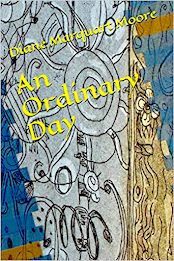
In the introduction to my now out-of-print book, Their Adventurous Will, a volume about Louisiana women, I wrote that she read aloud to us every night and related how that nightly reading contributed to my development as a writer: "When I was three years old, she'd seat me, cross-legged in the middle of our small kitchen, and open for me giant editions of Mother Goose, A Child’s Garden of Verse, and Marigold Garden…She read aloud the entire series of Uncle Wiggly in the Cabbage Patch, The Little Colonel, Raggedy Ann and Andy, Greek Legends, Black Beauty and Grimm's Fairy Tales, even after all the children in our family had learned to read…"

In that same introduction, I wrote about another family member, my Godmother Dora, who built a library of books that would challenge my own 2,000-and-more book collection. "Books by mystics, theologians, poets, and Christian apologists crowded the bookshelves in her home," I wrote. "A visitor might be engaged in intent conversation with her, and she'd suddenly scurry away on her tiny feet, select a book from a shelf nearby and begin reading some lengthy passage. On the flyleaf of a small, yellow-gold volume entitled The Fruits of the Spirit by Evelyn Underhill, which Dora gave me in 1963, she inscribed in her elegant but often-illegible handwriting: "For Diane, for whom we wish the fruits of the spirit above all else…"
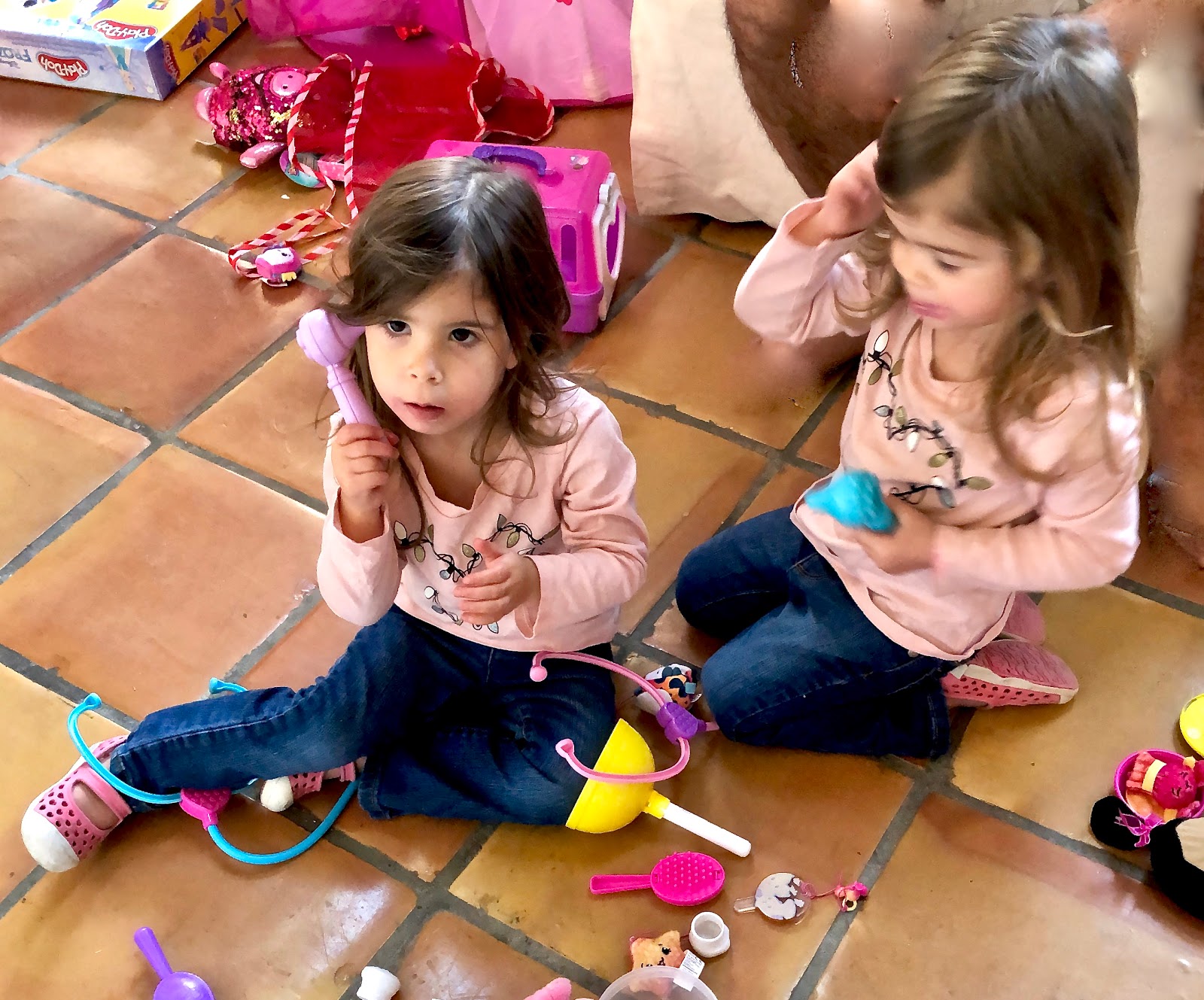
Lillian and Kate with Christmas toys, 2018

Dora was a stern critic of literature and had she lived to read my books, she would've referred me to those disciplined writers who put in their 10,000 hours before calling themselves poets. However, a friend recently told me that her band leader in high school often admonished, "practice won't make you a great musician if you practice wrong." 

Recently I loaned a copy of Their Adventurous Will to a friend and when she returned the book, I found a message on a sticky note within telling me that as she read the introduction about my mother, she journeyed back to her own childhood and the times her Mama had read to the family long after they could read themselves. "It was a special bonding time," she added.

Just yesterday, when I visited a funeral home to pay respects to an old friend, her daughter told me that in her mother's demise, she often requested that "someone read aloud to her." Her daughter would protest that there were mostly children's books available in the house. "I don't care," her mother had said. "Just read to me!" And the implication was that, like my mother, she probably enjoyed children's books as much as any contemporary novel or tome.

When Sister Elizabeth came down to New Iberia from the Convent of St. Mary in Sewanee, Tennessee last year, she did a "walk through" of my home and gave us her candid appraisal. "I always go into a home and find myself thinking about what their major interests are," she said. (Now there are many crosses scattered about and I'm a deacon, but she didn't list them as a major interest). 

Instead, she commented, "Books and art…you really value them." She was spot on. So now I'm wondering why I apologized about giving my great-grandchildren "just books," and this blog is an apology for making such a foolish remark.


As Piglet (in Winnie the Pooh) said to Eeyore: "Many happy returns of the day" to precious Kate and Lillian. May you always have an abundance of beloved stories of adventure, friendship, and fun in your home.


Wednesday, August 2, 2017

LATE SUMMER ON THE MOUNTAIN

SOYBEAN FIELD AND MOUNTAINS FROM COWAN, TN

A beetle resembling a roach upended, his feet in the heavy air, lies near part of a speckled moth wing — porch tokens, beside withering flowers. Driftwood fencing the herb garden has become drier. Crickets protest 80-degree temps, singing the same chorus. Empty yard chairs face the bleached fence slats. We’re all looking for invisible streams, a flowing landscape. Gulls fly over, bringing news of the coast where thunder rolls in, promising afternoon rain. Equable tempers ride the wind, the heavens busy making water for a disinherited earth. I look up and see a calendar written on the moon’s face; fall unfolding in a sky dark and drained of heat.

I wrote this a few days ago in the middle of a hot day, and then rain obliged us, bringing in a spell of cool air. The heavens also showered corn patches along the road to Cowan, Tennessee, and even flooded our struggling herb garden at the back door, which perked up the mint, rosemary, thyme, chives… Like amateur farmers, we seem to watch the weather more often than we did in Louisiana. I suppose it’s because we find so many fresh vegetables and fruit at markets on The Mountain and have eaten them aplenty this summer, especially corn and peaches, huge home-grown tomatoes and cucumbers. Many days we drive into the Valley just to look at and buy a few ears of corn and a carton of peaches at the vegetable and fruit market on the highway leading to Winchester. 

I sometimes long for the city so I can get a shot of “culture,” but I think more about the pastoral aspects of life on The Mountain than I did ten years ago. We pass a sign advertising a chicken farm for sale and tell friends we’re going to buy it, but the notion soon passes. Pulling weeds in the small herb garden by the back door is about as much farm activity as we can muster. And we’re sorta’ turned off when we read about the nine billion chickens that are killed each year in the U.S. The unfortunate poultry are raised in warehouses with 20,000 other chickens, and half of them are fed feed with arsenic in it because this concoction is reputed to foster growth. Some of us remember the spacious chicken yards of our grandparents where chickens roamed freely and weren’t fed anything to promote abnormal growth. Anyway, chicken farms? No way!

I do read and think about agriculture a lot; thus the interest in weather, I reread my favorite essayist, E.B. White, who divided his year between bustling New York City and a getaway place in Maine. His description of late summer is worth a few “words worth:” 

“Summer, languishing but not really sick, receives her visitors with a certain deliberateness -a pretty girl who knows she doesn’t need to stay in bed. The yellow squash illuminates the aging vine…and zinnias stand as firm and quiet as old valorous deeds…the farmer picks up the first pullet egg, a brown and perfect jewel in the grass; …[This is] the day a car stops and a man gets out and tacks up a poster advertising the county fair…” (from The New Yorker, September 3, 1949, p. 17.)

Last night we attended a dinner featuring “radical hospitality” in the cottage of summer interns at St.Mary’s Convent We met guests from different locales in the South, including Louisiana, a fund development director from Boston, and a physical therapist from Chicago, and during dinner, the thought occurred to me that we sometimes had no need to search out a shot of culture in nearby cities as it was right there at the table among congenial young people who had migrated to The Mountain and liked the good life here. 

Photograph by Victoria Sullivan

Monday, July 10, 2017

PAW PRINTS ON MY SOUL


Monks, nuns, and sisters in Orders that practice the Benedictine way of life are noted for hospitality when newcomers knock on their monastery or convent doors. The Anglican sisters in the Community of St. Mary, a Benedictine Order, carry on this tradition here at Sewanee, Tennessee. As an associate of CSM, I’ve met a diverse group of pilgrims who come here on individual and group retreats, as well as regulars who attend services at the convent and share breakfast with the sisters after weekday and Sunday Eucharists.

Last week Deb Gerace, an overnight guest from Kennesaw, Georgia, sat next to me at breakfast in the refectory, and I learned that she was only here for an 'overnight' —“just to step back for a little while,” she said. I asked her if she was a priest on retreat.

“No, a chaplain and therapy dog handler.” She laughed, assuming that I’d think this a strange vocation.

“At a church?”

“Everywhere. My husband Mike and I, and our two former rescue dogs who have become therapy dogs — Sammy and Babycakes — minister to homebound at our own church in Kennesaw, Georgia, to people in nursing homes, rehab centers, and schools…wherever we’re needed.”

Gerace has told the story of training two dogs (who have their own disabilities) for this ministry in Paw Prints on my Soul, describing the dogs as having good dispositions, energy, loyalty, and a willingness to please. Two initial “gigs” for which the dogs trained were at Christ Episcopal Church Gerace attends, the church’s pre-school and in a visit with a cancer patient. On another occasion, they dressed in costumes while Gerace, also a singer/guitarist, gave a music performance and Sammy entertained with a learned wolf howl at a special Halloween show.

Lap sitting, bed sitting, performing to music, the dogs became the inspiration and therapy for the sick and dying, “often triggering a stream of consciousness from somewhere deep inside the jumbled memories of bed-ridden people,” Gerace writes. She and her husband Mike later joined a Chaplain Crises Training group so that they could visit post-disaster areas and share Sammy and Babycakes with traumatized survivors.


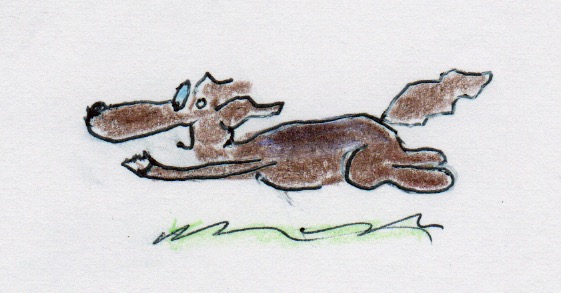
St. Mary’s Convent already has its special healing dog, Penny, an adopted part pit bull, part Labrador retriever who has never had any training in healing or crises intervention, but she’s the Convent’s hospitality hostess and has her own “pew” in the chapel — a basket lined with blankets right behind Prioress Madeleine Mary’s chair. This gentle, calm canine attends all the Chapel services and knows when to settle in for the prayers and when to get up at the dismissal. Sister Elizabeth says that Penny has tended several sisters when they were ill, not by invitation but by intuiting that she’s needed, sleeping in their rooms until they recover. I’m allergic to animal dander, particularly cat dander, but I can now be near Penny without suffering allergic reactions. I’ve never heard Penny bark! Sister Madeleine Mary relates that she’s known Penny to growl at strangers they encounter on walks near the Convent because she knows they aren’t sisters or associates, but she isn’t the kind of dog to greet people with aggressive behavior; in contrast, she runs up to greet Convent visitors, gently brushes up against them, receives a few pats on her head, then goes her way. All of us associated with St. Mary’s Convent know that Penny joins the healer dogs, Sammy and Babycakes, in being a creature that leaves paw prints on others’ souls.

While doing research recently, I read a book entitled Mystical Dogs by Jean Houston that described the mystical qualities of dogs and the comfort they provide during dark nights a human may experience. She tells the story of a prison pet partnership program in which inmates train dogs to serve the physically disabled, the elderly, and the blind. “…Our present day canine friends inspire and support us through that stage of the mystic path known in some traditions as ‘the dark night of the soul…over and over again throughout my lifetime, with its share of personal dark nights, my dogs have known not only what my soul has needed, but also that I would survive, even when I felt that I would have a hard time doing so…they have known how to supply the faith, the warmth, the rapt attention, and the bodily presence that human friends and helpers cannot always provide…”

Houston believes that animals aren’t afraid of the darker aspects of life and are happy with us even when we feel broken, explaining that they like nothing better than searching for lost things, whether it’s a buried bone or a missing part of a human soul.


Wednesday, June 15, 2016

ON THE EVE OF EVELYN UNDERHILL’S FEAST DAY

Today is the Feast Day of Evelyn Underhill, Anglican writer and mystic often described as someone who, in the first five decades of the 20th century, was one of the most widely read authors on prayer and the spiritual life in the world. I’ve conducted several retreats featuring Evelyn’s work, and ‘though some readers may call my ruminations outdated, I continue to quote her in sermons and read her works monthly.

Evelyn Underhill loved to attend and, later, to conduct retreats at Pleshey House in the village of Pleshey in England, a place now known as “The Retreat House,” where Evelyn made her first retreat in 1921. Later, it became the spot where she conducted her first retreat during Lent, 1924. She became the best known retreat director of her time and described Pleshey (her favorite retreat house) as a place “soaked in love and prayer.”

Every summer, as part of my commitment as an Associate of St. Mary’s Convent at Sewanee, I attend the silent retreat, and this year I fortuitously noticed that Evelyn Underhill’s feast day occurs this day before the retreat begins. So I began reading The Fruits of the Spirit again, Evelyn’s notable work first published in the 1940’s. A memoir of Evelyn Underhill by Lucy Menzies, one of the frequent retreatants during Evelyn’s lifetime, includes the guru of retreat master’s thoughts about how to prepare for a retreat. Evelyn writes a recipe for recovering “spiritual poise,” as she calls it — she says that we don’t go to retreats to gain spiritual information but for spiritual food and air — to wait on God and renew our strength not for our own selves but for the sake of the world.

That one sentence set me straight about the real reason for retreat. Evelyn says that anyone can retire into a quiet place and have a thoroughly unquiet time in it—but that isn’t making a retreat. “Shut the door,” she says. “Nearly every one pulls it to and leaves it slightly ajar so that a whistling draught comes in from the outer world with reminders of all the worries, interests, conflicts, joys and sorrows of daily life. But Christ said ‘Shut the door,’ and he meant Shut.” A retreat, Evelyn emphasizes, isn’t self exploration, but communion with God so that afterwards you’re more powerful interceding for others and experience such self loss in Him that your wounds will be healed by new contact with his life and love. In other words, if you follow her counsel for a good retreat, you may return to “ordinary time” and move about in the world emanating a bit more humility and charity. I don’t need to remind anyone of how much we need the latter two qualities nowadays.

Evelyn reminds us that there are three points in which we can respond to God’s creative will for us: 1) our prayer; 2) our work or service, the middle point between our action toward and with God; and 3) our action toward men.  The entire chapter on “Preparation” in The Fruits of the Spirit could be handed out to every retreatant who enters this “thin place” that is St. Mary’s of Sewanee, or any retreat space, and major transformation would result, I think. That transformation is not only the objective of retreats but the answer to all that is burdensome to us when we finally tune into the world again – an acknowledgement that the spiritual growth of humans has to do with the “creaturely status of man and thus the gathering of man into communion with God.”  

On this day, Evelyn reminds us that all must be subdued to the law of charity, and that all must be colored by the joy and peace of our spiritual inheritance carried through with patience, faithfulness and humility.

Pardon the “preach,” but on second thought, just order a copy of The Fruits of the Spirit and sit with it a spell.


P.S. That battered-looking copy of The Fruits of the Spirit that appears above has survived 53 years and was given to me by my godmother Dora on the occasion of my first visit to Blacksburg, Virginia to be with her and godfather Markham. It came directly from one of her shopping trips in London and resulted in my return to the Anglican fold after a 12-year hiatus in church attendance.


Monday, April 25, 2016

SUNDAY ON THE MOUNTAIN AND IN THE VALLEY

Agreeable responses to sermons have a salutary effect on those who preach, and Sunday I received perhaps one of the best responses to any sermon I’ve delivered since I began preaching seventeen or more years ago. I’ve mentioned Peanuts and his gang in previous sermons, but yesterday when I brought up Snoopy as an example of what Robert Short calls “the little Christ,” the small crowd in the chapel at St. Mary’s Convent, Sewanee, TN, became instantly alert. I apologized for seeming irreverent but went on to explain that, according to Short, Snoopy may be lazy, sarcastic, a coward, and quite weary of being a dog, but he also possesses love, loyalty, watchfulness, and courage. Furthermore, Short advises that before we can become a good Christian who loves well, we have to take on the dog’s lowliness of complete obedience and humility at the feet of the master and in service to others. When I said that Hegel, the German philosopher, recognized the dog as the most religious of all creatures who loves with complete dependence, the congregation seemed to be on the edge of applause. It was a memorable moment, and Penny, the Convent dog, who was curled under Sister Madeleine Mary’s feet, awoke from her usual nap in the sanctuary during church service and looked around for recognition.

I received a similar response when I went down to Grace Fellowship Church on Garner Road to deliver the same sermon. The response both gladdened and saddened me because I love dogs but cannot withstand too much exposure to them as I’m allergic to animal dander. Of course, Sophie, the Convent cat, isn’t as polite as Penny and insists on following me around, hiding under the table when I share breakfast with the Sisters in the refectory. Yesterday I was informed that the Sisters were up late vacuuming the chair on the altar where I sit before delivering a sermon because perverse Sophie had been lining it with animal dander all week in preparation for my arrival.

Sunday afternoon, we went down to the valley in Cowan, TN, to view an exhibit of the work of Carolyn Tocco who is one of the members of Grace Fellowship. Although Carolyn owns several dogs, I didn’t find any renderings of them; however, one wall of the Artisan Depot in Cowan featured a beautiful display of her oils that depicted wildlife and nature. Carolyn works in a studio of her home at Winterberry in the woods near Sewanee that we had visited last fall before we left Sewanee. We had come away from the visit with two small depictions of bugs and berries now hanging on the walls of the cottage here on The Mountain, and yesterday I added a painting of butterfly weed to our Tocco collection. I also left the Artisan Depot with two ceramic tea bag holders by Gretchen McCance who has a kiln at her home in Tim’s Ford, TN and another in Blue Ridge, Georgia.

The Artisan Depot just moved into a new facility on the main thoroughfare of Cowan and is a part of the Franklin County Arts Guild, which features fine art and crafts from Franklin County and surrounding areas. The Arts Guild is an organization of local artists and friends who promote the visual and performing arts for all ages in Franklin County. It also provides a scholarship for a promising high school senior who plans to study art or education at the university level, and an annual Sweet Tooth Theater, which is a musical act accompanied by coffee and dessert. The Artisan Depot is one of those galleries found in small communities throughout the Appalachians that promote venues for artists to sell their work.


It was a Sunday filled with “glad surprises,” as Thomas a Kempis says, made more pleasant by a Mexican dinner at the Fiesta in Cowan where the walls are decorated with another visual experience —the work of Sewanee artist, Edward Carlos.