Showing posts with label Chattanooga. Show all posts

Wednesday, September 6, 2017

AT THE HUNTER MUSEUM

The patio at Tony's, Chattanooga, TN


Chattanooga is a high point on my list of favorite cities, especially its art district adjacent to the Tennessee River. Yesterday, we sat outdoors under a black umbrella at Tony’s on a balmy September morning waiting for lunch while I warmed my ailing joints. We watched sparrows and a hummingbird flying off course. The sparrows were searching for food under the tables and seemed to know that a platter of flatbread was on its way, so we had to be careful not to drop any crumbs or we would have been inundated by an invasion.

We were on our way to the Hunter Museum to see a special exhibit of the work of pop artist Wayne White, and I kept thinking that I could easily live in an apartment facing the river where I could walk to the art galleries, museum, and fine food restaurants every day.

Wayne White, a puppeteer, set designer, cartoonist, and illustrator, was born in Chattanooga and it’s appropriate for him to be exhibiting in his native city, although much of his fame was garnered in New York City where he began working as a cartoonist and illustrator for notable newspapers like The New York Times and The Village Voice. He also gained a foothold in the television world through his work on sets for Pee-Wee’s Playhouse, winning three Emmy awards for his work. Later, he worked on sets for the award winning video for the Smashing Pumpkins.

MISS CAR, In The Hunter Museum exhibit
Courtesy of the Artist and Western Project, Los Angeles, CA

Security guards allowed us to take a few photographs of the exhibit, and we were overwhelmed by so much from which to choose, but as a lover of cartoons and comic book characters, I was drawn to a section featuring White’s “Miss Car,” White’s first published comic strip about a female protagonist who appears as an upside down car. White began his career by making black and white photocopies of this comic and handing them out on the streets of New York. The Art Director for East Village Eye magazine, popular during the 1980’s, began publishing “Miss Car” as a comic strip; and High Times Magazine later featured the strip in color.

When I saw the huge puppets White had designed; e.g., The Louvin Brothers, country music stars who had influenced the Everly Brothers and Emmylou Harris, I wished my oldest daughter Stephanie, who loves country music, had been with us. White portrays the puppet Ira Louvin with a huge forehead and wild looking eyes (probably indicative of his erratic behavior as an alcoholic); and Charlie, the smaller of the two is dwarfed by his brother’s massive presence. I read that the Rice Gallery at Rice University in Houston, Texas features a huge puppet head of country singer George Jones — an installation in which the puppet’s eyes rotate in its head, and if the viewer pulls a rope, the head begins to snore.

THE LOUVIN BROTHERS, In The Hunter Museum exhibit
on loan from Songbirds Museum

Another section of the exhibit includes some of White’s paintings and drawings of the “Moonship Launch” from the Smashing Pumpkins’ Song “Tonight, Tonight.” I wish that the exhibit had featured White’s “Wayne-O-Rama” cardboard heads of figures in Chattanooga’s history and a model of Lookout Mountain that shows Rock City, Ruby Falls, and the Incline.

UNDERWATER, In The Hunter Museum exhibit
Courtesy of the Artist and Western Project, Los Angeles, CA

White’s work is sometimes classified as art exemplifying the surrealism movement and reflects his interest in cubism. When I saw his sketch books filled with ideas for set designs, cartoons, and puppets, I felt like I was looking at the outpouring of one of the most imaginative minds in the contemporary art world —the sketchbook reminded me of Leonardo da Vinci’s notebooks.

When we went into the gift shop, I bought a set of colored pencils and a “rescued paper note book,” for the doodle art that sometimes accompanies this blog. The closest I will get to cartooning is through the written narrative of Petite Marie Melancon in the kajun kween that features the whimsical illustrations of talented New Iberia artist Paul Schexnayder.

MY DOODLING, In Doodling A Word's Worth, February 2013,
by Diane Marquart Moore

P.S. The White exhibit is sponsored by the famous MoonPies Company that produces a round cake with marshmallow filling baked in Chattanooga Bakery, a fitting backer for this talented southern artist.

Photographs by Victoria I. Sullivan


Monday, August 22, 2016

DOWN IN THE VALLEY

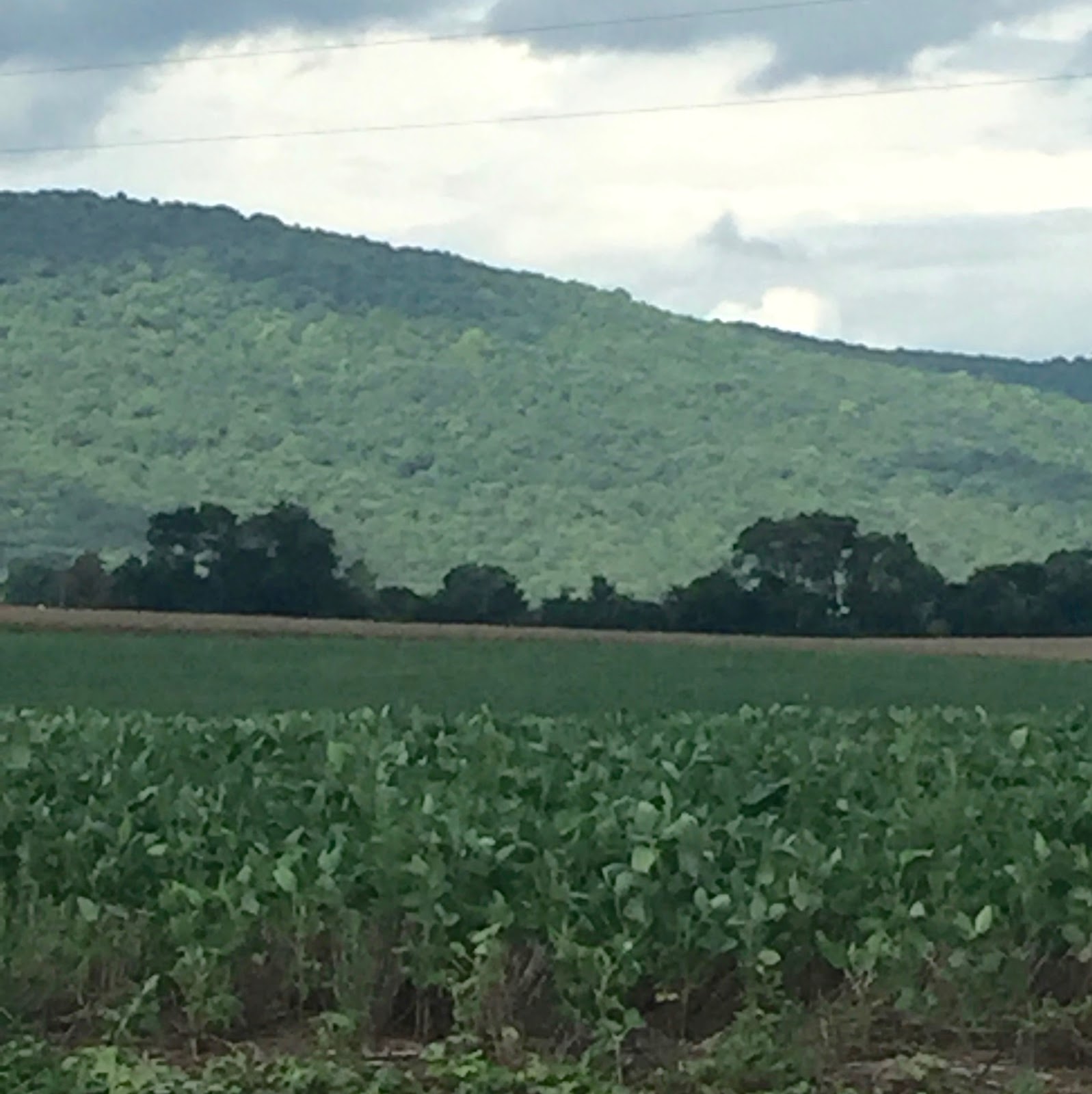
I grew up and have lived in Louisiana most of my life and now live on one of the highest elevations in New Iberia (25 ft.) part of the year and Sewanee, Tennessee (2,000 ft.) the other part. I find it strange when “Sewaneeans” say “I’m going down to the Valley to shop,” and they’re referring to several towns, the peak elevations of which rise 1,000 ft. Now that I live during the spring and summer on The Mountain, the elevation of a town like Cowan, Tennessee, which peaks at 954 ft., doesn't seem to be much of a valley.  

At the western base of the Cumberland Plateau, which juts out in ridges that create small valleys, stands the town of Cowan, which drains via Boiling Fork Creek (a dry bed the first year I glimpsed it), a tributary of the Elk River. I love to drive through the little town on the way to Winchester, Tennessee for groceries, and I don’t ever remember much water running through Boiling Fork. I’ve experienced perhaps two downpours while shopping near Cowan. Many of my poems include the landscape and vegetation of the Valley where corn, soybean crops, pastures of yellow rapeseed, and rolls of hay dot the fields.

Cowan’s claim to fame can be traced to the mid-19th century when it became the site where railway lines met the Nashville to Chattanooga trunk of the Nashville, Chattanooga and St. Louis Railway, and trains traveled through the Cowan Tunnel. Pusher engines assist
ed trains to climb the steep ascent to the Cumberland Plateau, and are still being used today. When I pass the station on my trek to Winchester and see the engines, I wonder if they were the prototypes for The Little Engine That Could, a children’s classic with a moral about what a positive attitude can do for a machine (or a human) wanting to achieve success. It was a book popular during my childhood and is still found in most contemporary libraries.

Last week we stopped at a renovated restaurant renamed “The Valley Cove Bistro” in Cowan and discovered an excellent menu for a restaurant in a small town of 1,770 people, including classic French Onion Soup, the original Corner House (former name of the restaurant and a Tennessee Back Road Heritage property) Gazpacho, Grilled Salmon and Cucumber Wrap, and Apple Rose Puff Pastry (the latter filled with Maple Custard served with Vanilla Bean Ice Cream). I asked about the Chef and was told he’s a native of the Valley area.

Further down the road in the Valley, we stopped at a fruit and vegetable store supplied by Amish farmers from Lawrenceburg, Tennessee and purchased ears of sweet corn, a cantaloupe the size of a watermelon, and home-grown tomatoes. The store was attached to Lapp’s Greenhouse, a nursery where we’d bought herb plantings earlier this summer, and which have survived the drought.

I read that one of the characteristics of a valley is “low land” and that most of them are deep and narrow, but this one must be an old one because it isn’t steep sided like younger valleys  still being uplifted to create mountains.

When we travel home from the Valley, we often try to guess how many degrees cooler the temps are at the higher elevation of The Mountain, and today The Mountain proved to be seven degrees cooler. However, I hasten to mention a major advantage of living in the Valley: real estate is $100,000 cheaper down below than on The Mountain! The main thoroughfare of Hwy. 41A running through Cowan is lined with lovely homes and businesses housed in quaint buildings that were built during the town’s heyday when the railroad came through.

Photographs by Victoria I. Sullivan


Tuesday, April 9, 2013

JAZZ ON THE BLUFF

Jazz on the Bluff program

Last Sunday was a day of serendipity. The weather lifted, and after church we ventured over to Chattanooga, Tennessee for lunch. We had glimpsed early signs of Spring on drives to Cowan in the valley–pear and cherry trees in full bloom–but the newest color on the route to Chattanooga were the purple blossoms of the redbud trees scattered along the highway. The sun had finally appeared, and the gloomy gray clouds that often hang over Sewanee had dispersed, revealing greening on the lower slopes of The Mountain.
Serendipity appeared following lunch at Tony’s Italian Restaurant in the art district of Chattanooga when we decided to take advantage of our membership in the Hunter Museum, one of the finest museums in the South. We had talked about seeing the glass art exhibit, “Beauty Beyond Nature,” the work of Paul Stankard who does botanical compositions under glass, but we were drawn to the sound of jazz being played on the outdoor terrace of the Hunter Museum. Booker T. Scruggs, II and his jazz ensemble were playing some old-time favorites of Duke Ellington: “Satin Doll,” “Solitude,” “Don’t Get Around Much Anymore,” and other crowd pleasers. A river breeze blew in while they played, and it was a perfect day for nostalgic listening–I became especially wistful when they struck up a Henry Mancini tune, “Moon River.” It was an apt rendition to perform on the Museum’s River View space that overlooked the bright blue-painted bridge spanning the Tennessee River.
Scruggs and his group were celebrating “JazzaNooga,” part of Chattanooga’s Creative Underground Family, in honor of National Jazz Month, which coincides” artfully” with National Poetry Month. His group’s rendition of “Just A Closer Walk With Thee,” played New Orleans style, caused a lot of toe-tapping and would have been a curtain call had Scruggs chosen to play an encore.
Booker T. Scruggs Ensemble
Scruggs is a familiar face on the jazz and gospel music scene in Chattanooga and has produced four albums, one of which I bought, “A Salute to the Duke,” which he recorded with the MaxTiam Trio. He’s an adjunct professor of sociology at the University of Tennessee at Chattonooga and is noted for his service as director of Upward Bound at UTS for thirty-six years. The sales of his Ellington CD generated $10,000 for “Upward Bound” UTC students from low income families one year. Music wasn't really Scruggs' vocation, but he played at Howard High School and Clark Atlanta University where he earned a Master’s in Social Science and gradually became known throughout Tennessee for his clarinet and sax performances. He claims that he didn't plan to make a lot of money playing music and adds that he certainly hasn't but he has a lot of fun, especially when he plays gospel and inspirational music.
I wonder if National Poetry Month will sponsor readings that will draw as much attention as the JazzaNooga celebration. April is the month when the Academy of American Poets highlights the legacy and ongoing achievement of American poets and encourages increased publication, distribution, and sales of poetry books, as well as increases public and private philanthropic support for poets and poetry. I couldn't help wishing that the Hunter Museum of American Art would sponsor a poetry event for both young and old poets who believe that poetry influences the progress and health of a culture as much as politics and religion.
If you haven't participated in a Jazz or Poetry appreciation event this month, try a little listening and reading–you'll likely find some serendipity.

Monday, June 4, 2012

MUCH ABOUT MOON PIES


Yum! Yum!
Last month I spent several days in Chattanooga, Tennessee and accompanied my daughter and her husband on a shopping spree. Mostly, I watched them shop, but when we went into a bookstore, my shopping spirit suddenly came alive. I picked up a copy of David Magee’s MoonPie: Biography of an Out-of-This-World Snack and began reading about one of the snacks that has been consumed by millions of southerners since a recipe was created for the pies in 1929 at the Chattanooga Bakery.

My experience with MoonPies dates back to fishing trips in the late 1950’s, which I'll mention in a subsequent blog. MoonPies were an indispensable part of lunch when we floated the Bogue Chitto River fly fishing near Franklinton, Louisiana. We didn’t take along RC Cola, but I’m told that this drink was a popular and inexpensive complement to the pie. During the 50’s the song “Gimmee an RC Cola and a MoonPie” became popular and celebrated the success of this inexpensive workman’s lunch.

The MoonPie is a dessert sandwich that consists of two moon-shaped graham cracker cookies, filled with marshmallow and coated in chocolate, banana, or coconut. It isn’t a high fat concoction but the sugar in it is deliciously high. It was first concocted by a chef at Chattanooga Bakery in Chattanooga, Tennessee following the instruction of Earl Mitchell, a salesman for the bakery, who had learned from miners in Kentucky that they wanted a filling snack shaped like the moon for their lunch pails. Mitchell returned to the Chattanooga Bakery with the idea to stack one round graham cookie on top of another, sandwiching marshmallow in between and covering the snack with a layer of chocolate. The concoction sold for a nickel and was a big seller in the coal fields, later becoming popular throughout the South, from the Carolinas to Georgia and Tennessee.

David Magee reports that the Chattanooga Bakery doesn’t expend large quantities of its time and resources telling customers how great their product is – the little round dessert pie, about four inches in diameter, sells itself. Of course, there’s the famous MoonPie festival in Bell Buckle, Tennessee, approximately an hour’s drive from Sewanee, attended by more than 20,000 festival goers. It features a run, a parade, and the crowning of a MoonPie king and queen. I’ve always been a week late for the Bell Buckle celebration, but when I want to ship this dessert to my daughters, I shop in Bell Buckle for the snack. I don’t know whether New Orleanians throw the pies from their parade floats, but Mardi Gras krewes in Mobile, Alabama have been known to throw MoonPies, in addition to the traditional beads, to clamoring crowds.

According to David Magee, 100 million MoonPies are produced annually, and the Chattanooga Bakery is believed to be one of the largest producers of marshmallow in the world. The MoonPie has a phenomenal shelf life of four months.

In the introduction to MoonPie: Biography of an Out-of-This-World Snack, David Magee quotes from one MoonPie consumer in Clayton, North Carolina who claims that the first breakfast she ever fixed for her husband was a MoonPie and an RC Cola, and his book is filled with similar anecdotes extolling the flavor of this snack.

When Magee questioned Sam Campbell IV, third generation leader of the MoonPie company, concerning the number of MoonPies that have been produced in its history of over eighty years, he estimated that three to four billion of the flavorful snack have been produced since the first pie was baked!

Author David Magee is a newspaper columnist and non-fiction author who lives on Lookout Mountain, Tennessee. He has also authored The John Deere Way and Turnaround: How Carlos Ghosn Rescued Nissan.