Showing posts with label Border Press. Show all posts

Wednesday, August 29, 2018

DESTINATIONS


“Our life is a constant journey from life to death. The landscape changes, the people change, but the train keeps moving. Life is the train, not the station.” Paulo Coelho

Border Press announces the publication of Destinations, New and Selected Poems by Diane Marquart Moore. Her 50th book features glimpses of train travel throughout the U.S. and one memorable ride over mountain tracks in Persia. Included are portrayals of characters making trips via rail who convey feelings of escapism and nostalgia and record observations from “the platform” during the actual train rides.

Destinations also features Section III. Of “Everyday Journal” that contains ironic observations about ordinary life in both New Iberia, Louisiana and Sewanee, Tennessee. Photography by Victoria I. Sullivan. Available now at Border Press Books and Amazon.


Saturday, August 4, 2018

FORTHCOMING…DESTINATIONS


A memorial graveside service and homily for a close friend, followed by a homily I’ll deliver at a reception for an American/Turkish marriage, both in Gettysburg, Pennsylvania… then a visit with an author friend of 60 years’ duration in Potomac, Maryland…August will be a busy month as I’m headed East in two days. I won’t return until after August 15 and should find serendipity in unfamiliar places and people to blog about along the way.

Meanwhile, Border Press is reviewing the proof of a new book of my poetry slated for distribution this month. It’s called Destinations and includes train travel plus another everyday journal within the pages. The cover features an interesting shot Victoria Sullivan took of the ceiling or dome of the old, restored Chattanooga Choo Choo train terminal in Chattanooga, Tennessee. My grandson, Martin Romero, rendered the attractive design for this cover.

Train fans may want to take a ride through new and selected poems, ranging from those based in Bryson City, North Carolina to Tehran, Iran and other destinations enjoyed by a peripatetic poet.

Publication Date: Later this month. Destinations will be distributed by Amazon or can be ordered through Border Press, P.O. Box 3124, Sewanee, TN 37375. 


Monday, July 24, 2017

SPRING’S KISS


In 2014, Border Press published Between Plants and People, a book of my poetry about plant life accompanied by eighteen color photographs by Dr. Victoria I. Sullivan, a noteworthy botanist. It contained metaphors describing the impact of plants on humans — food plants, medicinal plants, and decorative plants, and is an innovative account of “humanistic botany” in poetry.

The second volume of plant poems I wrote this summer, with accompanying photographs by Dr. Sullivan, is now in press. Spring’s Kiss, a book of poetry praising the qualities of wildflowers that inhabit and create beauty in the plant kingdoms of the world, is a nod to Susan Albert’s: “One person’s weed is another person’s wildflower,” and many of those weeds are included in this volume. Medicinal, as well as aesthetic qualities of the plants, are touted in some of the poems, and the beautiful blooms of these weeds reinforce Albert’s observation about plants.

The cover of this volume is a photograph of Karen Bourque’s glass rendition of the Pickerel Weed as inspired by Susan Elizabeth Entsminger’s illustration of the aquatic weed in Why Water Plants Don’t Drown by Victoria I. Sullivan, and the photograph was used in the cover design by Martin Romero, a landscape architect who renders the final designs for my book covers.

Spring’s Kiss can be pre-ordered from Border Press, P.O. Box 3124, Sewanee, TN 37375 for $20 including shipping and will also be available from Amazon by Aug. 15.


Friday, May 12, 2017

INTO THE SILENCE

Border Press has produced many "first novels," and its latest, Into the Silence by John Gibson, is among the press's growing list of excellent fiction writers who base their work in southern locales. Gibson, a physician who spent over thirty years on the faculty of an academic medical center in Mississippi, sometimes speaks of his novel as a "medical novel," but I think that Into the Silence could be called a "metaphysical novel" and reveals that Gibson, an Episcopalian, has spent a lifetime of study about esoteric religions, including his own Anglican church roots.

Gibson gives the reader a substantive view of a state that has produced some of the finest writers in the U.S. One of his characters, a farmer, provides readers with well-crafted passages about "connecting with something that's bigger than the soil, bigger than the ground you're working on...Some people say it's people who make history. But I think it's the land — it's the land and the rivers that make all the difference...take the Mississippi Delta, for instance: just by being there the Delta enticed man to dig in its soil, to cut and shape the land to suit man's needs...by just choosing to live in the Delta instead of the hills, man was shaping himself, his culture, his politics, his ability to earn and spend money..."

Gibson knows his region, as well as the politics of hospital administration and swiftly propels the reader into a story set in the emergency room of a bustling hospital where readers meet Dr. Todd Sutherland and his patient, Anna Chadwick, who suffers from Ebstein's Anomaly, a ventricular dysfunction. It's Christmas Eve and Sutherland is standing in for another physician; the woman is beautiful and charming, and the scene seems primed for an unlikely romance. However, beneath the surface of Sutherland's obvious attraction to Chadwick, lie questions related to life and death that take the reader into issues far deeper than the introduction of a romance. Sutherland becomes a frequent visitor at the bedside of Chadwick, and ultimately she undergoes a surgery. When she enters into a coma, Sutherland begins sitting with her, and during the vigil at her bedside, he undergoes a dark night of the soul, pondering where her soul must be as it relates to the difference between life and death. As the story progresses, he is accused of shutting off her respirator and endures an ethics trial.

Sutherland, in a state of grief, wrecks his car in New Orleans and ends up in Ochsner's Hospital where he experiences a state of consciousness near death and begins to probe the condition of his soul: "I moved through the walls and out in the open air and even more quickly rushed through a kind of tunnel and out an opening at the other end. While I came out of the tunnel, I could see a bright light. When I moved toward the light, a figure came into view..." The man is identified as Parmenides, an ancient healer who heals by prophecy and informs Sutherland that since he is a healer, he needs to learn to go "into the silence." Sutherland begins a study of Parmenides with a New Orleans professor who suggests that the physician put himself in a trance called Orphic Shamanism to contact the Divine for the purpose of healing.

Gibson's knowledge of Greek literature, Christianity, shamanism, meditation practices, philosophy, and metaphysics is extensive, and he interweaves these subjects into a suspenseful storyline without becoming didactic. Characters emerge from his medical background showing his adeptness at creating authentic personalities, and his extensive knowledge of healing — ancient and contemporary forms — strongly suggest the quality of care this compassionate, well-intentioned professional practiced during his career as a physician and teacher.

Gibson also rendered the pen and ink cover image of Into the Silence that is one of many works of art he has created and exhibited in Jackson, Mississippi as part of his lifework. Several years ago, he provided the pen and ink pointillism drawings in Illuminate, a book of poetry by his daughter Margaret Simon that communicates the beauty and mystery of the manifestation of God in the world. He also received an award in the 2012 Annual Cedars Juried Art Exhibition.

A Renaissance man actively working in retirement, Gibson is another author who joins Mississippi's impressive gallery of writers and artists.

Order from Border Press, P. O. Box 3124, Sewanee, TN 37375 or amazon.com

Thursday, March 2, 2017

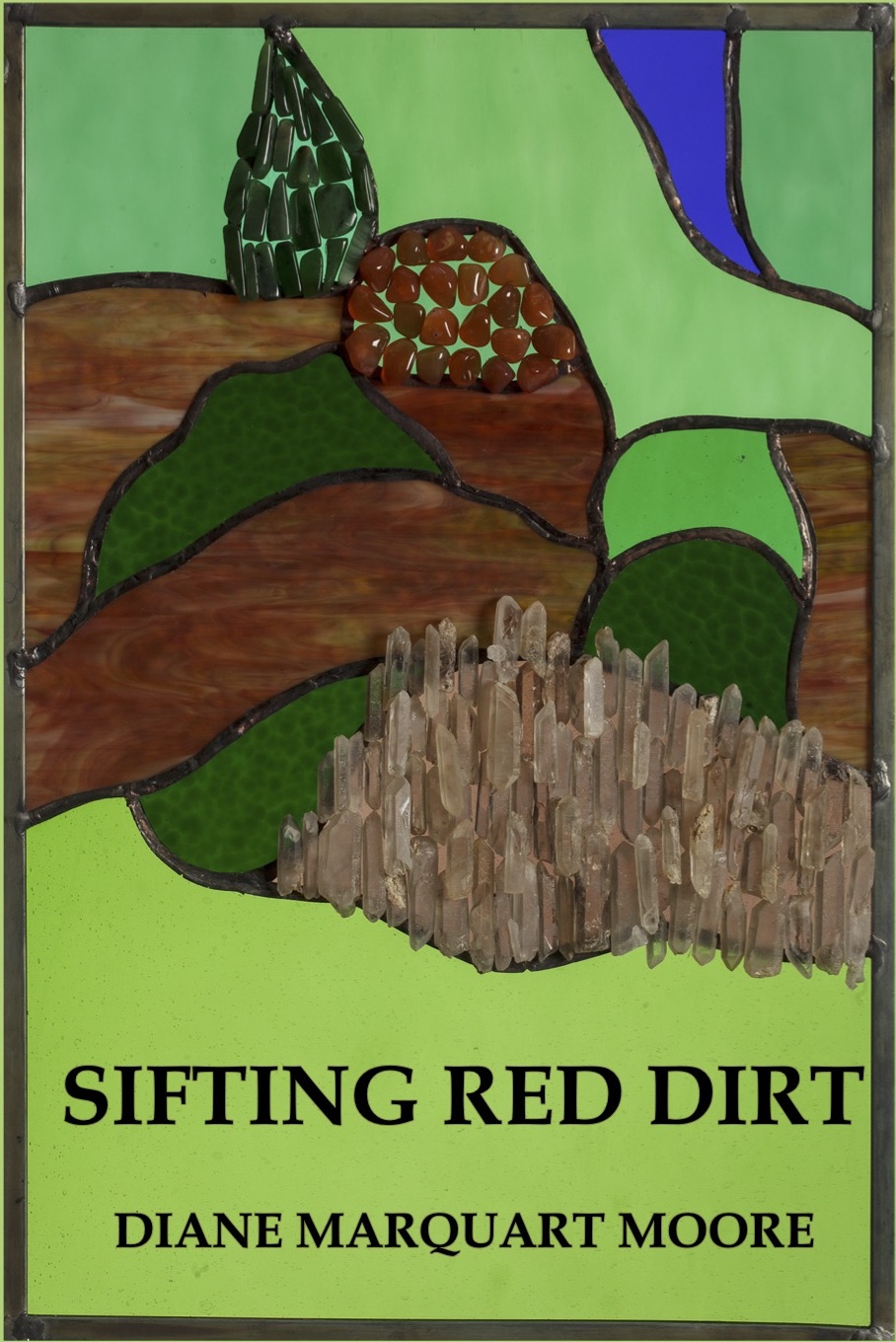
SIFTING RED DIRT

This week, I received the first copies of Sifting Red Dirt, my poetic offering for the year 2017. The cover, as usual, is a photograph of the unique glass work of Karen Bourque, a glass artist in Church Point, Louisiana. When I look at the beautiful glass pieces Karen renders to be photographed for the book covers of my poetry, I feel especially blessed to have her artwork in my home and on the book covers.

In the "Author's Note" of Sifting Red Dirt, I speak of the influence Karen has had on my work, and Border Press felt that the best introduction to this volume would be through the note about Karen's art being so compatible with my books:

"Last year I published a book of poetry featuring my Cajun ancestors about whom I had no knowledge until I reached my forties, and after the book, A Slow Moving Stream, appeared and I gave several readings, my maternal ancestors began to rival those paternal ancestors for inclusion in a book. They appeared in old photographs I had put away, in dreams, and in cogent memories...So I went to Mississippi where my great grandmother, Dora Runnels Greenlaw, was born and photographed a red hill near Brandon, Mississippi, then sent it to Karen Bourque of Church Point, Louisiana, who has rendered many of the wonderful glass pieces for covers of my books of poetry. Almost immediately, I was assailed with doubts about writing a book about them and announced I was finished before I began.

However, when I returned to Louisiana from my spring/summer stay in Sewanee, Tennessee and met for dinner with Karen and her husband, Darrell, former poet laureate of Louisiana, Karen gifted me with Brown Cotton, Red Hills, a wonderful glass piece. Karen gently placed her feet at my back, along with those deceased family members who had appeared in my dreams, and I began writing Sifting Red Dirt. Although it is among 46 books I could not have written without the support of Dr. Victoria I. Sullivan, owner of Border Press, during the last ten years Karen has become an intuitive co-creator in my work. Her glass pieces hang in my home in New Iberia, Louisiana and in the cottage at Sewanee, Tennessee, and one of the poems in Sifting Red Dirt is about her work."

Dr. Mary Ann Wilson, professor of English, University of Louisiana at Lafayette, best describes the poems in Sifting Red Dirt on the back cover as "resist[ing] an easy nostalgia but instead drill down to the core of feeling and memory...the poetry "taking us to the sources of personal and cultural identity — family and place..." Also, Dr. Darrell Bourque endorses the volume with a comment about the poems concerning "our mostly buried lives that shape us and define us in ways that are hardly explicable...Diane's story would not have been complete without those memories rising into language..."

Karen is working on another glass piece to illustrate one poem I've written about Prairie des femmes, Louisiana that will be among photographs of two or three glass pieces she created for my book covers. The photos will be featured alongside several of my poems in the fall/winter issue of Pinyon Review.

One of Karen Bourque's glass pieces is permanently exhibited in the Ernest J. Gaines Center, an international center for scholarship about the work of Gaines at the University of Louisiana at Lafayette; another was featured at the Louisiana Book Festival in Baton Rouge, Louisiana, and many hang in homes and churches throughout Acadiana. Her notes about the photographs of glass work on the covers of my books of poetry have appeared in several volumes and could be classified as "prose poems."


Monday, May 2, 2016

THE BAYOU TECHE

This beautiful image will appear on the cover of my latest book of poetry about Bayou Teche entitled A Slow Moving Stream, which will be published this month. The glasswork for the cover photograph was rendered by Karen Bourque of Church Point, Louisiana and is an interpretation of the Bayou Teche as it flows past the town of Arnaudville, Louisiana. The glass piece is entitled “Beneath the Surface,” and an afterword by Karen describes the elements included in the piece. She writes an eloquent explanation, an excerpt of which follows: “Spring, the dominant seasonal reference to the piece, is symbolic of the time of renewal. Spring, either as time measure or as metaphor, marks that time when the soul awakens inside the crossing of a water barrier, that time when unconscious mind and conscious mind surface and co-exist in the balance of renewed beginnings.”

Darrell Bourque, who is a former Louisiana poet laureate and author of Megan’s Guitar and Other Poems from Acadie, “if you abandon me, comment je vas faire: An Amédé Ardoin Songbook” and forthcoming “Where I waited” and Love Bridge, describes my book: “Diane Moore reminds us that poems begin in memory and in interrogation. The grand march of history holds one version of who we are. Mostly hidden grace notes and terrors hold other versions, and language tied to memory perhaps the truest version. Moore’s pathway to the sacred is through the word and she knows with the right inquiry we can also know in the ways that trees know, and clouds, and crows, and streams, and the whole earth. The universe she creates in the poems in A Slow Moving Stream is a universe where the obvious and the imperceptible, the mundane and the magnificent, the political and the personal are talking, where everything large and small is talking to the other all the time.”

Border Press announces that A Slow Moving Stream contains poetry that “follows the languid Bayou Teche from its source at Port Barre to Morgan City, Louisiana where it empties into the mighty Atchafalaya River, making a journey that traces some Acadian origins in a lovely and sometimes lonely landscape. During the journey, the poet unveils some of the characters and events of early Acadian settlements, as she imagines the history taking place, from the time the Acadians fled their native Pisiguit, Nova Scotia to a present-day oil wealthy Acadiana. This volume contains poems about the Great Flood of 1927, a Civil War battle near Franklin, Louisiana with an attendant drawing by the late Morris Raphael, author of The Gunboat Named Diana. Moore includes descriptions of swamp life and explores spiritual ties that have bound the people who built homes and enterprises along ‘a slow moving stream’ in one of the United States’ most colorful cultures.”

While A Slow Moving Stream alludes to historical events and people, it is, as Karen Bourque writes, “a poetic recreation of people and experiences” as I imagined them to be. Photographs by Victoria I. Sullivan, a botanist who formerly taught at the University of Louisiana at Lafayette and author of Why Water Plants Don’t Drown, Adoption, and Rogue Genes, enhance the poems in this volume and add to the reader’s experience of that slow-moving body of water called “The Teche.”


I conceived the idea for the poetic work last year while lunching on the deck of The Little Big Cup Restaurant in Arnaudville, Louisiana, watching the bayou flow by, with Vickie, Darrell, and Karen. Actually, the poetry has been hovering in my mind for a long time, and an account of one journey I made along the route of the Teche appeared in Tour Guide: Louisiana’s Beautiful Scenic Byways, Part I that Trent Angers commissioned me to write for Acadiana Profile magazine in 1996.