Showing posts with label Where I Waited. Show all posts

Friday, September 16, 2016

THE LIGHT FROM GLASS


Last evening about dusk, I went into the dining room of our home in Sewanee, Tennessee and noticed that despite the shadowy room, three glass pieces by Karen Bourque of Church Point, Louisiana, hanging in the windows overlooking the woods, had captured the last light of the day. Two of the pieces, “Lotus,” and “Ibis and Crow” had been created as commissioned art for my personal collection, but the third one entitled “Beneath the Surface,” was one I had asked Karen to create for a book cover and seemed to embrace the room, and the woods viewed through the windows, in a soft light. (In the photo above, it's the glass piece on the left side of the screen.)

Karen explains that her glass piece, “Beneath the Surface,” is a “message of new beginnings and happiness.” The stone used to represent the wild ranunculus (yellow flowers) in the piece is prehinite, “a stone that illuminates the path forward to spiritual growth through attunement to divine energy,” according to Karen. Prehinite is also used by stone healers as a stone of vision “used to access higher levels of awareness.”

Karen relates all of the above and more in a special afterword to my book of poetry, A Slow Moving Stream, from which I’m scheduled to read next month as one of the selected, featured poets at the Louisiana Book Festival in Baton Rouge, Louisiana. The oak tree in the glass piece is the most dominant feature, and Karen says that the oak, a protector and stabilizer, is ever present in Louisiana Acadian iconography. The stark image aptly represents a poem entitled “The Mind of Trees” included in A Slow Moving Stream.

Karen, who worked in the field of medical technology for years, began creating glass art as a hobby, but soon achieved a professional level of success with her work, both as a glass artist and as a writer of sensitive texts that describe the glass pieces. Her biggest admirer is husband, Darrell Bourque, former Poet Laureate of Louisiana and Louisiana Writer of the Year, whose latest poems, paired  with the paintings of Bill Gingles, are contained in Where I Waited, published by Yellow Flag Press.

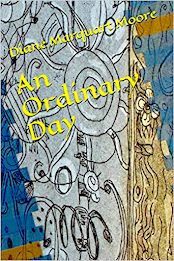
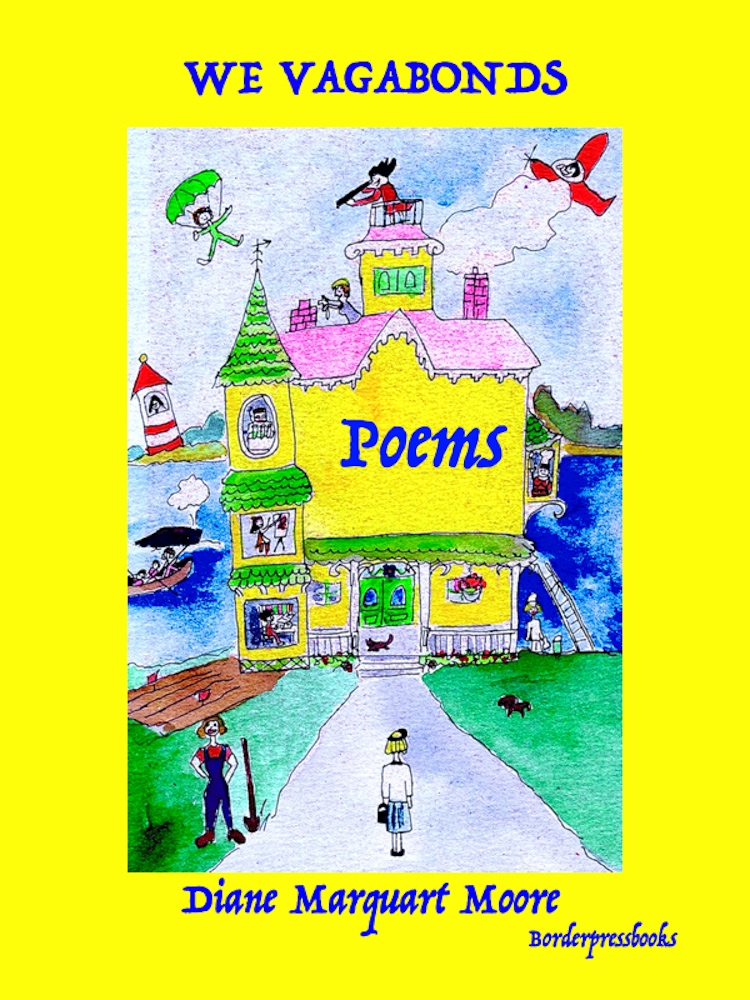
Karen has created covers for four of my books of poetry, as well as a book of essays: A Strand of Beads, A Lonely Grandmother, Street Sketches, Porch Posts, and the latest volume of poetry, A Slow Moving Stream. Several of the books have included either an introductory description of Karen's glass piece, or an afterword describing the work on the cover especially written by her.

I loved the afterword about “Beneath the Surface,” in which Karen says: “Spring, either as time measure or as metaphor, marks that time when the soul awakens inside the crossing of a water barrier, that time when unconscious mind and conscious mind surface and co-exist in the balance of renewed beginnings.”

I also have five additional glass pieces hanging in the dining room of my home in New Iberia, Louisiana. The pieces remind me that although many glass artists require special lighting or running water to showcase their work, Karen’s creations require neither of these elements and illuminate a room with natural light that helps the viewer to “grasp higher, more abstract concepts and facilitates inter-dimensional communication.”


Yesterday’s encounter with Karen’s glass images inspired me with enough light to anticipate “new beginnings and happiness,” and I’m most grateful for her artistic gifts. The one poem I’ve written lately, which will appear in the fall/winter issue of The Pinyon Review published by Gary Entsminger in Montrose, Colorado, will have to suffice to inspire Karen to create a glass piece entitled “Pandora’s Legacy” that I hope to acquire next year.


Monday, July 11, 2016

WHERE I WAITED


Where I have been waiting for several months now is in Sewanee, Tennessee…waiting for the mail to bring me the latest book of poetry, Where I Waited, by Louisiana’s premier poet, Darrell Bourque. To say that it was worth the wait is banal; the book is all that I anticipated. As I told Darrell, the Muse that sat on his shoulder as he ran every morning while he was creating Where I Waited (a time when Darrell writes many lines of his sonnets in his mind) was a very old, wise one who had been waiting to inspire him to write the poetry of his lifetime.  “Mystical” is an inept word to describe the work.

In this volume, the beautiful abstract paintings of Bill Gingles are paired with Bourque’s sonnets and must have also lain in wait for the moment to accompany the voices of iconic Creole-Cajun musicians and their wives and forebears featured in Where I Waited. In the words of the poet’s title poem, they are “… [those] voices all turn & wave & memory situated/in some arch between now & then…” Each expressionistic narrative poem is a song as poignant as the songs of the musicians represented.

Bourque includes poems about the lives of Amédé Ardoin, Cléoma Breaux Falcon, Iry Lejeune, and Goldman and Theresa Leday Thibodeaux, musicians and their spouses whose songs have been kept alive by historians and anthropologists and reimagined by the poet. It was impossible for me to single out one or two poems as examples of excellence. As I read each poem and looked at the paired painting, I found myself reluctant to move on to another, and I was not disappointed by the work of artist and poet after I turned each page in this remarkable volume. I read through Where I Waited twice.

The landscape of small rural communities in south Louisiana (Church Point, Mamou, Lawtell…) is the backdrop for musicians who seem to rise above their impoverished childhood and enter a mystical world of singing “we might wave over who we were, over what lives & what dies.” That line taken from “Wish Pond” was one of many tribute poems to Goldman Thibodeaux, still living, with whom Bourque has a strong bond. Lines describing Thibodeaux’s native Prairie Ronde sing of “crawfish pond, rice field & gravel pit pond, pond with dragonflies/hovering, pond dark as my brother’s skin, as light as mine, second/and third ponds & more for horses & cows & geese & ducks & skies/filled with thirsty Monarchs, ponds with us hanging in them there/like heavy pears in late spring or fat ripe figs in July tethered/barely to their trees…” 

In Bourque’s poetry, the reader recognizes that the poet could have been as adept at painting as he is in his poetry, and I know that he once considered majoring in Art History. In his home in Church Point, Louisiana, books vie for space with walls covered with art – fine art, Louisiana primitive art, abstract art…

One of the most moving poems, “Second Rate Mystic,” in Where I Waited is dedicated to Iry Lejeune. It's a sonnet about this blind musician who spent five years boarding at the Louisiana School for the Blind in Baton Rouge, Louisiana. Bourque writes in Lejeune’s voice: 

“…In parceled light the only measure/I knew was true was measured sound. So, I made breakdowns/ & two-steps & laments, easy as flowers turning to sun. I broke/the mold of who I was supposed to be with air. Newly mown grasses were song & Caillette’s lowing too…Waltzes tied to the names of towns, /to branches in trees & to those cordoned off & lonely & broke…"

Only a highly-enlightened poet could enter the world of “there” and become the voice of deceased musicians traveling to “here,” as Bourque accomplishes with three of the music legends in this volume. The lyrics cross boundaries between physical and metaphysical to form a world in which there are no cultural fences, only the uplifting sounds of music that should be listened to and preserved.

Equally as valuable as the poetry are the Notes in the back of the volume. They provide factual material that Bourque used to shape the voices and narration of the musicians’ lives. Where I Waited is a book that will be lauded by scholars, fellow poets, historians, and artists, and this blog, limited in space and by the attention of casual readers, is intended only to titillate those who want to further explore the work of Louisiana’s finest poet.

Darrell Bourque, professor emeritus of English at the University of Louisiana Lafayette, directed the interdisciplinary humanities program and served as the first Friends of the Humanities professor. He is a founding member of Narrative4, an international story exchange program, a member of the board at the Ernest J. Gaines Center at ULL and a former Louisiana Poet Laureate. Two years ago, he was named Louisiana Writer of the Year by the Louisiana Center for the Book, Louisiana State Library, and this year he received the James Williams Rivers Prize in Louisiana Studies awarded by the University of Louisiana Lafayette. His latest book is Megan’s Guitar and Other Poems from Acadie, and his latest chapbook, if you abandon me, comment je vas faire: An Amédé Ardoin Songbook, has become the best selling book in the history of Yellow Flag Press.


Congratulations Darrell! 


Monday, May 2, 2016

THE BAYOU TECHE

This beautiful image will appear on the cover of my latest book of poetry about Bayou Teche entitled A Slow Moving Stream, which will be published this month. The glasswork for the cover photograph was rendered by Karen Bourque of Church Point, Louisiana and is an interpretation of the Bayou Teche as it flows past the town of Arnaudville, Louisiana. The glass piece is entitled “Beneath the Surface,” and an afterword by Karen describes the elements included in the piece. She writes an eloquent explanation, an excerpt of which follows: “Spring, the dominant seasonal reference to the piece, is symbolic of the time of renewal. Spring, either as time measure or as metaphor, marks that time when the soul awakens inside the crossing of a water barrier, that time when unconscious mind and conscious mind surface and co-exist in the balance of renewed beginnings.”

Darrell Bourque, who is a former Louisiana poet laureate and author of Megan’s Guitar and Other Poems from Acadie, “if you abandon me, comment je vas faire: An Amédé Ardoin Songbook” and forthcoming “Where I waited” and Love Bridge, describes my book: “Diane Moore reminds us that poems begin in memory and in interrogation. The grand march of history holds one version of who we are. Mostly hidden grace notes and terrors hold other versions, and language tied to memory perhaps the truest version. Moore’s pathway to the sacred is through the word and she knows with the right inquiry we can also know in the ways that trees know, and clouds, and crows, and streams, and the whole earth. The universe she creates in the poems in A Slow Moving Stream is a universe where the obvious and the imperceptible, the mundane and the magnificent, the political and the personal are talking, where everything large and small is talking to the other all the time.”

Border Press announces that A Slow Moving Stream contains poetry that “follows the languid Bayou Teche from its source at Port Barre to Morgan City, Louisiana where it empties into the mighty Atchafalaya River, making a journey that traces some Acadian origins in a lovely and sometimes lonely landscape. During the journey, the poet unveils some of the characters and events of early Acadian settlements, as she imagines the history taking place, from the time the Acadians fled their native Pisiguit, Nova Scotia to a present-day oil wealthy Acadiana. This volume contains poems about the Great Flood of 1927, a Civil War battle near Franklin, Louisiana with an attendant drawing by the late Morris Raphael, author of The Gunboat Named Diana. Moore includes descriptions of swamp life and explores spiritual ties that have bound the people who built homes and enterprises along ‘a slow moving stream’ in one of the United States’ most colorful cultures.”

While A Slow Moving Stream alludes to historical events and people, it is, as Karen Bourque writes, “a poetic recreation of people and experiences” as I imagined them to be. Photographs by Victoria I. Sullivan, a botanist who formerly taught at the University of Louisiana at Lafayette and author of Why Water Plants Don’t Drown, Adoption, and Rogue Genes, enhance the poems in this volume and add to the reader’s experience of that slow-moving body of water called “The Teche.”


I conceived the idea for the poetic work last year while lunching on the deck of The Little Big Cup Restaurant in Arnaudville, Louisiana, watching the bayou flow by, with Vickie, Darrell, and Karen. Actually, the poetry has been hovering in my mind for a long time, and an account of one journey I made along the route of the Teche appeared in Tour Guide: Louisiana’s Beautiful Scenic Byways, Part I that Trent Angers commissioned me to write for Acadiana Profile magazine in 1996.