Tuesday, January 10, 2017

THE GIFT


from Sea Quilt by Susan Elliott

During this last cold spell, I received a late Christmas gift from chilly Colorado, home of Pinyon Publishing, the company that published the mystery Chant of Death that I co-authored with Isabel Anders and many of my poems in Pinyon Review. Publishers Gary Entsminger and Susan Elliott sent me a packet of note cards with an illustration Susan rendered — one of a square from Susan's "Sea Quilt," a picture done with watercolor, ink, and thread on 140-lb cold-pressed watercolor paper. The blues in this watercolor express Susan's thoughts of "sensing the ocean in the stillness of snow-covered fields of sagebrush./...The other dimension laps at my ears like the hum of Om."

Susan always writes a long Christmas letter to accompany the gift she and Gary send, and on a cold day here, I visualized her "sitting in my new favorite chair — Mom's Danish rocking chair padded with a Navajo blanket from Dad. Facing the kitchen (aka the apothecary, center of daily dances with the vegetable kingdom) — to my left the wood stove is not lit because the cabin is still warm from last night's fire; to my right, on the counter, sit sprouts (garlic and broccoli) greening and steel-cut oats soaking for oat milk..."

Susan and Gary are vegetarians and eat lots of legumes and vegetables, the latter which they grow on the Uncompahgre Plateau where they live. Many times when one of them e-mails me, they're making tomatillo sauce from home-grown tomatillos. In the Christmas letter, Susan quoted from Thoreau: "Though I do not believe that a plant will spring up where no seed has been, I have great faith in a seed. Convince me that you have a seed there, and I am prepared to expect wonders."

We sent this couple pecans from Cane River Pecan Company, which Susan was sampling as the "sky lights up here in pinks and cloudy blues to the west and rising yellows to the east." She says she researched the pecans indigenous to the Mississippi River basin and thinks that they may be "a Centennial variety that was developed in the 1850's by Antoine, a black slave. That variety is believed to have initiated the commercial popularization of the nuts now claimed to be the most popular nut in the U.S. (after the peanut)." Susan also discovered that Indians in Texas considered the pecan tree to be a manifestation of the Great Spirit.

Susan Elliott
When I think of Susan, I think of the word "manifest" because she's always manifesting food, music, art, poems, and good spirits in her life on the Plateau. Susan and Gary are Renaissance people, and their interests are many and varied. Both of them compose, play, and record music, mainly on the guitar and banjo; both are authors and editors. They grow a large vegetable garden every year, are avid believers in sustainability and are stalwart hikers. Susan has a Ph.D. in Botany and rendered the illustrations for Why Water Plants Don't Drown by Victoria Sullivan, published by Pinyon a few years ago. She also sews, bakes a good bread, and is an accomplished herbalist. Some of our Christmas gifts have included exotic seasonings that she mixed and tied in packets for family and friends.

At the end of Susan's Christmas letter, she told us to look out the window for the first birds of the year: Mountain Chick-a-dee, Steller's Jay, and Dark-eyed Junco, which we can't see here in swamp country but can imagine perching on the window sill of her cabin (a residence to which they refer as "The Castle").  A woman who seems to be prepared and enthusiastic for any experience, Susan ended the annual letter with a new year greeting: "We're on our way." And here in south Louisiana, following a frosty week-end, today's 70-degree weather bodes better for "our way."




Sunday, January 8, 2017

SPENDING WINTER IN THE SOUTH?

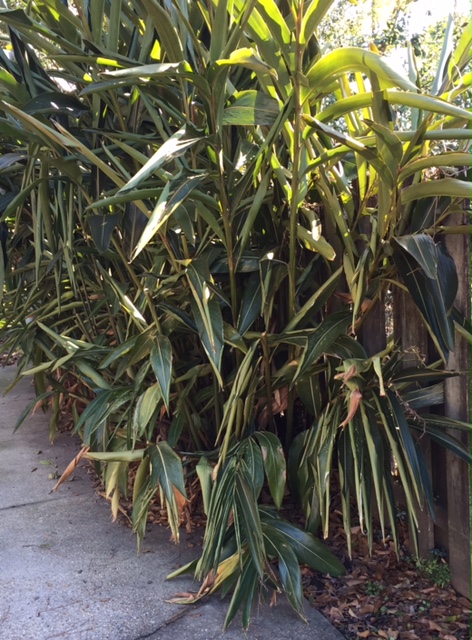
Twenty-six degrees outside. Winds out of the North at 15 mph. Icy rain. Wilted ginger leaves on the large plant beside the drive. We can always tell how severe the winter has been by the death of the ginger plant; the leaves curl up in protest against unusual Louisiana weather. We leave Sewanee, Tennessee every year in late October, migrating to Louisiana in anticipation of warm winters. And here we are, looking out at silver-topped roofs gleaming with frost and at a drooping ginger plant.

Fortunately, the ginger is easily resurrected. We often throw its dead leaves into the coulee behind the house, and when we return the following year, they have become themselves again. This year, a resurrected plant by the drive had overtaken our neighbor's fence by the time we arrived in late October. It is (was) such a beautiful proliferation we named the apartment beside our house "The Ginger House."

We also planted three orange trees that have been draped with white sheets for three days now and are either smothered or near death. I get up in the night and frighten myself by looking out the window at shrouded plants. I'm accustomed to seeing frozen vegetation and late snows many times when I return to Sewanee in early spring, but winter scenes here have become almost an outrage. I suppose this kind of weather drives Eastern snowbirds to lower climes like Florida. Friend Vickie's family lives in a town called Frostproof because temps there have been kind to family orange groves most winters.

I think of the winter I spent in Limestone, Maine, a town near the border of New Brunswick, Canada — of a night when the temps dipped to 52 below zero and broke the block of an old station wagon we left parked outside because we didn't have access to a garage or carport...of the heat supplied by an ancient oil stove in the living room, and a bathroom sans heat of any kind...of snow piled as high as telephone wires beside the farm road that led to our apartment. In my memorabilia I have a picture of me, fresh from the dry heat of El Paso, Texas, hanging out the washing in a Maine November, the washing stiffening as I attached each clothes pin to the line... of living on Aroostook County potatoes the entire winter, not just because they were accessible but because Army pay didn't cover sumptuous meals...of winds that howled under the eaves of an old farmhouse and swept in through the cracks of a makeshift stairwell leading from the outside to our upstairs apartment.

I often wondered why people chose to live in that remote part of the country. When people think of Maine, they usually visualize its jagged coast, the hub of fishing and tourist industries. The famous environmentalist Rachel Carson spent many summers in Maine as she was attracted to the plants and animals on the Maine coast, which she wrote about in her first book entitled The Edge of the Sea. It was based on the many hours she spent observing tide pools along the Maine seashore. Artists Andrew Wyeth, John Sargent, and Winslow Homer produced colorful seascapes while working on their art in Maine. Interestingly, about 900 years ago, pale-skinned Norsemen with blonde hair landed in a rocky inlet of Maine and frequented the coast for 300 years. They attempted to establish a colony but their demise has been attributed to disease or raids by Abenaki or Wabanaki Indians.

In my novel, The Maine Event, I included scenes about the northernmost community of Madawaska on the St. John River, a town that schedules an annual Acadian Festival celebrating with food and music much like we do in south Louisiana. Two of my favorite authors were inspired by life in Maine: Sarah Orne Jewett who wrote that she was proud "to have been made of Berwick dust" (Berwick, Maine)...of the love of friend for friend and the kindness of neighbor to neighbor in this beloved town..." and E.B. White, the famous essayist I admire who spent summers in North Brooklin on Penobscot Bay, Maine.

From the not-so-warm South today to memories of Maine's north woods, I might as well be in an Arctic museum or at the foot of Mount Katahdin in northern Maine, but I'm probably safer here in New Iberia, Louisiana where 72-degree days are forecast for next week.


Wednesday, January 4, 2017

CHENIERES, BEACH RIDGES

Cheniere by Don Thornton

I have many pieces of art by regional artists in my home, and among my favorites is a small painting of a cheniere by the deceased artist/sculptor Don Thornton of New Iberia. Don gifted me with the painting years ago after I'd written several articles about him for regional publications. He did a series of paintings of the Louisiana Cheniere Plain which extends from Sabine Lake to Vermilion Bay along the Gulf Coast, and my prized painting is #64 in this series. I was drawn to the painting a few days ago when a heavy storm forced me to stay indoors and enjoy my book and art collections.

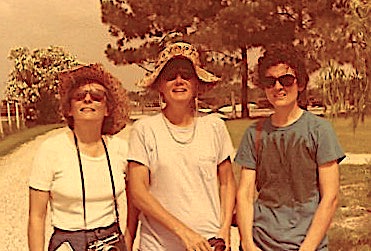
I became familiar with chenieres almost forty years ago when I joined a group of four females who set out one humid summer day to find Cheniere au Tigre in Vermilion Parish, Louisiana. We embarked from Intracoastal City in a speedboat piloted by Dr. Victoria I. Sullivan, a biologist at the University of Louisiana at Lafayette who was armed with a pile of maps by which she attempted to guide us.  Although I'm not sure we found this famous site that was advertised as a summer resort in the early 20th century and which offered tourists room and board for $1.50 per night at that time, but we did hike through a wood of old live oaks that topped the sandy ridges of the Cheniere Plain. A Cheniere Plain consists of a beach ridge separated by marsh and swamp vegetation, and is often wooded; in fact, the word is derived from the French word, "chene," which means "oak" to designate the ancient oaks growing on the ridges.
Explorer, Cheniere au Tigre

Several books have been written about Cheniere Caminada, a cheniere adjacent to New Orleans that was destroyed by a hurricane in 1893. This cheniere was settled by the Chitimacha Indians, and because of the oak grove at the tip of the peninsula, it was called an island. Early settlers of the cheniere included Lafitte's privateers, among whom was an Italian named Vincent Gambi who raided any vessel he sighted in the Gulf. Descriptions of his exploits and of the famous hurricane are recorded in a volume entitled Cheniere Caminada, Buried at Sea, by Dale P. Rogers. It's an account of the tidal wave and hurricane that killed 2000 people living on the island in 1893 and includes photographs, maps, and drawings depicting the disaster. Some of the remains of buildings the hurricane did not totally destroy were salvaged and reused, one of which is the Curole home later occupied by the descendants of the Curoles in Cut Off, Louisiana.

Chenieres appear in my young adult book, The Kajun Kween and also in a book of poetry entitled Old Ridges. The photograph on the cover of the latter, by Dr. Victoria I. Sullivan, is among my favorite photos of Louisiana, and if readers look carefully at the bayou pictured, they may sight an alligator snoozing on the bank.

The following verse is extracted from the poem, "Old Ridges," which is the lead poem of Old Ridges and alludes to the famous Cheniere au Tigre trip that four adventurous females took too many years ago:

"...Hackberry trees grew among stands of oaks
and in the center of one grove,
a house of silvered cypress,
torn screen on the sagging porch,
door ajar, as if someone had just departed,
the abandoned house among trees
buffeted and twisted by Gulf winds.

Like the trees, it seemed to say
I haven't forgotten how it is
to die before dying,
consider my age,
consider this shade,
no voice, no sound...
and a tiger lurks over the ridge."