Showing posts with label chenieres. Show all posts

Tuesday, May 4, 2021

ABOUT "LITTLE ESSAYS"


Fourteen years ago, I began writing blogs, or as two of my friends called this medium, "writing essays." When I think back to the inception of "A Word's Worth," I hear those two voices urging me to record short pieces about people and events, "exploring the fullness of life," as Rebecca Dale said of E. B. White's essays in The New Yorker. Some weeks I hear the "thud of ideas" White described as the action of his Muse. On other days, I hear the roll of thunder without the lightning of ideas.

Today is noisy enough with occasional thunder rolls, but the lightning flashes are confined to memories. And that's OK because most subject matter in my on-the-cusp-of 86 years old mind lies in the depository of memories. This rainy day I probe the memory of my decision to become a poet.

I was in the sixth grade and had returned to civilization after my father's great folly about the family becoming gypsies via tent camping, sleeping on roadside park tables, bathing in rivers en route to California in 1946. I was eleven years old and sighed in relief when we returned to the small southern town of Franklinton, Louisiana. There, I decided to become a poet in my sixth-grade classroom filled with what I called "country people" (offspring of farming parents). I'd been reading in a sixth-grade reader and delighted in a section on poetry. "I can do that," I thought, and promptly wrote a few lines about my new home: "away from the town's noisy din/from the roar of the cotton gin…" I wrote this following the example of my mother's hero, Robert Louis Stevenson. It's one of the very few rhyming verses I've left to posterity. Well, it does sound a bit better than "A birdie with a yellow bill/hopped upon my window sill…."

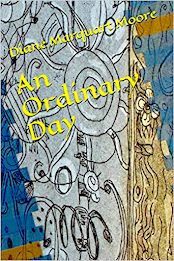
For approximately thirty years, I thought about becoming a poet, read a lot of poetry, and finally submitted a poem to The American Weave (now defunct) magazine, which published "My Father's Hands." The American Weave was a literary journal that paid me $18 from the Hart Crane Memorial Fund. Did I become a poet? No, this publishing event occurred in 1967, and I spent twenty more years reading and studying poetry and writing poems "underground." I did not return to thoughts about publishing poetry until 2008, when I moved to Sewanee, Tennessee. It is here that the biggest lightning strike in my life occurred, the flash in 2020 when I wrote Ridges, now on sale*. It's a book featuring my poems that accompany Don Thornton's wonderful paintings of Louisiana chenieres.

And so much for rain-inspired blogs and "come lately" poetry books. Tomorrow the weather may be sunny.

My latest book of poetry, Ridges, is available from me at P. O. Box 3124, Sewanee, Tennessee 37375 and from Pinyon Publishing, 23847 V66 Trail, Montrose, CO 81403. 


Friday, April 23, 2021

PINYON REVIEW 19, SPRING 2021, LIMITED EDITION

Chenier, a glass piece by Karen Bourque


This pocket-sized literary and art journal is another hand-sewn treasure produced by talented Susan Entsminger, editor/publisher of Pinyon Publishing in Montrose, Colorado. Susan, who began her artistic work alongside her husband, Gary Entsminger, (deceased) a decade or more ago, has continued designing and producing unique poetry and art books since Gary’s death. She has expanded this independent press's list to include international writers, photographers, and artists.

Susan has added poetry to her painting, drawing, and design repertoire in this issue of Pinyon Review 19 with an introductory poem entitled “Cured.” As I read the poem, I imagined the voice of my former editor (Gary) speaking to Susan: “She only heard/one message from the other side/he said, do not waste your joy/Sun on snow… Crows kept calling on the telephone wire/long after she had forgotten his number…” While reading author bios in this issue of Pinyon Review, I also discovered that Susan has been publishing poetry in Mudfish, Main Street Rag, and SAL. As I read, I envisioned Gary agreeing that she hasn’t “wasted her joy.”

In this hand-sewn edition, the poets Susan showcased  include renowned Luci Shaw, whose “Wishing Flower” is a poignant verse featuring a small child who observes “…dandelions proliferated enough/to cover the field with a tablecloth of gold/stars blowing in the wind…” Shaw, a long-time contributor to Pinyon, is Writer in Residence at Regent College, Vancouver, and received the 2013 Denise Levertov Award for Creative Writing.

I’ve had sporadic correspondence with the poet, Chuck Taylor, former Creative Writing Coordinator at Texas A&M who operates Free Slough Press. Chuck, also an accomplished photographer, contributed four lovely nature photographs, “Seeing More Than You See,” in this issue of Pinyon Review. He showcases his photographic work through shows in galleries, literary magazines, and on the web.

My dear friend, Karen Bourque, contributed a glass rendering of Ridges, my recent book of poetry and Don Thornton’s paintings published by Pinyon. The art piece features chenieres of Louisiana that publisher Susan describes as “vivid, visceral paintings.” Karen used stained glass, Apache tear, and kyanite to create her portrayal of the chenieres. It’s an arresting art piece that accompanies selected poems from Ridges, my book Susan will release in May.

Four haiku by Gary Hotham, a long-time contributor to Pinyon Publishing, will delight readers of “Dark Matters, ” a quartet about “early stars/fireflies changing/places.” Hotham is the Vice-President of the Haiku Society of America and has received several book awards for his haiku contributions.

As I said earlier, Pinyon #19 is a treasure created by Susan Entsminger, from the cover art and design of the High Country, Ouray Colorado to the last untitled poem by Simon Perchik “…in ashes, making room on the stove/in rest by a river/where there was none before.”

Limited Edition. Order through Pinyon Publishing, 23847 V66 Trail, Montrose, CO 81403


Wednesday, December 2, 2020

RIDGES IN GLASS

Cheniere glass art by Karen Bourque


I have the good fortune of owning fourteen glass pieces created by Karen Bourque, the masterful glass artist of Church Point, Louisiana. Many of these pieces have been photographed for the covers of my books of poetry and now hang on the glass porch of our Celeste residence here in New Iberia, Louisiana, and in the windows of our home on Fairbanks Circle in Sewanee, Tennessee.


Karen’s latest glass piece is her interpretation of a Louisiana Cheniere, or ridge, and will be featured in the spring edition of Pinyon Review along with several of my poems. The featured poems derive from Ridges, a book of my poetry that Pinyon Publishing will publish this summer.


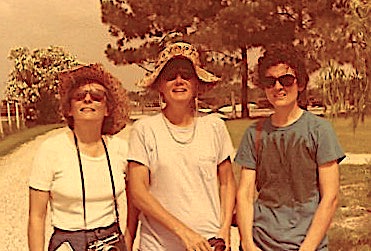
Karen’s latest piece is a beautiful work of stained glass, Apache Tear, and Kyamite that she created this year. It now hangs on the glass porch of my home here in New Iberia, Louisiana. As I look at the purple sky overhanging a cheniere, I’m lifted out of the Covid doldrums and remember a brighter day's visit I made to Cheniere au Tigre many years ago when three female companions and I traveled by boat to this site.


Diane on way to Cheniere au Tigre

Karen’s renderings always evoke strong emotional responses in me. A unique non-traditional glass artist, she creates most of her work in a studio beside the Bourque home that she shares with the former poet laureate and humanist, Darrell Bourque. Before the dreaded Covid caused me and my friends to sequester ourselves, I often visited there.


Karen’s work is featured in the Ernest Gaines Center at the University of Louisiana at Lafayette, in a window depicting the Holy Spirit at Christ the King Roman Catholic Church near Opelousas Louisiana, at the Louisiana Book Festival, in an issue of Pinyon Review, and many other venues and homes.


As the maxim reads, “One picture is worth a thousand words,” and this photo of Karen Bourque’s latest rendering affirms that critique. Briefly said, her work is a spiritual experience. 


Monday, June 25, 2018

OLD RIDGES


Some mornings I get up wanting to write and feel a certain fogginess of mind and absence of subject matter that reminds me of E. B. White and his essay of “Writer at Work.” In March of 1927, he wrote that Edna Millay was contemplating a trip to Washington, D.C., and he quotes a Washington news story: “to have this tender poet here in cherry blossom time and to hear her version of this glorious spectacle [would be great].” E.B. White, who is obviously struggling to create his essay for the day, remarks that “Even the theme is laid out for her, like clean linen.”

E. B. White says that a writer is always straining his eyes, peering ahead and around so that when the moment of revelation comes, his eyes are poppy and tired and his sensitized mind has become fogged by the “too frequent half-stimuli of imagined sight…”

I sat here, reading those lines, waiting for my mind to clear, and wondered if there were new ridges there that prevented clear thoughts. What appeared to me was an actual vision of ridges —chenier ridges south of the Intracoastal Waterway in Louisiana. I could almost smell the marshy air and see oak trees in the distance — old beach ridges or cheniers. The sand in the ridges is above the marsh so that oak trees abound in the dry soil there. According to an entry in Roadside Geology in Louisiana by Darwin Spearing, the ridge, Little Chenier, marked the position of a beach 2800 years ago. The town of Creole is strung out along another chenier where Chenier Perdue, 2500 years old, and Pumpkin Ridge, 2200 years old, merge.

The largest beach ridge plain in Louisiana is near the Caminada-Moreau Coast with as many as 70 sandy beach ridges that began to grow about 700 years ago. Of course like much of Louisiana coastland, the Caminada-Moreau coast continues to erode.


I’m more familiar with the ridges near Creole, Louisiana because I explored that territory when I was writing my book for young adults entitled Kajun Kween. Those ridges provided the setting for this tale about a young girl named Petite Marie Melancon who wasn’t so petite and who became the heroine in a comic strip. I have an envelope of photographs showing scenes of cheniers that includes a beautiful one which Dr. Sullivan snapped, and I framed for a wall of my study. There’s even an alligator in a corner of the photo, and it’s a scene that has not only inspired me while I was writing Kajun Kween, it became the cover of a book of. poetry entitled Old Ridges in which the opening poem describes the scenery I encountered back in the early 2,000s. 


Although the theme wasn’t “laid out for me, like clean linen,” as E. B. White wrote, my nostalgic thoughts sent me to the bookcase where I found Old Ridges and began to read:

OLD RIDGES

Writing a story of persiflage
I found a place of legend,
a station of shade 
cool enough to wade in,
no voice, no sound,
an alligator hiding on the bank
sliding into murky water,
breaking the silence and the shade.

Further back, I could see ancient ridges,
oak groves, wild grapevines overarching
marshmallow, yucca, and oleander,
some distance from the Intracoastal Canal
where I once rode in a boat
bound for Cheniere au Tigre,
weaving through a network of canals
and anchoring at a wooden dock
that may have been near the old town.

We climbed an old-fashioned stile
astride a barbed wire fence,
searching for an abandoned hotel,
and found: the bones of a cow,
the feather of a crow,
the leaf of a toothache tree --
mystery.

Old oaks stood sentinel, asking:
Do you think it’s too late?
I haven’t forgotten how it is
to die before dying,
consider my age,
consider this shade,
no voice, no sound.

What was I looking for?
The corpse of a cowboy lying
among bones of Brahma and Charolais?
a chest of Lafitte’s treasure?
the old watchtowers of WWII?
the tiger that mauled a boy a century before?

Hackberry trees grew among stands of oaks
and in the center of one grove,
a house of silvered cypress, 
torn screen on the sagging porch,
door ajar, as if someone had just departed,
the abandoned house among trees
buffeted and twisted by Gulf winds.
Like the trees, it seemed to say
I haven’t forgotten how it is
to die before dying,
consider my age,
consider this shade,
no voice, no sound

and a tiger lurks over the ridge.


Wednesday, January 4, 2017

CHENIERES, BEACH RIDGES

Cheniere by Don Thornton

I have many pieces of art by regional artists in my home, and among my favorites is a small painting of a cheniere by the deceased artist/sculptor Don Thornton of New Iberia. Don gifted me with the painting years ago after I'd written several articles about him for regional publications. He did a series of paintings of the Louisiana Cheniere Plain which extends from Sabine Lake to Vermilion Bay along the Gulf Coast, and my prized painting is #64 in this series. I was drawn to the painting a few days ago when a heavy storm forced me to stay indoors and enjoy my book and art collections.

I became familiar with chenieres almost forty years ago when I joined a group of four females who set out one humid summer day to find Cheniere au Tigre in Vermilion Parish, Louisiana. We embarked from Intracoastal City in a speedboat piloted by Dr. Victoria I. Sullivan, a biologist at the University of Louisiana at Lafayette who was armed with a pile of maps by which she attempted to guide us.  Although I'm not sure we found this famous site that was advertised as a summer resort in the early 20th century and which offered tourists room and board for $1.50 per night at that time, but we did hike through a wood of old live oaks that topped the sandy ridges of the Cheniere Plain. A Cheniere Plain consists of a beach ridge separated by marsh and swamp vegetation, and is often wooded; in fact, the word is derived from the French word, "chene," which means "oak" to designate the ancient oaks growing on the ridges.
Explorer, Cheniere au Tigre

Several books have been written about Cheniere Caminada, a cheniere adjacent to New Orleans that was destroyed by a hurricane in 1893. This cheniere was settled by the Chitimacha Indians, and because of the oak grove at the tip of the peninsula, it was called an island. Early settlers of the cheniere included Lafitte's privateers, among whom was an Italian named Vincent Gambi who raided any vessel he sighted in the Gulf. Descriptions of his exploits and of the famous hurricane are recorded in a volume entitled Cheniere Caminada, Buried at Sea, by Dale P. Rogers. It's an account of the tidal wave and hurricane that killed 2000 people living on the island in 1893 and includes photographs, maps, and drawings depicting the disaster. Some of the remains of buildings the hurricane did not totally destroy were salvaged and reused, one of which is the Curole home later occupied by the descendants of the Curoles in Cut Off, Louisiana.

Chenieres appear in my young adult book, The Kajun Kween and also in a book of poetry entitled Old Ridges. The photograph on the cover of the latter, by Dr. Victoria I. Sullivan, is among my favorite photos of Louisiana, and if readers look carefully at the bayou pictured, they may sight an alligator snoozing on the bank.

The following verse is extracted from the poem, "Old Ridges," which is the lead poem of Old Ridges and alludes to the famous Cheniere au Tigre trip that four adventurous females took too many years ago:

"...Hackberry trees grew among stands of oaks
and in the center of one grove,
a house of silvered cypress,
torn screen on the sagging porch,
door ajar, as if someone had just departed,
the abandoned house among trees
buffeted and twisted by Gulf winds.

Like the trees, it seemed to say
I haven't forgotten how it is
to die before dying,
consider my age,
consider this shade,
no voice, no sound...
and a tiger lurks over the ridge."