Showing posts with label E. B. White. Show all posts

Tuesday, May 4, 2021

ABOUT "LITTLE ESSAYS"


Fourteen years ago, I began writing blogs, or as two of my friends called this medium, "writing essays." When I think back to the inception of "A Word's Worth," I hear those two voices urging me to record short pieces about people and events, "exploring the fullness of life," as Rebecca Dale said of E. B. White's essays in The New Yorker. Some weeks I hear the "thud of ideas" White described as the action of his Muse. On other days, I hear the roll of thunder without the lightning of ideas.

Today is noisy enough with occasional thunder rolls, but the lightning flashes are confined to memories. And that's OK because most subject matter in my on-the-cusp-of 86 years old mind lies in the depository of memories. This rainy day I probe the memory of my decision to become a poet.

I was in the sixth grade and had returned to civilization after my father's great folly about the family becoming gypsies via tent camping, sleeping on roadside park tables, bathing in rivers en route to California in 1946. I was eleven years old and sighed in relief when we returned to the small southern town of Franklinton, Louisiana. There, I decided to become a poet in my sixth-grade classroom filled with what I called "country people" (offspring of farming parents). I'd been reading in a sixth-grade reader and delighted in a section on poetry. "I can do that," I thought, and promptly wrote a few lines about my new home: "away from the town's noisy din/from the roar of the cotton gin…" I wrote this following the example of my mother's hero, Robert Louis Stevenson. It's one of the very few rhyming verses I've left to posterity. Well, it does sound a bit better than "A birdie with a yellow bill/hopped upon my window sill…."

For approximately thirty years, I thought about becoming a poet, read a lot of poetry, and finally submitted a poem to The American Weave (now defunct) magazine, which published "My Father's Hands." The American Weave was a literary journal that paid me $18 from the Hart Crane Memorial Fund. Did I become a poet? No, this publishing event occurred in 1967, and I spent twenty more years reading and studying poetry and writing poems "underground." I did not return to thoughts about publishing poetry until 2008, when I moved to Sewanee, Tennessee. It is here that the biggest lightning strike in my life occurred, the flash in 2020 when I wrote Ridges, now on sale*. It's a book featuring my poems that accompany Don Thornton's wonderful paintings of Louisiana chenieres.

And so much for rain-inspired blogs and "come lately" poetry books. Tomorrow the weather may be sunny.

My latest book of poetry, Ridges, is available from me at P. O. Box 3124, Sewanee, Tennessee 37375 and from Pinyon Publishing, 23847 V66 Trail, Montrose, CO 81403. 


Tuesday, October 8, 2019

SUNSHINE


Author Margaret Simon knows the hearts and minds of young people, as is evidenced in her forthcoming book, Sunshine, to be released by Border Press Books. She demonstrates knowledge of their feelings and behavior in her middle-grade novels about Blessen LaFleur, the heroine of the Blessen series that features a spirited and caring child who lives near the rusty Bayou Teche in southwestern Louisiana. Simon, who has been an elementary school teacher for over thirty years and who now teaches gifted children in Iberia Parish, Louisiana, possesses unusual insight into the lives of those about whom she writes. Her first book about Blessen introduced readers to a heroine who struggles to find joy within the dysfunctional family into which she was born and who proves herself to be the supreme mistress of misadventure. Darrell Bourque, former poet laureate of Louisiana, praised the novel as a “cross between a fairy tale and wisdom literature.”

Simon’s second book, Sunshine, A Blessen Novel, again features Blessen, who has taken on the responsibility of raising a hen she calls Sunshine and, simultaneously, a homeless child named Harmony. Blessen feels she needs to save Harmony from a foster home where she has been placed and neglected. When Sunshine becomes a broody hen, Blessen is forced to get help from her teacher, Ms. Fullilove, to appease the hen, but the care needed for Harmony, an enchanting child Blessen encounters, eclipses her caretaking of this pet. Harmony is a twirling seven-year-old who talks in rhyme most of the time. Of course, the two girls, who call themselves “guardians of nature,” propel themselves into an adventure, running away from home and hiding near an abandoned convent alongside the Bayou Teche, but the unwise decision Blessen makes is resolved in a surprise ending, and young readers will find themselves wanting even more exciting chapters in the life of Blessen…and now, Harmony.

Simon features characters that resonate with authenticity; e.g., Blessen’s brief narration about herself: “All this time, in my life of eleven years, I thought I was white, and come to find out, my father was black as night. My tan skin and big wide nose come from my father’s side, along with my unruly nappy hair; Momma gave me her green eyes and strong will…” Her deceased grandfather: (Pawpee) “Even in his wheelchair, Pawpee was a handyman and master gardener. He saved enough money for Momma to make a down payment on a doublewide with central air. Thanks to my sweet grandpa, I now have my own room and my own bathroom…” And Mae-Mae, her grandmother: “Mae-Mae was the rock who held us all together. She told me then and there that God saved me for a purpose. I was reborn. I was fulfilling my name, Blessen, being a blessing to them all…”

However, Harmony emerges as the primary character in this new story about Blessen, “swirling off the porch, a young black girl [who] swoops like a hawk to my side. She wears a tattered pink dress that’s too short for her long skinny legs. Her skin is as dark as a moonless night, her hair plaited in braids close to her scalp.” Harmony speaks in rhymes that reminded me of the children’s story about the “churkendoose,” a creature who dismays fellow barnyard creatures with his rhyming speech but who becomes a hero because he chases a predatory fox out of the barnyard. Harmony introduces a nonsensical element in this novel; e.g., her wordplay: “You’re pretty as a daisy in Maysy!/Daisy, Mays,/won’t you look at me/twirling like a dancing girl/ready for a partee.”

Simon’s descriptive abilities are evident in each chapter and showcase her powers of observation: “I stop talking and look out across the fields of high sugar cane. Stalks of long, green leaves sway in the wind. We pull behind a cane truck with its yellow triangle ‘Slow’ sign shining on the huge metal basket filled to overflowing with burned stalks…” She tells of the makeshift quarters that Harmony calls home: “The window near the door is open wide, no screen or curtains. I peek inside. There’s no furniture in the room. The hardwood floors are dusty. Two makeshift beds, pallets of blankets and pillows lay in the corner. A small doll sits on one blanket, naked with frazzled plastic blond hair. The doll winks at me with only one eye open…” That vivid last line captures the unkemptness of Harmony’s quarters and underlines Simon’s talents as a writer who is master of concrete detail. 


Children’s literature is Simon’s forte. In Sunshine, as in Blessen, there are no “heavy, cluttery phrases,” as E. B. White says. The language is true and clear, the characters well developed, action consistently moving the readers through suspense with a balance of humor and serious intent, and wisdom is imparted without the writing impinging on didactic. Much of our adult morality in children’s books, White says, has “a stuffiness unworthy of childhood,” but Simon’s characters don’t overpower young readers with lessons in character building. Sunshine is a delightful, spirited work about an unusual family that, despite its dysfunction, manages to convey a message of faith and love, grace and whimsy. It’s Margaret Simon at her best.


Monday, August 26, 2019

A RAINY DAY — Dismal?

Figure lurking behind tree?

My favorite essayist, E. B. White, once penned a short column for The New Yorker in which he reported that the weatherman had forecast the day as one that would be “rainy and dismal.” White said he regarded that forecast as one that produced the demise of the era of pure science and the dawning of the day of philosophical science. Dismal? Perhaps for the philosophizing forecaster. White further said that this forecast showed the weatherman had been spending too much time indoors and “to the intimates of rain, no day was dismal and a dull sky is as plausible as any other.”

Today is a rainy day on The Mountain here at Sewanee, but it isn’t a dismal one. The plants have been thirsty for far too long, the last of the corn crop in the valley needs watering, and I’m not into predicting the impact of rain on the human spirit like the weatherman in New York. The stony ground here is drinking noisily. Unlike the muddy ground of my native Louisiana, we seldom experience flooding at Sewanee, but continuous, heavy rain sometimes causes trees to loosen their roots and fall.

I looked out this morning and saw darkened tree trunks, thinking how happy they appeared to be after showering all night. At breakfast, I went to the dining room window and saw what seemed to be a shrouded figure hiding behind a white oak, but the dark figure turned out to be only part of the tree that had lost a branch. (Evidently, we’ve been watching too many mysteries on television that probably influenced my first impression of a figure lurking behind the tree).

I looked for birds that seemed to have disappeared from our yard during the last few weeks and which we’ve tried to lure on site with filled bird feeders, but they’re still absent from the woods behind us. Yesterday, we saw two giant crows grazing in the back yard and wondered if they had scared the smaller birds away just as they’d attacked a squirrel on the fence. My friend Susan Entsminger in Colorado says that perhaps the birds have begun their winter migration already, and I’m hoping that such a natural occurrence has taken them away. 

Sister Hannah at the Convent of St. Mary asked for permission to read one of my bird poems for an environmentalist program she’ll coordinate this winter while we’ve flown further south, and I was pleased to pass it on after she reminded me the poem had appeared in my book, All Love. It’s called “Watching the Wrens”:


Where have they gone?
Infant wrens, directionless,
fluttering into a blue ocean,
their mother pushing, telling them
to expect welcomes from the unseen.

The nest now an untidy hanging,
twigs, leaves, declarations of love
twisting in the wind
beneath green painted eaves,
secure and shadowy.

Them thinking how good it was
to be fed, making noises
to call someone home,
hoping nothing would change
if they opened their beaks

and received the message:
soon she will let you go,
and you must let her go,
singing as if you knew
where you are going… 


Tuesday, June 18, 2019

FOUR RAVENS


I was reading E. B. White’s One Man’s Meat yesterday when Four Ravens, a book of poetry by my friend and editor Gary Lee Entsminger, arrived. I had just finished reading about White’s wife complaining that she didn’t quite understand poetry, and he told her that a poet’s pleasure is to “withhold a little of his meaning, to intensify by mystification, zipping the veil from beauty but not removing it.” Entsminger’s new book of poems certainly bears out White’s assessment of poetry while reminding us of his awe for nature and organisms and, at the same time, embracing metaphysical thoughts in many of his musings.

I particularly liked Entsminger’s poems about his wife, Susan, who is an artist and who drew the raven on the cover of Four Ravens and sketched this bird in simple line drawings throughout the book. In “Second Reality,” Entsminger reveals the force of Susan’s work as an artist in a poem that shows his respect and devotion to his talented wife: “…sky reflects through the window/smudges resemble puddles/bright yellow circles simmer/like sunflowers six feet high./…When did she realize her sketches/said something words cannot explain/as objects came together without touching/the way they once reigned.” 

The Entsmingers live in a rustic cabin on a plateau in Colorado and exemplify the philosophy of a “Thoreau-like” life, doing tasks that the modern world would call drudgery, including the task of cutting wood. For a winter fire that Susan performs in the poem “Oak,” as husband Gary watches: “Paté done he glances out the window/sees the girl still building trail/work not easy but satisfying/attention focusing her energy/as the waning light casts/shadows of unfamiliarity/she picks up her tools/and goes to the woodpile/stacks the oak/looks at him/through the window/already smelling smoke.” Such poems often concentrate on every day, revealing the couple’s devotion to sustainability and uncomplicated dramas that occur in their daily life together.

Another poem that exemplifies Entsminger’s concern for the environment and objection to a chemical that has proven to poison human life on a large scale is one entitled “In Murdoch’s Ranch and Home Supply,” in which the poet speaks out about Roundup, “buckets and thickets/poisoning everyone/around him…long ago people here/knew to grow/sun-loving crops/in a leafy moon/roots herbs berries/learning how to eat.” 

In “Guide,” readers could surmise that Entsminger is inspired to portray his wife at musical play (Susan also composes and plays guitar and other string instruments): “Bare shouldered/mountain maiden/plucks melodious/strings of sunshine/drawing the youth/who listens/to her paintbrush/glistening/in a meadow/he has climbed to/dawn after dawn/Knowing he’s there/she stops playing/sets aside her psaltery.” The imagery in this spare poem is reminiscent of a long haiku, another rich drama in everyday experience.

Gary’s oeuvre is not without wryness in the pithy lyrics entitled “Cowgirl” placed within the opening pages of Four Ravens, when a mysterious woman roams mountain slopes: “misplaced perhaps/or meant to be/alpine chic/and lengthy curves…in this gentle range/no one spends/their lives/on indifferent things/she rises now and sings/as the cows look up/still chewing patiently/ready to follow her/down to the milking/She looks across the meadow/seeing something we don’t see/and tips her hat to me. “

This book is the second collection of poetry Gary Entsminger has published and contains new work as well as older poetry that adds to an abundance of original nature lyrics and existential musings that constitute a profound volume of rewarding reading. 

Four Ravens is available from Pinyon Publishing, 23847 V66 Trail, Montrose, CO 81403 (www.pinyon-publishing.com).


Saturday, June 8, 2019

TIME WAS, TIME IS…


In E. B. White’s Writings From the New Yorker, 1927-1976, White includes an essay entitled “Disillusion” in which he writes about aging humans hanging onto or “groping toward things that give us a sense of security.” He names clocks in telegraph offices as vanguards of the correct time, and when he passes a clock in a telegraph office that has lost time, he feels that life is slipping away from him. This entry was written in 1929, but it carries the same message for me 90 years later — a thought underlined in a quatrain of The Rubaiyat of Omar Kayaam: “Whether the cup with sweet or bitter run, the wine of life keeps oozing drop by drop; the leaves of life keep falling one by one.”

Unfortunately, I’m a time watcher, and I think at 84, it’s too late for me to develop a new behavior unless this behavior slips up on me when I’m not looking at clocks. There are five clocks in our house here in Sewanee, Tennessee, not including the clock on the computer and in my iPhone, and the only one I feel I can count on, like White’s clock in the telegraph office, is my iPhone. However, I use these clocks for a variety of activities. The clock radio in the bedroom is fast, so this means I can sleep ten minutes longer (I don’t have to punch in at an office but am shame-faced if I’m not at my desk at 8 a.m.). Two clocks in the kitchen advertise two different times: the one on the stove is a bit early and announces breakfast when I’m really hungry; the other on the opposite wall is ten minutes behind the correct time and means I still have time to dawdle before breakfast preparations begin... and so on. 


My good friend Janet Faulk-Gonzales, who, bless her, always manages to be late, often reminds me that too much emphasis on heeding time could bring disastrous results similar to what she refers to as “walking off the porch,” a story that appeared in a book entitled Porch Posts we co-authored several years ago. 


Painting by artist Paul Schexnayder for Porch Posts

Painting by artist Paul Schexnayder for Porch Posts


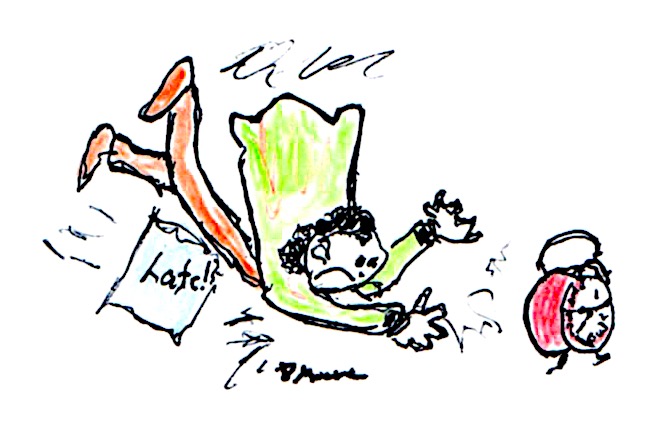
In the essay, “The Pacing Porch,” I relate how I obsessed over being on time for school every morning while my brother and sister chanted “Hup two, three, four, hup two, three, four,” and I paced the front porch in a frenzy until I walked right off the porch, treading air for a few moments before falling with a loud thunk. I was nine years old at the time, and ‘though this event chastened me and my impatience for a day or so, I was back at it a few days after the “flying high” moment. I never fell off again, but I figured out how many paces I could make before reaching the dangerous edge.


Diane's sketch for blog Time Was, Time Is...

Diane's sketch


Although there’re many synonyms for time; e.g., flash, spell, instant, jiffy, twinkle, wink, etc., my favorite is “jiffy,” which resonates with my translation: “joyfully on time.” I’m one who couldn’t abide using such an instrument as an hourglass —what if the sand got damp? Or someone gave me a genuine cuckoo clock from Switzerland and visited often to see if I had hung it even though I was made nervous by such a loud announcement of an entire hour gone forever? The silent, digital hands on a cell phone keep me attuned to movements of day and night in the revolving universe and suit my time watch quite well.

Let’s face it — some people watch second hands; some people  watch minute hands; and some people watch hour hands on the clock. Then, some people lose all sense of time, and the latter isn’t in my DNA. It’s now 9:37 a.m., and I’ll end this reflection on the passage of time by 9:38. Whew, I made it!


Wednesday, May 22, 2019

RUMINATIONS ON WRITING

There are times when writers of any genre get up in the morning, primed to write, go into their writerly lairs, turn on their computers and…and end up staring into space looking for the sun to appear and shine in their brains. On such occasions, many of us resort to writing about writing and feel mildly satisfied that we’ve been vigorous enough to produce a few sentences. 

Today is such a day, and I’m armed with tools I read about in a recent article concerning composing poetry. The poet said that he got first draft results from writing with a fountain pen — a good one — in a journal containing high quality paper and, sometimes, from using an old manual typewriter. So, a friend gave me a quality fountain pen (no, not a Mont Blanc, but a good pen) for my birthday, and I bought a moleskin journal a la Hemingway style with graph paper lines and for awhile, the fountain pen produced a fountain of language. I haven’t purchased an old Olivetti like the one I used in Iran when I wrote columns to send back to a newspaper in New Iberia, Louisiana, but this morning’s bout with writer’s block has inspired a search for the typewriter.

In the foreword to Strunk and White’s 4th edition of The Elements of Style, Roger Angell tells of E.B. White’s Tuesday morning battles with words for White’s “Notes and Comments” column that appeared in The New Yorker and how he was often silent and preoccupied at lunch time, excusing himself early to get back to working on this column. “He rarely seemed satisfied,” Angell writes. “It isn’t good enough,” White said at times. “I wish it were better.” I might add, would that any writer could compose such pithy, humorous, and wide-ranging topics once a week for fifty years!

Angell also says that although White’s prose was celebrated for its ease and clarity, he had to be eternally attentive to style to maintain that celebrated standard. Early White essays showcased what Rebeca M. Dale regarded as “life’s little adversities — short, frothy, witty, even sometimes flippant, articles,” but his later pieces became longer and more serious. In either case, White was a dedicated author who for more than fifty years, practiced his craft despite mornings when he felt dissatisfied with the finished product.

When I was writing Their Adventurous Will: Profiles of Memorable Louisiana Women, I interviewed Shirley Ann Grau, author of The Keepers of the House, a book that won a Pulitzer Prize, and she confessed that she often cooked to avoid beginning any writing. She further explained that writing was “making a structure,” an art that required work and honing of technique.

Oh well, my trouble with blank spaces this morning could be worse. E. B. White says that “life is apt to be translated more accurately by a person who sees it break through the mist at unexpected moments, a person who experiences sudden clear images…his eyes are poppy and tired, and his sensitized mind has become fogged by the frequent, half-stimuli of imagined sight…he knows he must invite his soul…” And, White quips, “especially when he has received a thousand dollar advance from a publishing house.” 

We writers should all have the latter problem! Meanwhile, I think about purchasing an Olivetti manual typewriter and walk out on the porch to ruminate on Sherwood Anderson’s words: “Writing is not an occupation.”


Wednesday, January 3, 2018

WINTER

Friends think I’m stretching the truth when I say that I lived in a place where the temps dipped to 52 degrees below zero in January 1954. This morning, people in that place — Limestone, Maine — are experiencing only thirteen below zero, but their winter won’t be over until May. I know because in May of the year I experienced the 52 below zero temp, I went outdoors wearing a short-sleeved shirt. Sub-zero weather lasted long enough for me to memorize most of the quatrains of the Rubaiyat and listen to recordings of Tchaikovsky’s music so much that I could hear the music reverberating in my mind even when the little 45 rpm record player wasn’t turned on. What became apparent to me is the same thing that became apparent to me while living in the desert province of Khuzestan in Iran — people who live in extreme climates had better develop a gracious plenty of indoor pursuits. 


Right now, temps in Louisiana have been in the 20’s, and winds from the north bluster over the swamps at 17 and 18 mph. We laugh when someone kids us about returning to the South from The Mountain at Sewanee, Tennessee to get warm. Temps at Sewanee hover around 7 and 8 degrees, and I receive e-mails from friends on The Mountain complaining about the hard winter. When I read them, I cite my famous statement about living in Maine during the winter that temps dropped to 52 below zero. It’s almost as good a line as the one that an old-timer tells school children about trudging a mile or so to school in the snow back when…

Many authors based, and still base, their writing habitats in wintry Maine: Henry Wadsworth Longfellow, Sarah Orne Jewett, Edna St.Vincent Millay, E. B. White, Stephen King…Sarah Orne Jewett remains among my favorite Maine writers. I didn’t visit her home place in South Berwick, Maine because I was rather isolated in northern Maine, but I discovered The Country of the Pointed Firs, a series of sketches written about New England life, in a Limestone library while I lived in Aroostook County, Maine. In this volume, Jewett talks about the “unchanged shores of the pointed firs, the same quaintness of the village with its elaborate conventionalities, all that mixture of remoteness, and childish certainty of being the center of civilization of which her affectionate dreams had told…”

Jewett lends a kind of romanticism to the stark winter I spent in Limestone; however, truth told, an old oil stove and an electric blanket were my only defenses against the wind that whistled under the eaves of a two-story farmhouse in which we lived. No heat in the bathroom; no heat in the bedroom; no garage to keep the block from breaking in an ailing Mercury station wagon; meatless meals and much beans-and-potatoes fare; no washer/dryer and lots of washing clothes in the bathtub of cold water. I have a long list of discomforts, but oddly enough, over forty years later, I began to write a novel entitled The Maine Event and last year, I had the novel recorded by a professional reader and put on Audible. As I listen to it, I find that the descriptions of the area and the primal forces of nature loom larger than the story, but, no matter, I enjoyed relating the memories of that winter of the 50’s.

I lived near descendants of Acadians who settled in the St. John River Valley after being exiled from their homeland by the British. Their homeland Acadia had been renamed Nova Scotia by the British in 1710 which ended one hundred years of war between the British and French in North America. New France consisted of the colonies of Acadia, Louisiana, and Canada (Quebec). The St. John River had been a prime communication route between Port Royale, Acadia, a port from which some of my ancestors departed! I had no knowledge of this family association when I lived in Maine or perhaps I’d have been more interested in the history of Aroostook County. In my readings today about this history in Land of Promise edited by Anna Fields McGrath, I discovered an arresting sentence: “The Acadians remained dominant due to their very large families, economic control, and stubborn adherence to oral traditions and melancholic memories…” And why was I not surprised at that description of the Acadians?!

Meanwhile, the temps have risen to 31 degrees in New Iberia, Louisiana and dropped to 9 degrees below zero in Limestone, Maine, and I am happy to be reminiscing rather than living in the harsh “Land of Promise” first inhabited by humans 11,000 years ago.


Monday, September 18, 2017

FELLOW PORCH DWELLERS


A few years ago, my friend Janet Faulk-Gonzales and I wrote a book, Porch Posts, in which we extolled the virtues of porch sitting. Here on The Mountain at Sewanee, Tennessee I often sit on a small front porch and write. Usually, I am a solitary dweller, but this morning I was joined by several spiders, one of which may have been a Wolf Spider, a big hairy thing that is rumored to have a painful bite, and I wasn’t enchanted by the company. In fact, I killed it — without remorse, I might add.

I know that spiders inhabit the pages of many famous writers — the talking spider that makes clicking noises in Harry Potter and the Chamber of Secrets by J. D. Rowling; Charlotte, the spider who talks to a pig in Charlotte’s Web by E. B. White; Shelob, the giant spider in J.R.R. Tolkien’s Lord of the Rings, and out of the childhood of most of us whose mothers read us nursery rhymes: the critter that scared Little Miss Muffet when she was trying to eat her breakfast. I have no fondness for any of them. We have spider pest control but as we live in a small wood, our spider population is often abundant, even though the bug man visits monthly and brings in a giant swifter to sweep away nests, eggs, and the persistent spiders.

I console myself that spiders do eat pest insects like the mosquito that abounds in south Louisiana where I live part of the year, but I don’t see as many of them in Teche country as I do in Tennessee. In fact, the pest control workers here publish a list of common Tennessee spiders that might cause you pain. Among them are the brown recluse that gets the worst press of all in the spider kingdom; the black widow with its red hourglass marking; and the wolf spider that I did away with this morning.

Some of these creatures have eight eyes; some, six, but the wolf spider only has a pair of large eyes that were watching me this morning. Did I get any writing done out on the porch after I sent the wolf spider to meet his maker? Not much. But I did look up a poem about spiders by one of my favorite writers, Don Marquis, who wrote: "…I will admit that some/ of the insects do not lead/ noble lives but is every/ man’s hand to be against them? Yours for less justice/ and more charity." This was signed by aArchie the cockroach, Marquis’s major character (along with Mehitabel the alley cat) who appeared in his newspaper column in New York City’s The Evening Sun.

Sorry that this is so abbreviated but I dared not invite the Muse this morning as She usually keeps better company.


Sunday, January 8, 2017

SPENDING WINTER IN THE SOUTH?

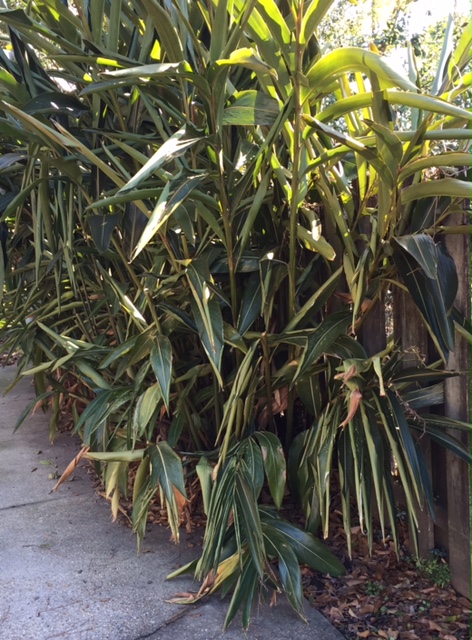
Twenty-six degrees outside. Winds out of the North at 15 mph. Icy rain. Wilted ginger leaves on the large plant beside the drive. We can always tell how severe the winter has been by the death of the ginger plant; the leaves curl up in protest against unusual Louisiana weather. We leave Sewanee, Tennessee every year in late October, migrating to Louisiana in anticipation of warm winters. And here we are, looking out at silver-topped roofs gleaming with frost and at a drooping ginger plant.

Fortunately, the ginger is easily resurrected. We often throw its dead leaves into the coulee behind the house, and when we return the following year, they have become themselves again. This year, a resurrected plant by the drive had overtaken our neighbor's fence by the time we arrived in late October. It is (was) such a beautiful proliferation we named the apartment beside our house "The Ginger House."

We also planted three orange trees that have been draped with white sheets for three days now and are either smothered or near death. I get up in the night and frighten myself by looking out the window at shrouded plants. I'm accustomed to seeing frozen vegetation and late snows many times when I return to Sewanee in early spring, but winter scenes here have become almost an outrage. I suppose this kind of weather drives Eastern snowbirds to lower climes like Florida. Friend Vickie's family lives in a town called Frostproof because temps there have been kind to family orange groves most winters.

I think of the winter I spent in Limestone, Maine, a town near the border of New Brunswick, Canada — of a night when the temps dipped to 52 below zero and broke the block of an old station wagon we left parked outside because we didn't have access to a garage or carport...of the heat supplied by an ancient oil stove in the living room, and a bathroom sans heat of any kind...of snow piled as high as telephone wires beside the farm road that led to our apartment. In my memorabilia I have a picture of me, fresh from the dry heat of El Paso, Texas, hanging out the washing in a Maine November, the washing stiffening as I attached each clothes pin to the line... of living on Aroostook County potatoes the entire winter, not just because they were accessible but because Army pay didn't cover sumptuous meals...of winds that howled under the eaves of an old farmhouse and swept in through the cracks of a makeshift stairwell leading from the outside to our upstairs apartment.

I often wondered why people chose to live in that remote part of the country. When people think of Maine, they usually visualize its jagged coast, the hub of fishing and tourist industries. The famous environmentalist Rachel Carson spent many summers in Maine as she was attracted to the plants and animals on the Maine coast, which she wrote about in her first book entitled The Edge of the Sea. It was based on the many hours she spent observing tide pools along the Maine seashore. Artists Andrew Wyeth, John Sargent, and Winslow Homer produced colorful seascapes while working on their art in Maine. Interestingly, about 900 years ago, pale-skinned Norsemen with blonde hair landed in a rocky inlet of Maine and frequented the coast for 300 years. They attempted to establish a colony but their demise has been attributed to disease or raids by Abenaki or Wabanaki Indians.

In my novel, The Maine Event, I included scenes about the northernmost community of Madawaska on the St. John River, a town that schedules an annual Acadian Festival celebrating with food and music much like we do in south Louisiana. Two of my favorite authors were inspired by life in Maine: Sarah Orne Jewett who wrote that she was proud "to have been made of Berwick dust" (Berwick, Maine)...of the love of friend for friend and the kindness of neighbor to neighbor in this beloved town..." and E.B. White, the famous essayist I admire who spent summers in North Brooklin on Penobscot Bay, Maine.

From the not-so-warm South today to memories of Maine's north woods, I might as well be in an Arctic museum or at the foot of Mount Katahdin in northern Maine, but I'm probably safer here in New Iberia, Louisiana where 72-degree days are forecast for next week.