Showing posts with label Cheniere au Tigre. Show all posts

Wednesday, December 2, 2020

RIDGES IN GLASS

Cheniere glass art by Karen Bourque


I have the good fortune of owning fourteen glass pieces created by Karen Bourque, the masterful glass artist of Church Point, Louisiana. Many of these pieces have been photographed for the covers of my books of poetry and now hang on the glass porch of our Celeste residence here in New Iberia, Louisiana, and in the windows of our home on Fairbanks Circle in Sewanee, Tennessee.


Karen’s latest glass piece is her interpretation of a Louisiana Cheniere, or ridge, and will be featured in the spring edition of Pinyon Review along with several of my poems. The featured poems derive from Ridges, a book of my poetry that Pinyon Publishing will publish this summer.


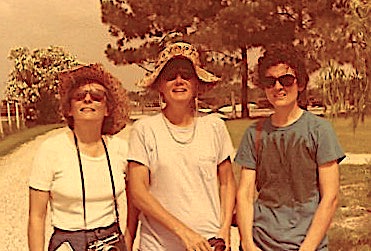
Karen’s latest piece is a beautiful work of stained glass, Apache Tear, and Kyamite that she created this year. It now hangs on the glass porch of my home here in New Iberia, Louisiana. As I look at the purple sky overhanging a cheniere, I’m lifted out of the Covid doldrums and remember a brighter day's visit I made to Cheniere au Tigre many years ago when three female companions and I traveled by boat to this site.


Diane on way to Cheniere au Tigre

Karen’s renderings always evoke strong emotional responses in me. A unique non-traditional glass artist, she creates most of her work in a studio beside the Bourque home that she shares with the former poet laureate and humanist, Darrell Bourque. Before the dreaded Covid caused me and my friends to sequester ourselves, I often visited there.


Karen’s work is featured in the Ernest Gaines Center at the University of Louisiana at Lafayette, in a window depicting the Holy Spirit at Christ the King Roman Catholic Church near Opelousas Louisiana, at the Louisiana Book Festival, in an issue of Pinyon Review, and many other venues and homes.


As the maxim reads, “One picture is worth a thousand words,” and this photo of Karen Bourque’s latest rendering affirms that critique. Briefly said, her work is a spiritual experience. 


Wednesday, January 4, 2017

CHENIERES, BEACH RIDGES

Cheniere by Don Thornton

I have many pieces of art by regional artists in my home, and among my favorites is a small painting of a cheniere by the deceased artist/sculptor Don Thornton of New Iberia. Don gifted me with the painting years ago after I'd written several articles about him for regional publications. He did a series of paintings of the Louisiana Cheniere Plain which extends from Sabine Lake to Vermilion Bay along the Gulf Coast, and my prized painting is #64 in this series. I was drawn to the painting a few days ago when a heavy storm forced me to stay indoors and enjoy my book and art collections.

I became familiar with chenieres almost forty years ago when I joined a group of four females who set out one humid summer day to find Cheniere au Tigre in Vermilion Parish, Louisiana. We embarked from Intracoastal City in a speedboat piloted by Dr. Victoria I. Sullivan, a biologist at the University of Louisiana at Lafayette who was armed with a pile of maps by which she attempted to guide us.  Although I'm not sure we found this famous site that was advertised as a summer resort in the early 20th century and which offered tourists room and board for $1.50 per night at that time, but we did hike through a wood of old live oaks that topped the sandy ridges of the Cheniere Plain. A Cheniere Plain consists of a beach ridge separated by marsh and swamp vegetation, and is often wooded; in fact, the word is derived from the French word, "chene," which means "oak" to designate the ancient oaks growing on the ridges.
Explorer, Cheniere au Tigre

Several books have been written about Cheniere Caminada, a cheniere adjacent to New Orleans that was destroyed by a hurricane in 1893. This cheniere was settled by the Chitimacha Indians, and because of the oak grove at the tip of the peninsula, it was called an island. Early settlers of the cheniere included Lafitte's privateers, among whom was an Italian named Vincent Gambi who raided any vessel he sighted in the Gulf. Descriptions of his exploits and of the famous hurricane are recorded in a volume entitled Cheniere Caminada, Buried at Sea, by Dale P. Rogers. It's an account of the tidal wave and hurricane that killed 2000 people living on the island in 1893 and includes photographs, maps, and drawings depicting the disaster. Some of the remains of buildings the hurricane did not totally destroy were salvaged and reused, one of which is the Curole home later occupied by the descendants of the Curoles in Cut Off, Louisiana.

Chenieres appear in my young adult book, The Kajun Kween and also in a book of poetry entitled Old Ridges. The photograph on the cover of the latter, by Dr. Victoria I. Sullivan, is among my favorite photos of Louisiana, and if readers look carefully at the bayou pictured, they may sight an alligator snoozing on the bank.

The following verse is extracted from the poem, "Old Ridges," which is the lead poem of Old Ridges and alludes to the famous Cheniere au Tigre trip that four adventurous females took too many years ago:

"...Hackberry trees grew among stands of oaks
and in the center of one grove,
a house of silvered cypress,
torn screen on the sagging porch,
door ajar, as if someone had just departed,
the abandoned house among trees
buffeted and twisted by Gulf winds.

Like the trees, it seemed to say
I haven't forgotten how it is
to die before dying,
consider my age,
consider this shade,
no voice, no sound...
and a tiger lurks over the ridge."