Showing posts with label Paul Schexnayder. Show all posts

Monday, November 18, 2019

IN THE TIME OF MISSION AND MIGHT


Yesterday, I went down to A & E Gallery here in New Iberia, Louisiana, to a reception and book signing for Margaret Simon of New Iberia, whose Sunshine, a notable middle-grade fiction book published by Border Press, just appeared on the market. (See the review of Sunshine on my blog, A Word's Worth).

However, when I walked over to the payment counter, I discovered more treasure from New Iberia’s growing body of artists/writers: In the Time of Mission and Might, the newest member of Paul Schexnayder’s children’s trilogy about Legacy Acorns. If I had found a beautifully illustrated children’s book like this one when my mother dropped me off to spend the day at the old Claitor’s Bookstore in Baton Rouge, Louisiana so many eons ago, I’d have been ecstatic, for to live within the imagination of Paul Schexnayder is to occupy enchanted space. 

The vibrant acrylic paintings, accompanied by his fanciful tale about animals, birds, and vegetation indigenous to Louisiana, had to be read aloud at my breakfast table. It is children’s fictionalization and visualization at its finest. Whimsical and dreamlike figures interplay throughout the story, and the informational, as well as playful text takes readers into a fantastical realm.

The illustrations alone in In The Time of Mission and Might will transport young readers into an adventuresome place where Lilla Cornflake (I love Schexnayder’s namings), a care-taking doe, makes a startling discovery when she unlocks the front door of the Live Oak Museum. Legacy Acorns that were produced by only one Live Oak tree in nine coastal states had become museum pieces, and they’ve been stolen from their glass case within the museum. Professor Morton Sterling Flynn, an eminent archaeologist, is brought in to investigate and solve the case, but, of course, he encounters a formidable obstacle. I’ll only hint at one of any reader’s worst nightmares: critters that slither and hiss! 

As Schexnayder does in the two former books of his trilogy, the problem of stolen treasure is resolved in a just and charitable conclusion within the walls of the Joy and Wonder Orphanage sans Schexnayder conveying overpowering moralism, but he communicates the kind of ethic Johnny Gruelle once showed in his children’s stories about the iconic Raggedy Ann and Raggedy Andy (shades of a former era). Schexnayder concludes with his legacy statement that reflects his compassion and vision: “The heart of home lives inside of you all; may you plant this in a safe place to produce a legacy worthy of your own dreams.”

Paul Schexnayder is an artist, author/illustrator, and art teacher. He is also a member of the Society of Children’s Book Writers and Illustrators and has illustrated over half a dozen children’s books. He’s known throughout Acadiana as an Ambassador for the Arts and sponsors readings, signings, and cheerful support for writers and artists throughout the South.


Another banner book, Paul! C’est Magnifique!


Monday, November 5, 2018

IN THE TIME OF SHIMMER AND LIGHT


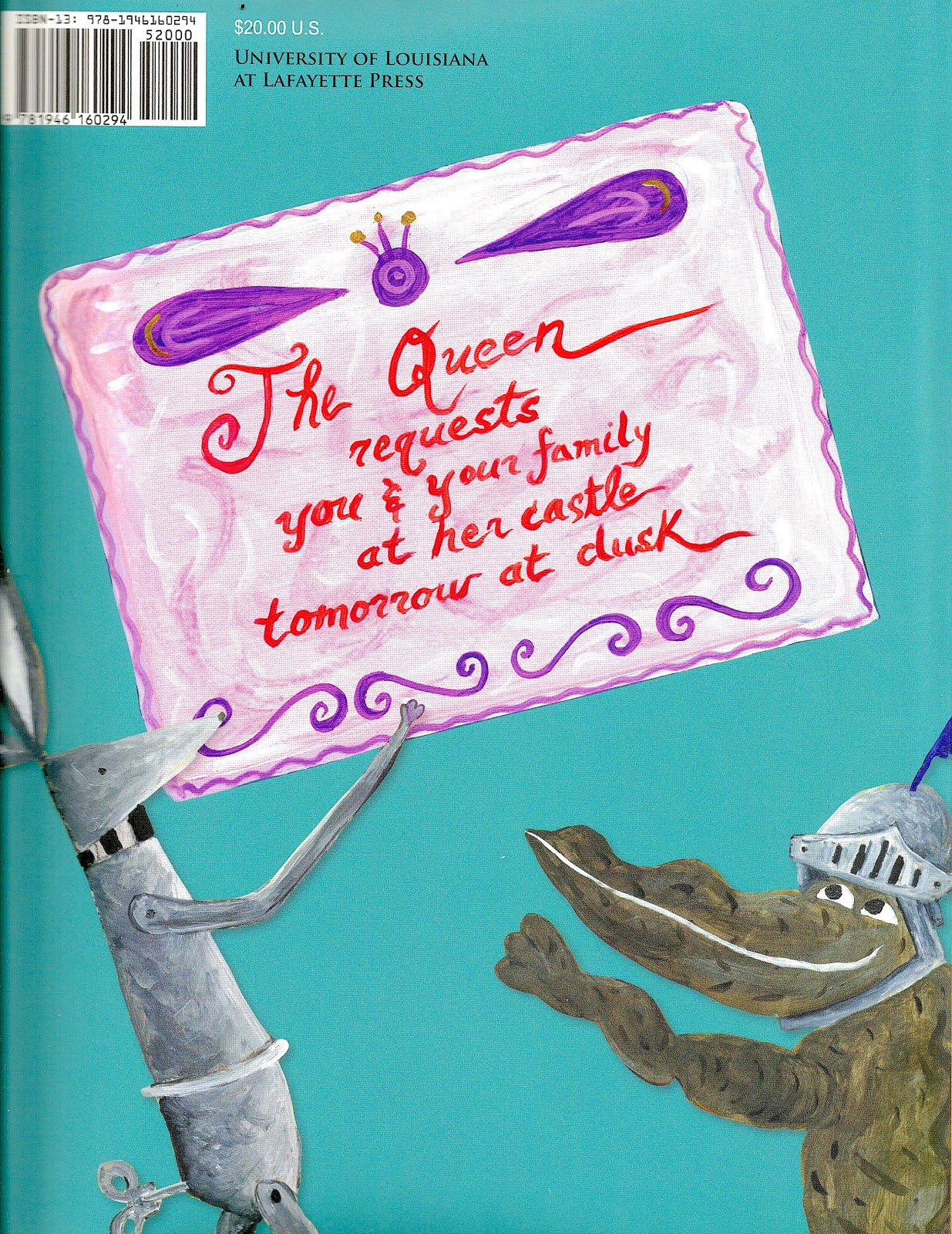
In this time of anxiety and darkness in our broken world, we can count on Paul Schexnayder, New Iberia, Louisiana artist, to gift us with his playful illustrations that always lift our spirits. In The Time of Shimmer and Light, the second book in a three-part series just released by University of Louisiana at Lafayette Press, will delight both young and adult readers. The story takes us to the happy island home of Sir Galatoire Gator, Tin Toy Hare and Queen Ida Peacock where the three critters vie for a dazzling doodad the Queen has found bobbing up and down on the water near their island home.

Schexnayder’s vivid acrylic paintings mesmerize readers, glowing with imaginative figures that “bumble, mumble, and grumble” until the Queen shows her critter friends the object she has discovered and placed in a brilliant red boat to dispel the disharmony developing amongst the friends. I won’t reveal the object or the end of the imaginative fable Schexnayder has created, but readers won’t be disappointed to find more serendipity in the work he offers.


A visit to Schexnayder’s gallery is an occasion of “joy and wonder, shimmer and light,” and visitors usually come away with an art object in hand. Lately, a visit reveals paintings of moss-covered kings who people one wall. The paintings depict mystical-looking beings who are a departure from his “Girth Series,” those kings with tiny heads and billowing robes that he initiated in 2016. “It takes awhile for patrons to get used to a new series,” Schexnayder explains. However, I've found favorable reviews of the new work on facebook and know that his followers will soon add them to their Schexnayder home galleries.

Schexnayder, who always discovers treasures to paint, has made memorable a simple red rowboat that provokes thoughts of optimism, and the word “joy” is frequently reflected in his books, as well as in his art. The mysterious factor in his paintings is that he’s color blind; however, his purples, reds, yellows, and blues leap from the walls and pages of his work after their birth in the colors of his imagination.

This notable New Iberia artist has created illustrations for at least three of my own books, and I often re-use them in blogs. The whimsy that Schexnayder conveys is infectious and his mission, a simple one — to recreate the Fruits of the Spirit, specially the one at the top of St. Paul’s List — JOY. His creations also emerge as acts of love, another outpouring of the Spirit.

Paul Schexnayder has a Bachelor of Fine Arts degree from Louisiana State University, has worked as an art teacher, serves as a member of the Society of Children’s Book Writers and Illustrators and owns an art gallery in New Iberia that he generously shares with regional artists and writers. Recently, he painted a mural depicting his “Girth Series” for the City of New Iberia. The mural emphasizes the idea that New Iberia is not only the “Queen City of the Teche”, as it is often called, it’s also the King City of Bayou Country.


Bravo, Paul, thank you for spreading joy and wonder, shimmer and light! 


Saturday, November 3, 2018

TURTLE SOUP

Art work by Paul Schexnayder

Yesterday, while riding along Hwy. 182 en route to New Iberia from Broussard, Louisiana, we whizzed past a ditch filled with water where a police car was parked. The police officer seemed to be arguing with a man holding a rope to which a turtle was tied. I only caught a glimpse of the turtle but could see the spiked shell and thick scaled tail of a huge alligator turtle. If I had satisfied my curiosity, I’d have asked the driver to stop, but thought I might get embroiled in some kind of endangered species argument. I’ve read that alligator turtles aren’t labeled as “endangered” in Louisiana right now, but they are over harvested for their meat. For all I know, the man holding the rope could have just caught his supper and was being chastised for fishing in a highway ditch. 

I’ve been interested in these primitive-looking turtles since I read that they were plentiful on Last Island during the 19th century and that their weight was reported to top 200-400 pounds. They also lived to be 50-100 years old. Several years ago, when I was writing The Kajun Kween, a young adult book, the alligator turtle became a challenge for Petite Marie Melancon, the heroine of a comic strip who caught one in a hoop net, and New Iberia’s famous local illustrator, Paul Schexnayder, painted a picture of her holding the critter by its tail.

Alligator turtles hardly ever come on land, except when the females want to lay their eggs, and November is the wrong season for egg laying, so I’m wondering why the turtle I saw ventured into a roadside ditch, unless the world was “too much with [her]” and she was near the 100-year old mark. After all, some hardy alligator turtles live to be several hundred years old, especially in southwest Louisiana.

According to Petite Marie, who read extensively before going on an adventure to catch an alligator turtle, in the 1800’s, a man named James Cathcart was sent to Last Island, Louisiana to survey timber suitable for making U.S. vessels, and he found fishermen catching 300-lb. turtles at the rate of five alligator turtles a day. They were selling them for $7 apiece and kept them in pens until buyers showed up. Petite Marie figured she’d be lucky if she caught a 50 pounder. However, she managed to net a huge one, and her fishing companions severed its head, placed it in a bucket of water, stuck a twig in its mouth, and the head clamped down on the twig. Petite tells us that the movement of the head was only a reflex but it must have been a frightening sight.

Of course, this is only a replay of a fictional account, but as we zoomed past the snapping turtle on a rope, I admit to being spooked enough not to turn my head for a backward glance. My mother often made turtle soup for her family of five children, but I think the turtle was probably a soft shell turtle my intrepid father had caught in the Bogue Chitto River and beheaded before he brought it home sans head for my mother to cook.


Monday, November 6, 2017

IN THE TIME OF JOY AND WONDER


Paul Schexnayder, New Iberia, Louisiana’s artist of note, has created illustrations for several of my books; the most notable being The Kajun Kween, a young adult book that carries Paul’s illustration on the cover and his drawings in the interior. Paul has illustrated many children and young adult books for other regional authors in Acadiana, and last month he came into his own as a children’s book author with The Time of Joy and Wonder. It’s a tale of a King Royal, a Trojan horse, and a blue monkey in a boat. He says that the painting of these characters hung on his wall for some time before he began to wonder about their origins and mission in life.

Readers will find it difficult to believe that Paul is color blind because the characters and landscape in The Time of Joy and Wonder are rendered in vivid blue, pink, orange, and green acrylics on masonite. The illustrations alone will delight young and old, carrying out Paul’s message of joy and wonder in his typically whimsical style. I understand that his “Girth series,” many subjects of which are kings with small heads and billowing robes, was initiated in 2016, and the king in The Time of Joy and Wonder continues this series as a royal person who has become an “exceptional explorer of the day.” The king, Trojan horse, and blue monkey embark on an exploration to find “anything stupendous and magnificent” and discover serendipity — a battered boat that causes them to wonder if it qualifies as a “joy and wonder.” Inside the boat they discover a treasure they decide not to claim and return to their kingdom with only a story that becomes as valuable as the find itself. 

The joy and wonder of Paul’s tale is that, without being didactic, he creates a story ending with an old-fashioned element: a moral. I won’t reveal all of the carefully-crafted tale, but I purchased a copy for my daughter to give to my three youngest great-grandchildren, and I know they will love this colorful narrative.

Paul's art is also displayed at A&E Gallery in New Iberia where he sponsors art classes, poetry readings, author signings, and, in his generous, inclusive way, features the art and crafts of talented area artists. He has been the artist for many state festivals, and his work has gained recognition throughout the U.S., often invoking the question: “Do you own a Schexnayder?” Every Christmas, my gift list includes pieces bearing his imaginative brush strokes. 

I know that Paul has had the desire to publish a children’s book for several years, and I congratulate him on this wonderful expression of his talent and beliefs. Bravo, Paul, and bountiful sales from all your admirers in Teche country! We are blessed to have an artist who believes we still live in a “time of joy and wonder” and wants to convey this message to young readers today.

Available at Books Along the Teche, New Iberia, Louisiana, A&E Gallery, University of Louisiana at Lafayette Press, and amazon.com.


Thursday, February 20, 2014

FOR PORCH SITTERS

While sojourning at Sewanee this past year, I jumped track from writing poetry and sat on the front porch composing essays about one of my favorite subjects—porches. I invited my friend Janet Faulk-Gonzales to contribute some of the vignettes for a book I began compiling because she and I share a mutual liking for these outdoor appendages to homes. At Christmas, I usually give Janet a calendar featuring porches, and we spend a lot of time discussing the virtues of the porches photographed for the calendar.

PORCH POSTS contains vignettes and stories about the "so-called passive life that goes on in the porch world," and features eight whimsical drawings by New Iberia artist Paul Schexnayder, as well as an arresting cover, a photograph of a lovely glass piece done by Karen Bourque, a glass artist who lives in Churchpoint, Louisiana. The vignettes range from descriptions of porch structures to tales recounted on galeries, as the French in south Louisiana call them. The porch settings cover wide territory—from Louisiana and Alabama to Iran and Qatar, but all of these observation posts offer a different view of the world as seen from the vantage point of two porch sitters.

Here are two snippets from the Foreword of PORCH POSTS, the first is from me and the second from Janet:

"The word 'porch sitter' describes, in unflattering vernacular, someone who is a lazy, good for nothing person. However, in more sophisticated settings, porch sitters are people who enjoy their galleries for evening gatherings in a space where they can relax, talk, sip libations, create good memories, and elevate their spirits... My childhood memories include porches of various types and architectural design, ranging from a simple, round concrete floor, painted red, with a slight overhang that my father constructed when we returned from a foolhardy trip to California, to a large one with lacy Queen Anne posts that my Grandmother Nell called her 'gallery'..."

And from Janet:

"For the most part, when we think of porches, we typically think of outside spaces, but I see them as places that hold the point for transitions of all sorts. On the porch, one is really neither in the rain, nor out of the rain; in the night nor out of the night; might be leaving but not yet gone; might be returning, but not yet settled—neither in nor out... At this moment, I can say that the two things which make the porch THE PLACE, whatever its dimension and decor, are its propinquity with the natural world and the fact that unexpected time on the porch comes as close to the still point of presence as any time anywhere..."


Look for PORCH POSTS to appear next month. It will be available on amazon.com, and I will provide a link at that time.

Wednesday, August 29, 2012

HURRICANES AGAIN

Illustration by Paul Schexnayder for
The Kajun Kween
Hurricane Isaac is casting his wet shadow on my home state of Louisiana where I live part of the year when I’m not residing on the Cumberland Plateau in Tennessee. Like many Louisiana residents, I remember Katrina and her destructive effects on people and property in the bayou country. For six weeks following that killer storm, I directed a clothing operation at Solomon House, an outreach mission of the Episcopal Church of Epiphany in New Iberia, and ministered to those who escaped the deluge in New Orleans, seeking higher ground in Acadiana.
Although New Iberia has not felt Isaac so far, I cringe when I think of the violent whirlwinds that have disturbed Acadiana in the past. New Iberians live near the Gulf of Mexico, a relatively shallow body of water with no chilling ocean currents running through it, and this shallow depth allows water to heat up to 85 degrees in the summer, so that the warm water can spawn a hurricane at approximately 80 degrees. As the heat from condensation causes the air in a hurricane to rise rapidly, the hurricane becomes a big wheel containing turbulent winds. And devastation occurs.
As far back as 1722, a hurricane demolished the new settlement of New Orleans, and one of the most memorable hurricanes was the storm on August 10, 1856 that struck Isle Dernier or Last Island. This hurricane caused high storm tides, killing hundreds of people reveling at a dance in a hotel called “The Trade Winds” and destroying every building on the island, as well as most of its vegetation. The devastation inspired the famous novel, Chita, by Lafcadio Hearn. Today, Last Island is an uninhabited beach containing little vegetation.
Hurricanes appear in three of my Young Adult fiction books and provide active settings that derive from my experiences of major hurricanes that struck New Iberia–Hilda, Betsy, and the worst, Andrew, when I sat huddled in my home while the wind vibrated the walls of my house like a giant accordion.
One of the lighter treatments of a hurricane occurs in my YA book, The Kajun Kween, in which the heroine, Petite Marie Melancon, ties herself to a tree to experience the Big Wind so that she can provide a story for a comic strip publisher. (However, this narrative is not intended as a jest to minimize the severity of hurricanes –in fact, it emphasizes the foolishness of Petite Marie.) Before Petite goes outside to experience this childish adventure (unbeknownst to her parents), a discussion of hurricanes takes place at the supper table, and Petite shows off her knowledge of hurricanes to her Papa: “Wizards in Finland used to sell wind to seamen. The wind was inside of three knots,” she says. “If someone untied the first knot, a small wind came up. If he untied the second knot, half a gale blew, and if he untied the third knot, a hurricane blew in. I read that seamen in the Shetland Islands still buy knotted handkerchiefs from old women to control the storms…”
Papa Melancon bests Petite’s story with one of his own. He claims that at one time when hurricanes blew in, Sumatrans ran from their houses armed with swords and lances to cut up the winds. Petite’s papa explains that the word “huracan,” which means “God of All Evil,” is derived from Indian tribes in the Caribbean, the Tainos, who thought that on many occasions Huracan got angry with them and tried to blow them away. You’ll have to read what happens to Petite Marie Melancon during her hurricane adventure in The Kajun Kween, but I don’t advise anyone to test the intensity of the Big Wind, as Petite attempted to do.
Meanwhile, we assume the position of “hunkering down” in sympathy with our Louisiana friends and family and pray that Isaac will take his winds to some other body of water or deserted island, settling his terrible rotary disturbances there.
The illustration at the beginning of this blog is a clip from a drawing by Paul Schexnayder, New Iberia artist, and appears in The KajunKween.