Showing posts with label Porch Posts. Show all posts

Saturday, June 8, 2019

TIME WAS, TIME IS…


In E. B. White’s Writings From the New Yorker, 1927-1976, White includes an essay entitled “Disillusion” in which he writes about aging humans hanging onto or “groping toward things that give us a sense of security.” He names clocks in telegraph offices as vanguards of the correct time, and when he passes a clock in a telegraph office that has lost time, he feels that life is slipping away from him. This entry was written in 1929, but it carries the same message for me 90 years later — a thought underlined in a quatrain of The Rubaiyat of Omar Kayaam: “Whether the cup with sweet or bitter run, the wine of life keeps oozing drop by drop; the leaves of life keep falling one by one.”

Unfortunately, I’m a time watcher, and I think at 84, it’s too late for me to develop a new behavior unless this behavior slips up on me when I’m not looking at clocks. There are five clocks in our house here in Sewanee, Tennessee, not including the clock on the computer and in my iPhone, and the only one I feel I can count on, like White’s clock in the telegraph office, is my iPhone. However, I use these clocks for a variety of activities. The clock radio in the bedroom is fast, so this means I can sleep ten minutes longer (I don’t have to punch in at an office but am shame-faced if I’m not at my desk at 8 a.m.). Two clocks in the kitchen advertise two different times: the one on the stove is a bit early and announces breakfast when I’m really hungry; the other on the opposite wall is ten minutes behind the correct time and means I still have time to dawdle before breakfast preparations begin... and so on. 


My good friend Janet Faulk-Gonzales, who, bless her, always manages to be late, often reminds me that too much emphasis on heeding time could bring disastrous results similar to what she refers to as “walking off the porch,” a story that appeared in a book entitled Porch Posts we co-authored several years ago. 


Painting by artist Paul Schexnayder for Porch Posts

Painting by artist Paul Schexnayder for Porch Posts


In the essay, “The Pacing Porch,” I relate how I obsessed over being on time for school every morning while my brother and sister chanted “Hup two, three, four, hup two, three, four,” and I paced the front porch in a frenzy until I walked right off the porch, treading air for a few moments before falling with a loud thunk. I was nine years old at the time, and ‘though this event chastened me and my impatience for a day or so, I was back at it a few days after the “flying high” moment. I never fell off again, but I figured out how many paces I could make before reaching the dangerous edge.
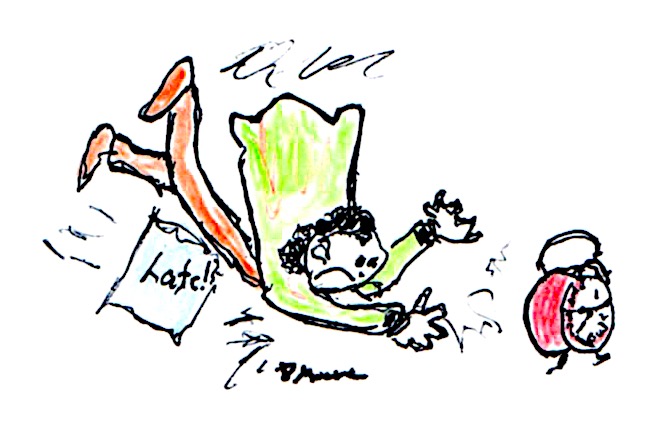

Diane's sketch for blog Time Was, Time Is...

Diane's sketch


Although there’re many synonyms for time; e.g., flash, spell, instant, jiffy, twinkle, wink, etc., my favorite is “jiffy,” which resonates with my translation: “joyfully on time.” I’m one who couldn’t abide using such an instrument as an hourglass —what if the sand got damp? Or someone gave me a genuine cuckoo clock from Switzerland and visited often to see if I had hung it even though I was made nervous by such a loud announcement of an entire hour gone forever? The silent, digital hands on a cell phone keep me attuned to movements of day and night in the revolving universe and suit my time watch quite well.

Let’s face it — some people watch second hands; some people  watch minute hands; and some people watch hour hands on the clock. Then, some people lose all sense of time, and the latter isn’t in my DNA. It’s now 9:37 a.m., and I’ll end this reflection on the passage of time by 9:38. Whew, I made it!


Thursday, December 13, 2018

SOUTHERN CROSS

Front cover of Southern Cross

Janet Faulk, a native Alabaman now working in New Iberia, Louisiana, stays close to her southern roots when she writes most of the time. However, when she discovered a diary written by an anonymous Alabaman who traveled abroad to find his fortune following the War Between the States, she became fascinated by his account of a colony of Alabamans who settled in Brazil and moved her literary interests farther afield. Over a decade later, after transcribing the handwritten diary of an anonymous man who authored the Brazilian Travel Diary, she wrote finis to Southern Cross. 

Based on a true account, but written in the tradition of “non-fiction fiction,” Southern Cross also mesmerizes readers with a love story between the major characters, John Foster and widowed Kate Teal who develop a shipboard romance en route from Baltimore, Maryland to Brazil. The romance is related in deft, accessible prose, and Kate’s life of “inconsistencies…in which she moves toward something rather than away from something” keeps the reader transfixed about her survival once she departs from Mississippi near the Escatawpa River for the hinterlands of Brazil.

Faulk’s finesse with description emerges in the first chapter; e.g., “Nothing brings buried thoughts to the surface like the first dark of evening. At twilight when shadows lay long and thin in the grass, the fading light of day pulls color along with it and orchestrates a symphony of evening sound. This is the time of day when it becomes difficult to tell a black cat from its shadow and stillness spills over the earth like indigo ink. Then, the night movement takes shape with the subtle rustle of a raccoon family easing along the water’s edge, the whirr of seven-year locusts creating a rhythmic background for an occasional bullfrog croaking and the singular intermittent chirping of a lone cricket…”

Faulk skillfully weaves rich descriptions of the diarist’s visits to farms and lumber operations scattered throughout Brazil and brings into focus the politics, slavery issues, and future of agriculture (cotton, sugar cane, etc.) in 19th century Brazil. Romantic scenes between John and Kate are interspersed in alternate chapters to sustain interest in the diarist’s detailed explorations of the diverse countryside.

Choctaws, African slaves, Brazilians—Faulk introduces international diversity among her cast of characters, working to achieve authenticity and remaining faithful to historical detail through the extensive research she completed. Her readings included the work of Zora Neal Hurston, Sylviane A. Diouf, and Sandra Medlock, Operations Manager, Mississippi Band of Choctaw Indians. 

Conversations between John and Kate contain serious ruminations about religion and ethics, and the end of Southern Cross will leave readers contemplating a softer denouement, but Kate embodies a kind of Faulknerean observation that humans will not only endure, they’ll prevail. This is a real page turner, as well as a heart warmer told with certainty of tone and narrated with an instinct for detail and sure sense of self.

Janet Faulk

Janet Faulk is a native of northeast Alabama and has resided most of her adult life in south Louisiana where she lives with her husband, Rudy Gonzales. Southern Cross is her first historical fiction. Previously, she published a book of personal essays, The Road Home, and co-authored Porch Posts with the poet Diane Marquart Moore.


Available online from Amazon and signed copies by mail from the author (janet.faulk@yahoo.com).


Wednesday, August 22, 2018

SEASON OF FRIENDS


Vickie and Anne on porch
This summer has been a season of friends, traveling afar to be with them and staying at home to receive them, and the latest visitor was a long-term friend from New Iberia, Louisiana. Yesterday, Anne Simon, author of mysteries called “The Blood Series” — Blood in the Cane Field, Blood in the Lake, and Blood of Believers — sat a spell with us on the small porch facing our woods here in Sewanee, Tennessee. Presently, Anne, a retired district judge, has turned her attention from writing mysteries to telling the story of an African-American woman named Felicité who nursed yellow fever victims in New Iberia during the 19th century, and we enjoyed a good writers’ chat concerning the extensive research she has been doing regarding Felicité.

We sat on the porch “taking the air,” as we say in south Louisiana, and I was reminded of the essay I wrote for Porch Posts (co-authored with Janet Faulk-Gonzales) a few years ago. This morning, I re-read my last essay in this book entitled “The Ultimate Porch:” 

“It [the porch] would be a place to which people brought peace and conversation, laughter, and their willingness to take time out. For me, the ultimate porch would also be a dual haven, in early morning hours offering me a safe place where I could sit in silence, stilling the storm of some past suffering in my mind, or expressing myself in writing, all my senses effortlessly taking in the scene around me, interrupted only by the squawk of a crow bringing me messages of affirmation.

Mostly, I’d want to bring to it my “belonging”… with friends, family, and community… where, as C.S. Lewis said, we all saw the same truth: love. Evening would be the best time for porch sitting, a time like that of an old memory at early dusk when there was just enough light to read by, and my Grandmother Nell and I sat together in a scaling, green-painted swing, reading from Stevenson’s A Child’s Garden of Verse: “The world is so full of a number of things,/I’m sure we should all be as happy as kings.”

In early September, we plan to venture over to LaGrange, Georgia to sit on the new porch of our friend, Mary Ann Wilson, who probably loves porches as much as I do and was laying the foundation for one when we first visited her in June. It’s a screened one overlooking a patch of Georgia woods “in the country,” she says, “a place I’ve never lived.” Every time she writes, she’s on that porch, enjoying a deserved retirement from the English Department at the University of Louisiana at Lafayette, her “roofed-in observation post where she can sit to get a clear view of what’s in the world outside and that allows for amiable company…”*

Moon in a Bucket
*Introduction to Porch Posts by Diane Marquart Moore and Janet-Faulk Gonzales. Illustration by Paul Schexnayder in Porch Posts.


Monday, September 18, 2017

FELLOW PORCH DWELLERS


A few years ago, my friend Janet Faulk-Gonzales and I wrote a book, Porch Posts, in which we extolled the virtues of porch sitting. Here on The Mountain at Sewanee, Tennessee I often sit on a small front porch and write. Usually, I am a solitary dweller, but this morning I was joined by several spiders, one of which may have been a Wolf Spider, a big hairy thing that is rumored to have a painful bite, and I wasn’t enchanted by the company. In fact, I killed it — without remorse, I might add.

I know that spiders inhabit the pages of many famous writers — the talking spider that makes clicking noises in Harry Potter and the Chamber of Secrets by J. D. Rowling; Charlotte, the spider who talks to a pig in Charlotte’s Web by E. B. White; Shelob, the giant spider in J.R.R. Tolkien’s Lord of the Rings, and out of the childhood of most of us whose mothers read us nursery rhymes: the critter that scared Little Miss Muffet when she was trying to eat her breakfast. I have no fondness for any of them. We have spider pest control but as we live in a small wood, our spider population is often abundant, even though the bug man visits monthly and brings in a giant swifter to sweep away nests, eggs, and the persistent spiders.

I console myself that spiders do eat pest insects like the mosquito that abounds in south Louisiana where I live part of the year, but I don’t see as many of them in Teche country as I do in Tennessee. In fact, the pest control workers here publish a list of common Tennessee spiders that might cause you pain. Among them are the brown recluse that gets the worst press of all in the spider kingdom; the black widow with its red hourglass marking; and the wolf spider that I did away with this morning.

Some of these creatures have eight eyes; some, six, but the wolf spider only has a pair of large eyes that were watching me this morning. Did I get any writing done out on the porch after I sent the wolf spider to meet his maker? Not much. But I did look up a poem about spiders by one of my favorite writers, Don Marquis, who wrote: "…I will admit that some/ of the insects do not lead/ noble lives but is every/ man’s hand to be against them? Yours for less justice/ and more charity." This was signed by aArchie the cockroach, Marquis’s major character (along with Mehitabel the alley cat) who appeared in his newspaper column in New York City’s The Evening Sun.

Sorry that this is so abbreviated but I dared not invite the Muse this morning as She usually keeps better company.


Thursday, September 24, 2015

A VISIT TO WINTERBERRY PLACE

The mission of the Convent of St. Mary here at Sewanee includes providing a Sister or minister to a small congregation of Grace Fellowship Church on certain Sundays, and the visiting member of the Religious coordinates "Reflection" time about the Gospel assigned for that Sunday. On the Sundays that I preach at St. Mary's, I also go down the road and deliver the same sermon to Grace Fellowship, and I've grown fond of the people who gather in the little church at the edge of a pond on Garnertown Road.

Yesterday, at the invitation of Carolyn and Charles ("Chuck") Tocco, a couple in this Fellowship congregation, I went out to Winterberry Place in Deep Woods to see Carolyn's studio paintings. I had seen many of her depictions of Jesus that hang in the sanctuary at Grace Fellowship and had asked about exhibits she schedules twice a year at times when I won't be on The Mountain, so she offered a private showing of her art.

I thought I'd hiked in and seen all of the deep woods around Sewanee, but Winterberry Place is situated in a wood Robert Frost would have called "lovely, dark and deepest." We drove down the Fire Tower Road just past St. Andrews School, then traveled about three miles on a paved road and on to a gravel path that ran through dense woods leading to Wormwood Lane, a lane ending at the gate of Winterberry Place.

Everywhere we looked, we saw flowers and gardens, and the Toccos stood on the porch to welcome us, attempting to shush the barking of several dogs (mixed breeds, Carolyn explained) that had been penned up so we could visit without interference. Just inside the front door, we glimpsed several of Carolyn's large oil paintings, one of a snow scene in the woods and another depiction of Jesus on a hill overlooking an ancient city.

We walked through the house and onto the back porch to get a view of the bluff that overlooks the town of Pelham, Tennessee and toured the tea house at the end of the porch. I had brought Carolyn a copy of my book, Porch Posts, and it proved to be a perfect gift because the Tocco's porch would make a good photograph for any home and garden magazine and appears to be a favored room of the home. My friend Vickie, who accompanied me, had brought her book Why Water Plants Don't Drown as a gift, and it was also a "hit" for the Toccos, two seasoned gardeners.

Carolyn, a native of Sewanee (actually Garnertown) has been painting since childhood and spent four years studying art with a private instructor in Chattanooga, Tennessee. She has done most of her excellent work in oils, although she has tried acrylics and watercolors, choosing oil as her favorite because "it's the most forgiving medium," she says.

Before we went upstairs to see Carolyn's studio, we sat and exchanged stories about our backgrounds. Both Carolyn and Chuck had been in the Air Force and met at an airbase in New Jersey, and both say that when other retirees tell them that they retire to travel, they're amazed because they've already had their peripatetic experience, traveling with the Air Force to stations in Alaska, Okinawa, Thailand, Guam, the Philippines, Hawaii, and other posts.

When the Toccos decided to join the retiree population, they were living in Sweetwater, Tennessee where Chuck worked as a Systems Engineer at Watts Bar Nuclear Plant (TVA) following his stint in the Air Force. Both sang in a Methodist Church choir in Sweetwater, and nowadays Chuck sings solo and a capella for the Grace Fellowship congregation.

Although Carolyn's former work had included a sophisticated assignment as an Air Force Communications Specialist executing flight plans and decoding cryptographic messages in a "vault," her background as a hardy Tennessean served her and Chuck well when they bought the ten acres of woodland in Deep Woods. She joined Chuck in clearing the land much as women of Tennessee stock must have done during pioneer days. "Chuck used one chain saw, and I used another until we had cleared the entire space for our home on the bluff," she says.

We climbed stairs to Carolyn's studio and entered a room with long windows that let in the generous shafts of light that artists need for painting. Bookcases on two walls contained Carolyn's eclectic reading, including books of poetry, religious writing, and classics. We were also intrigued by a small insect display that Carolyn had been collecting for her "bug paintings." Renderings of owls, dandelions, cotton plants, milkweed pods, horses plowing in a field, sheep, and other outdoor scenes leaned against the wall beneath the long windows, and a painting of a road resembling the entrance lane to Winterberry Place stood on Carolyn's easel. Carolyn paints in the afternoons and says the subjects for her paintings are inspired; she disciplines herself to carry out the work as "it is a gift from God."
 

We lingered longer than we had planned and were invited to return another time when Carolyn
promises she'll have two of her small paintings ready for us—a "bug painting" and a "berry painting"—mementos of this wonderful artist's haven in the deep woods on The Mountain at Sewanee that we'll take back to bayou country in October.

Photographs by Victoria I. Sullivan


Monday, July 13, 2015

THE TAIL OF MUNCHKIN

Photo of dill plant chewed off at base by rabbit
Clipped off dill
What a joy it is to plant a herb garden and harvest the herbs to season fresh, home-cooked food! And what a bummer it is to find some of the herbs with their necks broken or the plants neatly clipped off at the base. And the culprit? A Roving Rabbit!

Illustration of rabbit by Diane M. Moore
Satisfied Rabbit 
What a good idea my mother had when she cooked rabbit stew in a big black pot in an open fireplace! What better use could one find for these critters that rabbit lovers claim love basil, dill, cilantro, mint, oregano, parley, rosemary, sage, and thyme—all of the plants that we selected for our small herb garden. I'm just sorry that we didn't plant chives because those fat brown bunnies that steal into our garden at dawn and dusk dislike this particular herb. Rabbit lovers tout that melons, apples, peaches, strawberries, and plums are delicious desserts for Peter Cottontail, so I'm thankful we don't have any fruit trees in the yard.

I've read that Hollywood gives these critters the names of stars; e.g., for females: Madonna, Scarlett, and Drew; and for males: Ozzy, Leonardo, and Brad. And for those "rabbitsieurs" who adopt the bunnies and think they're adorable pets: Sweet Pea, Peony, Jasmine, and Buttercup suffice as cutesy names. Frankly, I prefer the more apt moniker of Munchkin.


Of course, these creatures have been immortalized in literature by writers of books for children like Thornton Burgess who placed Peter Cottontail roaming in green meadows and green forests (one of my mother's favorite bedtime readings to us) and Peter Rabbit whose father had an accident and was put in a pie by Mrs. McGregor in the Tale of Peter Rabbit. The latter bunny gained everlasting fame with 45 million readers, and his story was translated into 36 languages (do you think it had anything to do with the mention of rabbit pie?).

Maybe people love these little animals because the appearance of a rabbit in the yard or in a dream foretells a favorable turn of events. However, Jung says that if you dream about rabbits, you're experiencing a threat to certain freedoms—he didn't name the freedoms, but I'd venture to say that one of those freedoms is the freedom to plant a herb garden that will thrive without Munchkin nibbling away at those delicious seasonings for stews, soups, salads, and vegetables.

The only consolation I have about Munchkin destroying our dill is that rabbit lovers warn against the bunnies developing digestive upsets when they first taste their paradisiacal fruit. In that case, I hope the dill did its dirty work. I've read that hay is good for overweight rabbits, and I'm thinking of buying a bale of hay to spread on the perimeter of the yard and around the herb beds.

My good friend, Janet Faulk-Gonzales, believes that rabbits live on the moon, a story that exists in many cultures, including the Aztec one to which she is attracted, and I'm wondering if I could entice a crew from NASA to come to the Mountain and capture Munchkin to take on one of their moon voyages. ("The Rabbit in the Moon" is a story Janet wrote in a book she and I co-authored entitled Porch Posts).


Or, better still, I think that my mother's recipe for rabbit stew may be somewhere in my trove of cookbooks. Think of how delicious this stew would be with all those ingested seasonings bubbling in the pot!


Friday, December 12, 2014

MORE OF KAREN BOURQUE'S ARTISTRY

On Wednesday, we not only brought home good memories of hanging out in Arnaudville, Louisiana, with Darrell and Karen Bourque, we acquired another glass art piece by Karen, whose work hangs in our Sewanee, Tennessee and New Iberia, Louisiana homes. The latest acquisition is a rendition of the Pickerel Weed, an aquatic plant with brilliant blue flowers, densely clustered on a long spike with heart-shaped leaves, that attracts bees and butterflies.

Karen was inspired to create the stained glass piece using blue dog-toothed amethyst after reading Why Water Plants Don't Drown by Victoria Sullivan and discovering the lovely illustration for the Pickerel Weed rendered by Susan Elliott, artist and co-editor of Pinyon Publishing.

In the text accompanying the glass work, Karen explains that no blue stone felt right for the flowers, so she chose the dog-toothed amethyst to represent them. She attributes qualities of spirituality and contentment to the amethyst and relates that it has calming, protective powers of healing, divine love, and inspiration and that it enhances psychic and creative abilities. We have hung this art that represents "the peace of the perfect peace which was present prior to birth" in the sunroom and can look out and see it each morning at breakfast time.

I always enjoy the texts that accompany Karen's work as they are small inspirational pieces she chooses to use in her interpretations of objects in nature and the personalities who commission the work, as well as to foster creativity in those who acquire the glass work. She is married to the poet Darrell Bourque, and they're well suited to each other because she matches his gift for writing poetry with her visual poems in glass.

Karen has done glass pieces for many homes throughout Acadiana, for the Louisiana Book Festival, for the Ernest Gaines Center at the University of Louisiana at Lafayette and other art centers. Much of her work focuses on the natural world and spirituality—on those images that give meaning and harmony to human experience.

We now have five of Karen's glass pieces, three of which are at Sewanee. One of the more recent pieces is a rendition of a porch that was photographed and appeared on the cover of Porch Posts, a collection of essays and stories that I co-authored with Janet Faulk this year. I will be autographing this book at A&E Gallery in New Iberia Saturday, Dec. 13, 1 - 3 p.m., along with Vickie Sullivan who is debuting her sequel to the speculative novel Adoption entitled Rogue Genes.

Porch Posts' cover is Karen's interpretation of a painting done by the late Elmore Morgan, Jr. which shows the bare outlines of a porch open to the air that might have been a place to sit and watch the sunset and fireflies winking on a summer night.

Karen handles commissions for glass work created in her studio in Church Point, Louisiana, and if you're interested in her work, she can be reached at 337-684-3542 or 337-351-2219.

Photograph of the Pickerel Weed by Victoria I. Sullivan, author of Why Water Plants Don't Drown, Adoption, and Rogue Genes.


Monday, July 21, 2014

BOOKS AT A BAZAAR

Bookstores and readings are common venues for book sales, but Friday I enjoyed a different kind of marketing event. I sold books at a bazaar hosted by the Monteagle Sunday School Assembly Women's Association in Monteagle, Tennessee, just down the road from Sewanee. It was a "dark and rainy" morning when the sale opened at 9 a.m, The event was slated to close at 4 p.m., but my personal fortitude waned after standing by a table hawking books, from set-up time at 7 a.m. until 3:30 p.m., when I threw in the towel and helped pack boxes of books. Rain pelted us as we exited the bazaar and headed for dry quarters.

The bazaar featured everything from arts and crafts to clothing and baked goods. When we first entered the auditorium, I was intimidated by the long tables of goods since Border Press had only a small card table and copies of five book titles arranged on it, with photographs of the book covers of Porch Posts and Why Water Plants Don't Drown (Pinyon Publishing) in the foreground of the display. I was further intimidated by a craftswoman next to our table who had a large, dazzling display of silver jewelry created from old forks, spoons, and other silver items that took her at least an hour to set up on a table twice the size of ours.

"Are there many book sellers at these bazaars?" I asked the craftswoman.

She looked at me, gave our table a cursory glance, and said, "There's at least one of those at every crafts show I go to." She returned to arranging her table.

"Do they sell many?" I persisted.

"A few," she said dismissively. She was a native Tennessean from Tracy City, so I was accustomed to such brief conversations, but the dismissal didn't inspire confidence.

"Been to many of these crafts shows?"

My interruptions seemed to be a bit much for her, but she threw a long reply over her shoulder, "I go to three or four of these every week. I fill my van with the jewelry, take it to the show and unload it, find a campground, take out the seat in the back of the van, unroll a sleeping bag, and I'm good for the night." She beamed a smile, pleased with her resourcefulness.

The last piece of information silenced me. I thought to myself, this gal ain't camping out in a van to sell a few books... and I sent out for food fortifications.

I met visitors to the bazaar from Tennessee, Alabama, Georgia, South Carolina, and Virginia, and the first half of the day passed quickly because we received and talked with a lot of lookers. I spent several hours touting the virtues of porches and plants, but most people were more interested in the conversation than the books. After lunch, time lagged, and although my neighbor, the jewelry maker, stayed until the bitter end, we left at 3:30 p.m., having sold a dozen books and a few packets of cards. The cards featured the beautiful plant paintings of Susan Elliott who had illustrated Why Water Plants Don't Drown by Victoria Sullivan, owner of Border Press, and the arresting pictures attracted many lookers.

Although the sale seemed to last as long as a church meeting "singing all day and eating on the ground," it was a colorful event that benefits the work of the Monteagle Sunday School Assembly Women's Association, which has sponsored the bazaar and Tour of Homes for 51 years. Following lunch, Ralph Null, renowned floral designer, demonstrated his secrets for easy floral arrangements and auctioned these arrangements at the end of the program. Proceeds benefitted the Monteagle Women's Association.

The Monteagle Sunday School Assembly has a history dating back to 1882 when the Sunday School Convention of Tennessee established an educational congress for Sunday School teachers. Sunday School teachers from many southern states attended summer classes at the Assembly in Monteagle to enrich their Sunday School teaching.

The Monteagle Assembly had close ties with the first Assembly in Lake Chautauqua, New York, which was created to combine Sunday School teaching with "the promotion of the broadest popular culture in the interest of Christianity without regard to sect or denomination," and the organization attains its mission through a variety of spiritual, health, cultural, and educational activities. The Monteagle Assembly eventually became the headquarters for the Chautauqua Literary and Scientific Circle.

"The Assembly," as Sewaneeans refer to the attractive property, also contains over 160 homes, and the homeowners are fifth-and sixth-generation Assembly families. Two of the homes on tour Friday were the "Hallelujah Cottage" built in 1905, which has always been owned by women, and "Mojo," formerly known as "The Little House," built in 1885, that also has a special arrangement for dogs to come in through the screen porch door and leave through the kitchen door. Many of the homes have porches that reflect Queen Anne and Gothic architectural influences, which interested me because I've just published a book about porches and porch sitters. The homes are sought after as rentals during the summer months when special activities for adults and children are offered—youth programs dominate the Assembly's schedules.

The Assembly has an active rental program, public meeting rooms, a dining hall, tennis courts, an amphitheater, and other buildings and programs designed to accommodate thousands of visitors every summer. Sunday services and evening prayer (called Twilight Prayer) take place every week, and outstanding guest ministers and lecturers are featured in programs offered to the public.  


We actually developed good rapport with the silver jewelry craftswoman who was our neighbor at the bazaar and shared part of our lunch with her. She told us that she makes a better living creating and selling jewelry than she did managing a convenience store and gets more satisfaction from a creative occupation. In her spare time, she paints. She's representative of the numerous, talented craftspeople and artists born and bred in the Cumberland country, and I admire her ingenuity. But I'm still not going on the road and sleep in a van in order to market my "creations." Perhaps I would've been game for this sleeping arrangement at age 40, but that number is getting ready to double!

Wednesday, July 2, 2014

FROM THE FRONT PORCH

It's the time of the pause between books I've been writing—a time when I'm reviewing the work of ants, spiders, birds, plants, and the lime green trees in the wood beyond my front porch. I can't call it the time of idleness because I have a condition that is known as "racing mind," and contemplative or centering prayer is difficult for me unless I have some sort of mantra buzzing in my brain.

I console myself that the transcendentalist Thoreau observed, read, listened to the sounds of nature, built a cabin, planted a garden, and wrote about all of this during his two years of communing with nature in the Concord woods. As far as I know, he didn't assume a lotus position and just ponder or practice nothingness.

Right now, the crows overhead are jeering at me, as they do every time I come out on the porch. I've read that they recognize faces and voices, and we keep up a lively conversation above the sound of construction work going on near my driveway. One of them waddled over to my steps the other day and cocked his yellow eye at me when I recited the first poem I learned at age four while my mother read aloud from A Child's Garden of Verse: "A birdie with a yellow bill/hopped upon my window sill..." The crow quickly exited the yard at the sound of rhyming verse since he's more accustomed to readings of my free verse, and he flew away when I continued to recite the rhyme in a sing-song voice.

Moments later, my nose picked up the scent of a skunk, a creature more equipped for nocturnal visits, and I shuddered, remembering the family that colonized the insulation underneath our cottage two years ago—and ripped it into pieces for a nesting place to raise babies. Three skunk catchers later and $1,000 poorer, we rid ourselves of the offending visitors. I hope the scent this morning doesn't indicate there's a scouting expedition nearby.

We've had rain in sporadic bursts for weeks, and the snails are out. A large one was encamped by the French doors leading into our living room, and I was rude enough to interrupt his slumber, brushing him into the yard. When I was a child, a neighbor bully was fond of sprinkling salt on snail bodies when they emerged from their shells and would watch them turn into "butter," as he called it. It was a gruesome sight, and I've never bothered to find out why this chemical reaction occurred as it was a clear violation of nature.

Tiny bright orange toadstools have appeared in the bed of fern, varicolored hosta, a sickly lemon balm plant, and a stunted rosebush by the steps, the latter two preferring more sunlight than they're getting under the shade of the white oaks. The toadstools look like the fairy footstools my mother painted in her renderings of fantastical creatures that she imagined populated the piney woods near Franklinton, Louisiana. I expected a gnome with a pointed hat to appear on the spot as she always painted a gnome standing alongside huge mushrooms, a palette in hand and a large green frog perched in the foreground, observing the magical creature at work.

Those who want to read expert observations on the natural world should get a copy of The Unseen Forest: A Year's Watch of Nature by David Haskell, or read his blog entitled "Ramble." He has received national awards for his wonderful writings about a square meter of space in the woods where he spent a year observing nature at work. 


I'm not a trained naturalist, but I do like my observation post on the front porch here at Sewanee and find that it's a great way to reclaim my writing urges on a day that could have been a time for just being a good for nothing southerner doing some serious porch sitting.

Photograph by Victoria I. Sullivan

Monday, June 2, 2014

DEPARTURES

"My soul is constituted of thousands of images I cannot erase...I'm a grainy old, often silent, often flickering film," Charles Simic writes in his book, The Monster Loves His Labyrinth: Notebooks. This line spoke to my condition when I began writing my latest book of poetry, available on Amazon in a few days. Departures is the name of this volume, and a few people have asked me if the title indicates I intend to throw away my pen, or computer, as the case may be, and hang up my poetry hat. The answer is "no," as I'm already settled on The Mountain at Sewanee, Tennessee, working on another volume.

Departures explores the lives and departures of loved ones—parents, siblings, aunts and uncles, grandparents, an infant nephew, memorable teachers, godparents, musicians, an old friend—the faces of people who have passed on and left their imprint on my life...and about whom I often dream. The book is dedicated to my friend and mentor, Darrell Bourque, former Louisiana poet laureate and author of Megan's Guitar and if you abandon me, who read the original manuscript of Departures.

I know that I just published a book of essays entitled Porch Posts with Janet Faulk-Gonzales, but Departures has been waiting in the wings for some time, and since I had a painting for the cover that my brother Paul rendered a few years ago, the book almost birthed itself and begged to be "out there."

An example from Departures entitled "Sister's Blue Baby:"

the only boy among three girls
was buried in blue satin

in a tiny steel box
that held the porcelain body

and a heart that struggled
against death

before his time;
his crippled valves

leaking a love
never expressed...

and only his mother felt.

I hope that those of you who read my work will take a look at those people whose "points of departure felt...the faces appearing often enough...[have left] enough of themselves with me."

Departures also available online at www.borderpressbooks.com. If snail mail is your preference, send orders to Border Press, PO Box 3124, Sewanee TN 37375, along with $12 plus $4 for shipping.

Friday, May 2, 2014

THE MASTER OF CAJUN AND CREOLE POETRY

An important figure, dressed in black turtle neck sweater and black slacks who often stands in the background of my poetry readings is that of the "Dean of Poetry in Louisiana"—Darrell Bourque. Darrell, a cherished friend and former poet laureate of Louisiana, was recently named Louisiana Writer of the Year by the State Library of Louisiana and will be honored at the Louisiana Book Festival this fall. Most of us who enjoy his friendship know that he's a strong supporter of the literary arts, of both young and old poets and writers.

Sunday, Darrell was among those gathered for the book signing of Porch Posts at Belmont Plantation in New Iberia, Louisiana, and I knew exactly where he stood, his poet's ear alert to the essays Janet Faulk-Gonzales and I had written and were reading to a gathering of approximately fifty people. Afterward, I wished that I had asked Darrell to read one of his newest poems from a fascinating collection entitled if you abandon me, comment je vas faire: An Amédé Ardoin Songbook. The chapbook includes fourteen unrhymed sonnets about the early Louisiana Creole musician, Amédé Ardoin, who composed and sang songs in Louisiana Creole French and whose music inspired Darrell to write if you abandon me for the Louisiana Series of Cajun and Creole Poetry. This series was founded to highlight work created by exceptional poets of Franco-American descent, which includes Darrell's important contribution.

Amédé Ardoin, a once-popular Louisiana Creole singer and accordionist, was a tragic figure in the Acadian music world. Ardoin, one of the first musicians to record Cajun music, was the victim of a racial attack in which he was beaten on a night some time between 1939-1940 after a performance at a house dance near Eunice, Louisiana. The legendary story is that white men who were present at the house dance became angry during his performance because a white woman handed him her handkerchief to wipe the sweat from his face. After he had finished playing and started walking home, he was run over by a Model A Ford, presumably driven by the irate white men. His vocal chords were damaged, and he lost his mind and his ability to perform as a musician. He was committed to the mental institution at Pineville, Louisiana and died there in 1942.

Darrell was inspired by the recurring refrain of fear of abandonment or accusation that Ardoin is being abandoned in his songs. He explains that "the first part of the title is a play on his own words in the songs and the second part of the title is a version of another phrase, this time taken directly from one of the songs. The title is both in English and in French because that bi-lingual element remains an important part of Cajun and Creole culture in south Louisiana."

While Darrell was composing the fourteen unrhymed sonnets in if you abandon me, he shared many of them with me through e-mails, describing them as "nonce sonnets," a name for the 14-line poem in which he used the same line/stanza form that he usually used for his sonnet writing: quatrain, tercet, tercet, quatrain, but the units were unrhymed. The last poem in the book is written in French and was a rhymed quatrain and a rhymed couplet that he called a "found poem," containing lines from Ardoin's songs.

I loved the sonnet entitled "Ivy Lejeune Listens to Amédé," the last three lines cogently expressing the passion of early Louisiana Creole musicians: [Field work]..."was not for me either. Like him I couldn't see/anything but the songs. I walked like he walked./I carried my accordion in a sack to play. I caught/rides. Songs living in me said everything I knew."

Each sonnet in this wonderful book is a tribute to early Louisiana Creole musicians who are being rescued from obscurity by contemporary Louisiana poets and musicians. if you abandon me is a small score of perfectly formed notes—notes that are clear, precise, and dazzling with the poet's passion for his native Louisiana Creole music. Darrell Bourque's voice is Amédé's voice come alive again.


Note: Darrell says that a portion of the proceeds from if you abandon me will be donated to a public commemorative that will honor Ardoin's contribution to Cajun and Creole culture. The book is also available from:
J. Bruce Fuller
Yellow Flag Press
224 Melody Dr.
Lafayette, LA 70503
337-529-2761

Tuesday, April 29, 2014

UNDER THE OAKS

 Most authors are pleased when someone sponsors a book signing for them in a bookstore or at a book festival, but few of them have the privilege of autographing books on the porch of a private plantation home as I did this past Sunday afternoon in New Iberia, Louisiana. In an earlier blog, I described Belmont Plantation where the signing took place, but I didn't give much space to the grounds surrounding the old Wyche home.

From the porch of Belmont, visitors could see the copse of old live oaks in the front yard, and I sat at a table overlooking the overarching umbrella of trees. However, I didn't see the grandfather oak on the property until I went around the side of the house to look at Mary Wyche's hidden garden, and I almost gasped at the sight of the Quercus Virginiana standing sentinel over the back of the house. It was grand enough to warrant the photograph in this blog.

Louisiana is noted for its oaks, the sweeping limbs of which are often as large as the trunks of other trees, and the weight of the branches brings them almost to the ground. These grand trees aren't cut anymore, but at one time their heavy, durable wood was used to build ships. Today, members of organizations like the Louisiana Live Oak Society would cringe at the suggestion of cutting even one of them. The LLOS has been around since the year before I was born and is dedicated to preserving these Louisiana beauties. One of the organization's registrants is The Seven Sisters Oak in Mandeville, Louisiana on the shores of Lake Pontchartrain, which is 1200 years old and has a girth of over 38 feet!

On this latest trip to my home in New Iberia, I found leaves from the live oak in my backyard mounded everywhere and jokingly threatened to cut it down, but when I thought about the shade it provides in humid Louisiana weather, I was sorry to have voiced such sacrilege. Instead, I paid several hundred dollars to have a few limbs trimmed. The worker who raked the leaves accumulated in my yard remarked that last year's acorn crop from the oaks had been abundant, and this year the oaks had shed more leaves than they usually do. He claimed that many of his customers had been felling the trees because of the heavy leaf shedding and last year's plenteous acorn crop. Although acorns and leaves litter the yards of those of us who prefer pristine lawns, I can't imagine ending my prize oak's life—it was once valued at over $25,000!

The sight of Mary Wyche's massive oak in the backyard of Belmont Plantation sent me scurrying home to look up Walt Whitman's comments about the oak trees growing in Louisiana. In Leaves of Grass, he extolled the beauty of these trees: "I saw in Louisiana a live oak growing./All alone stood it and the moss hung down from the branches,/Without any companion it grew there uttering joyous leaves of dark green.../And I broke off a twig with a certain number of leaves upon it, and twined around it a little moss,/I brought it away, and I have placed it in sight in my room,/It is not needed to remind me of my own dear friends..."


About the massive oaks around New Iberia, I often say: "If only the old trees could talk, what stories they could tell that I would write about!"