Showing posts with label LA. Show all posts

Monday, December 7, 2020

LIGHT IN A GLASS ROOM

Glass porch in the morning


The glass porch in our Louisiana home is my favorite room. True, the glass is smudged with bayou country grime from lack of care during the months we are away. Or perhaps the glass is cloudy because the porch is a place friends have visited to tell some dark stories about broken relationships, illnesses, quarrels — the glass porch has often housed usual and unusual tales of human tragedies.

However, this four-season indoor/outdoor room also holds the hopes for new perspective…it is a living room with a better view. Sometimes I go there to write, but the room doesn’t invite labor or action. I frequently fall asleep sitting in a comfortable wicker chair while the sunlight beams through on my winter-pale face.

The room also houses a few of the glass pieces created by Karen Bourque, a talented Church Point, Louisiana artist, and adds to the idea of inspiring joy in this life, albeit smudged with our tragic stories.

All homes should have such a room, perhaps now more than ever in this time of Covid. I went into the glass sanctuary this morning to share in the grief of my dear friend, Kathy, who lives in Sewanee, Tennessee, and who just lost her sister, Mary Kay, to the dread Covid disease.

Wicker chair on glass porch


The glass porch is also a place of prayer. Another smudge has appeared on the glass, and another prayer goes up for Kathy’s release from suffering. The sun fills Karen’s pieces with light in this small blessed space, and I ponder the idea of glassing in our little front porch at Sewanee. However, the porch faces dark woods and only collects shadows…and spiders.

Vickie Sullivan’s photographs capture the essence of this space on a cold winter morning, and I wish that I could say, “Come and sit awhile,” but this open-to-sunlight room doesn’t tolerate masked visitors!


Tuesday, February 11, 2020

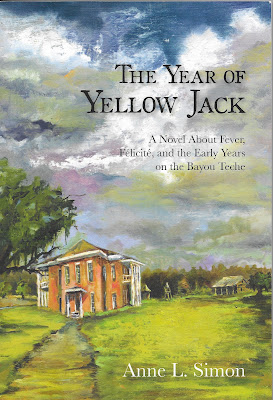
THE YEAR OF YELLOW JACK


Anne L. Simon has “found her oeuvre” in historical fiction. Her recent novel, The Year of Yellow Jack, is a fascinating story about New Iberia, Louisiana — the successes and tragedies of families living in this south Louisiana town of Bayou Teche country during the 19th century. 

The Year of Yellow Jack emerges as a regional story with a universal message and is the result of Simon’s meticulous research and lively imagination. Simon’s story is told in realistic voice about a social system that prevailed during this antebellum period in southern history and includes both wealthy and enslaved characters — the Bérard and Duperier families and their antecedents, and a Haitian woman of color named Félicité.

Both the “Foreword” and “Historical Notes” in this volume indicate the depth of research and dedication to an intriguing project Simon pursued for three years and provide a sampling of her accomplished expository style. The novel is narrated in three parts and covers the multicultural mix of south Louisiana — French, Spanish, African, English, and Attakapas who settled the towns of New Iberia and St. Martinville. In this mix, Henri Frederick Duperier and Hortense Bérard emerge as major characters who marry and build a home on the banks of Bayou Teche and are joined by Félicité, the enslaved woman of color from Saint-Domingue.

Simon’s research of colonial New Iberia and St. Martinville, Louisiana includes descriptions of the prevailing attitudes toward the enslaved during the early 1800s; e.g.,the rumination of Hortense Duperier: “When I was a small child, we had many slaves in our household. Patterning my behavior on that of my mother, I expected the slaves to do without question whatever they were asked to do, even when asked by a child. I could not recall any open discussion of their inferior status. Occasionally Maman corrected my behavior. She instructed me to be courteous at all times, not out of respect for the role the slaves played in our lives, but because courtesy was expected of people of privilege. I accepted the world I had been born into as normal. I gave little thought to the personal lives of those who lived behind the woods that separated us from them…”

Simon’s descriptions of Teche country landscape during the 19th century are succinct and skillfully done through the device of dialogue; e.g., Grandpa Bérard’s : “It was springtime in Teche country, and beautiful. The Garden of Eden, we thought. Untouched forests, not like the worn-out land we’d left behind in France. Oak, willow, and cottonwoods lined the bayous, giant cypress and tupelo trees thrived in the wetlands. Natural meadows spread to the west…” 

The major event that tied families of privilege in New Iberia and St. Martinville and the enslaved Félicité occurs in Part III of this novel when Félicité functions as a healer during the siege of yellow fever that strikes these communities. Using non-traditional medicine in the forms of hydration and herbs (fever tea), Félicité saves many lives and helps to "wash clean New Town (New Iberia)" of this deadly disease.

Interspersed in this narrative about Hortense Duperier and Félicité is a salute to Frederick Duperier — his valuable part in incorporating the town of New Iberia. The relationship of early settlers and the Atakapa Isak Nation, or the Attakapas are also included — facts corroborated by Simon through a record in the St. Martin Parish courthouse that shows Bernard, chief of the Atakapas, granting land to Hortense Duperier’s Grandfather Bérard  Such discoveries indicate Simon’s investigative abilities as well as her persistence in ferreting out facts that enhance the narrative. 

Scholarship and vision intertwine throughout this intriguing novel. Photographs included in The Year of Yellow Jack indicate the close relationship that Félicité had with the Duperier family of New Iberia — one of them features the Duperier family plot that shows Félicité’s grave marker as she is buried alongside her appreciative and respectful family.

The Year of Yellow Jack will intrigue south Louisiana residents, but its range is far-reaching in that it corroborates a major contribution made by an enslaved Haitian woman during the colonial period of American history. It also shows the bravado and competence of a widow who overcomes financial reverses and takes her place in history as an enlightened woman who refuses to be deterred by social mores. As I said, Simon has found her oeuvre in historical fiction, and The Year of Yellow Jack celebrates her place in this genre. Just as we celebrate Anne’s contribution — Brava, Anne!

Anne L.Simon was educated at Wellesley College, Yale, and LSU Law School. She was elected as a general jurisdiction trial court judge, and after mandatory retirement served in ad hoc and pro tempore appointments by the Louisiana Supreme Court, as an Appellate Court Judge for three Indian tribes in Louisiana, and was the Louisiana Court Improvement Fellow for the Pelican Center for Children and Families. She has authored three crime novels, entitled Blood in the Cane Field, Blood in the Lake, and Blood of the Believers "loosely based on her experiences."

Published by the University of Louisiana at Lafayette Press.

Note:  I am familiar with stories about the scourge of yellow fever through the Anglican Sisters of the Community of St. Mary at Sewanee who, every year, relate the legend of “The Martyrs of Memphis,” the story of  Anglican Sisters who nursed yellow fever victims in Memphis, Tennessee during the siege of 1878. I was drawn to Simon’s story because of historical similarities. However, my initial interest in Félicité began with a strange telephone call from a psychic named John Russel in San Angelo, Texas who called me one evening during the 1980s and asked if I knew why he was receiving psychic messages including my name and someone named Felicity in New Iberia. I told him I didn’t know anyone named Felicity, but I later remembered the marker honoring Félicité’s work with yellow fever located near the New Iberia Library. I never heard from this caller again. However, he had piqued my interest in the enslaved healer, and, later, I included Félicité as a character in a young adult novel entitled Flood on the Rio Teche that was more imagination and less factual than Anne Simon’s meticulously researched work of historical fiction.


Monday, November 18, 2019

IN THE TIME OF MISSION AND MIGHT


Yesterday, I went down to A & E Gallery here in New Iberia, Louisiana, to a reception and book signing for Margaret Simon of New Iberia, whose Sunshine, a notable middle-grade fiction book published by Border Press, just appeared on the market. (See the review of Sunshine on my blog, A Word's Worth).

However, when I walked over to the payment counter, I discovered more treasure from New Iberia’s growing body of artists/writers: In the Time of Mission and Might, the newest member of Paul Schexnayder’s children’s trilogy about Legacy Acorns. If I had found a beautifully illustrated children’s book like this one when my mother dropped me off to spend the day at the old Claitor’s Bookstore in Baton Rouge, Louisiana so many eons ago, I’d have been ecstatic, for to live within the imagination of Paul Schexnayder is to occupy enchanted space. 

The vibrant acrylic paintings, accompanied by his fanciful tale about animals, birds, and vegetation indigenous to Louisiana, had to be read aloud at my breakfast table. It is children’s fictionalization and visualization at its finest. Whimsical and dreamlike figures interplay throughout the story, and the informational, as well as playful text takes readers into a fantastical realm.

The illustrations alone in In The Time of Mission and Might will transport young readers into an adventuresome place where Lilla Cornflake (I love Schexnayder’s namings), a care-taking doe, makes a startling discovery when she unlocks the front door of the Live Oak Museum. Legacy Acorns that were produced by only one Live Oak tree in nine coastal states had become museum pieces, and they’ve been stolen from their glass case within the museum. Professor Morton Sterling Flynn, an eminent archaeologist, is brought in to investigate and solve the case, but, of course, he encounters a formidable obstacle. I’ll only hint at one of any reader’s worst nightmares: critters that slither and hiss! 

As Schexnayder does in the two former books of his trilogy, the problem of stolen treasure is resolved in a just and charitable conclusion within the walls of the Joy and Wonder Orphanage sans Schexnayder conveying overpowering moralism, but he communicates the kind of ethic Johnny Gruelle once showed in his children’s stories about the iconic Raggedy Ann and Raggedy Andy (shades of a former era). Schexnayder concludes with his legacy statement that reflects his compassion and vision: “The heart of home lives inside of you all; may you plant this in a safe place to produce a legacy worthy of your own dreams.”

Paul Schexnayder is an artist, author/illustrator, and art teacher. He is also a member of the Society of Children’s Book Writers and Illustrators and has illustrated over half a dozen children’s books. He’s known throughout Acadiana as an Ambassador for the Arts and sponsors readings, signings, and cheerful support for writers and artists throughout the South.


Another banner book, Paul! C’est Magnifique!


Tuesday, October 8, 2019

SUNSHINE


Author Margaret Simon knows the hearts and minds of young people, as is evidenced in her forthcoming book, Sunshine, to be released by Border Press Books. She demonstrates knowledge of their feelings and behavior in her middle-grade novels about Blessen LaFleur, the heroine of the Blessen series that features a spirited and caring child who lives near the rusty Bayou Teche in southwestern Louisiana. Simon, who has been an elementary school teacher for over thirty years and who now teaches gifted children in Iberia Parish, Louisiana, possesses unusual insight into the lives of those about whom she writes. Her first book about Blessen introduced readers to a heroine who struggles to find joy within the dysfunctional family into which she was born and who proves herself to be the supreme mistress of misadventure. Darrell Bourque, former poet laureate of Louisiana, praised the novel as a “cross between a fairy tale and wisdom literature.”

Simon’s second book, Sunshine, A Blessen Novel, again features Blessen, who has taken on the responsibility of raising a hen she calls Sunshine and, simultaneously, a homeless child named Harmony. Blessen feels she needs to save Harmony from a foster home where she has been placed and neglected. When Sunshine becomes a broody hen, Blessen is forced to get help from her teacher, Ms. Fullilove, to appease the hen, but the care needed for Harmony, an enchanting child Blessen encounters, eclipses her caretaking of this pet. Harmony is a twirling seven-year-old who talks in rhyme most of the time. Of course, the two girls, who call themselves “guardians of nature,” propel themselves into an adventure, running away from home and hiding near an abandoned convent alongside the Bayou Teche, but the unwise decision Blessen makes is resolved in a surprise ending, and young readers will find themselves wanting even more exciting chapters in the life of Blessen…and now, Harmony.

Simon features characters that resonate with authenticity; e.g., Blessen’s brief narration about herself: “All this time, in my life of eleven years, I thought I was white, and come to find out, my father was black as night. My tan skin and big wide nose come from my father’s side, along with my unruly nappy hair; Momma gave me her green eyes and strong will…” Her deceased grandfather: (Pawpee) “Even in his wheelchair, Pawpee was a handyman and master gardener. He saved enough money for Momma to make a down payment on a doublewide with central air. Thanks to my sweet grandpa, I now have my own room and my own bathroom…” And Mae-Mae, her grandmother: “Mae-Mae was the rock who held us all together. She told me then and there that God saved me for a purpose. I was reborn. I was fulfilling my name, Blessen, being a blessing to them all…”

However, Harmony emerges as the primary character in this new story about Blessen, “swirling off the porch, a young black girl [who] swoops like a hawk to my side. She wears a tattered pink dress that’s too short for her long skinny legs. Her skin is as dark as a moonless night, her hair plaited in braids close to her scalp.” Harmony speaks in rhymes that reminded me of the children’s story about the “churkendoose,” a creature who dismays fellow barnyard creatures with his rhyming speech but who becomes a hero because he chases a predatory fox out of the barnyard. Harmony introduces a nonsensical element in this novel; e.g., her wordplay: “You’re pretty as a daisy in Maysy!/Daisy, Mays,/won’t you look at me/twirling like a dancing girl/ready for a partee.”

Simon’s descriptive abilities are evident in each chapter and showcase her powers of observation: “I stop talking and look out across the fields of high sugar cane. Stalks of long, green leaves sway in the wind. We pull behind a cane truck with its yellow triangle ‘Slow’ sign shining on the huge metal basket filled to overflowing with burned stalks…” She tells of the makeshift quarters that Harmony calls home: “The window near the door is open wide, no screen or curtains. I peek inside. There’s no furniture in the room. The hardwood floors are dusty. Two makeshift beds, pallets of blankets and pillows lay in the corner. A small doll sits on one blanket, naked with frazzled plastic blond hair. The doll winks at me with only one eye open…” That vivid last line captures the unkemptness of Harmony’s quarters and underlines Simon’s talents as a writer who is master of concrete detail. 


Children’s literature is Simon’s forte. In Sunshine, as in Blessen, there are no “heavy, cluttery phrases,” as E. B. White says. The language is true and clear, the characters well developed, action consistently moving the readers through suspense with a balance of humor and serious intent, and wisdom is imparted without the writing impinging on didactic. Much of our adult morality in children’s books, White says, has “a stuffiness unworthy of childhood,” but Simon’s characters don’t overpower young readers with lessons in character building. Sunshine is a delightful, spirited work about an unusual family that, despite its dysfunction, manages to convey a message of faith and love, grace and whimsy. It’s Margaret Simon at her best.


Thursday, March 7, 2019

TRAINS IN THE NIGHT

Train engine at Chattanooga Choo Choo

As we prepare for an exodus to Sewanee, Tennessee, I realize that one of the sounds I’ll miss when we leave New Iberia, Louisiana is that of the many trains that pass through the town during the night — those long, shrieking whistles that annoy light sleepers. At one time, the sound made me feel lonely, but at 83 it’s a song that tells me all is well; the trains are still running. 

When I was working on a book that called for researching a history of trains in the South, I came across a section in Railroads of the Old South about the many interest groups that tangled with railroad officials during the 19th century. These groups caused a ruckus in small southern towns because the trains ran on Sundays, and railroad workers missed church. The group called itself “The Sabbatarians,” members of which placed high value on Sunday attendance and who wanted to enforce that vision on the then-modern technology. In Richmond, Virginia, a minister complained that the private consumer “couldn’t get wares untouched by the sacrilegious hand of the Sabbath breaker.” 

Word from the pulpit was so effective that a railroad worker in North Carolina resigned his job because he felt he was sinning on Sunday. Most of the petitions to southern railroad officials were advanced by preachers who lambasted stockbrokers as well as governing bodies of railroads. Condemnation included one argument by a Protestant Episcopal Church representative at a stockholders meeting: “The trains traverse great distances (on Sundays)…attracting great attention and exciting curiosity wherever they go…” Further complaints included the “hustle and bustle of business, properly belonging only to the working days of the week…”

Twenty years passed before the Sabbatarians were able to get railroad officials to reduce their Sunday service to a bare minimum; however, officials endured the criticisms and were finally praised for offering reliable and regular transportation. For many years, the Sabbatarians demonstrated that railroad companies weren’t in control of their own time due to the moral pressure from special interest groups.

Today, railway service is available seven days of the week and offers a plethora of schedules and time tables, running through towns like New Iberia throughout the night, and are a part of the social fabric that connects all of us who appreciate their services.

In 2018, I published Destinations, a book of poetry about trains, accompanied by photographs that Victoria Sullivan snapped in various locales of the South and including one poem about the trains that rumble through New Iberia at night:

NIGHT FLYERS

I miss hearing them at night,
trains carrying grave histories,
doing ghostly runs through New Iberia,
making sounds that once brought melancholy;

As I age, they become gifts
exploring places I don’t know,
good friends holding me close
yet keeping their distance,

their thunder an escape from bad dreams,
voices saying goodbye while I lie in bed,
move toward a world away,
out there in the storm,


bell ringing in an untroubled dawn.


Friday, November 23, 2018

THE CONUNDRUM

Couhig at work at The Conundrum

On a chilly Thanksgiving evening following turkey and too much food, we traveled to St. Francisville in search of an independent bookstore owned by Missy Couhig whom we had met when she represented the works of authors performing in a reading at the Festival of Words in Grand Coteau, Louisiana.

The bookstore’s name, “The Conundrum,” remains a conundrum in the sense that the reason for naming this bookstore after a riddle patrons can’t figure out isn’t apparent to me. However, I did figure out, rather quickly, that I’d met a master marketer of books. Couhig, who’ll travel anywhere to sell books and meet new authors, says the word “market” isn’t really consonant with her mission. “The mission is about sharing,” she says of her profession.

As director of three literary festivals, she touts authors in every discipline — fiction, poetry, children’s literature through three major events: The Walker Percy Weekend; Writers and Readers Symposium; and The Children’s Book Festival — all based in St. Francisville, Louisiana. 

“Bookstores are comfortable places,” she said. “If I see a bookstore, anywhere in the world, I’m going to enter it." She’s an esoteric reader, and it’s evident she’s fascinated with the idea of meeting writers “in person.”

Couhig retired from a position as executive manager of a pharmaceutical company, a job she had held for fifteen years before her husband, an attorney in New Orleans, came home one day and told her he had signed a lease on the building now housing The Conundrum (without her knowledge) in St. Francisville, Louisiana. He surprised her with the opportunity to pursue a profession as bookstore owner and manager — work for which she immediately showed a natural aptitude — and passion.

Although Couhig first majored in English at LSUNO (Louisiana State University in New Orleans), she received a degree in General Studies because she says she didn’t want to spend five semesters in French classes required in the English curriculum. “I love to read but have no desire to write,” she added.

Couhig arrived in St. Francisville on the heels of Hurricane Katrina when her husband, concerned about the safety of property belonging to his family, ended up buying a house in this small community of 1700 people. St. Francisville sits atop a ridge overlooking the Mississippi River and at one time provided the largest Mississippi River port between New Orleans and Memphis, Tennessee. Since the advent of the 21st century, the town has become a popular tourist destination for those who enjoy historic homes and southern culture.

Couhig’s maiden name, Aleman, denotes German descent, and her great grandfather settled in Napoleonville, Louisiana on a Spanish land grant. She spends half her time in New Orleans where she and her husband have one home and the other half in St. Francisville where they own another -- that is, when she isn’t on the road, searching for new authors and bookstores.

Couhig displaying Native Flora Louisiana: Watercolor Drawings by Margaret Stones


While talking with us, Couhig was busy inventorying shelves, opening shipments of books, serving other customers — doing some serious multi-tasking. And we could see why she wants to expand The Conundrum as she needs more space to house her plans for selling a wide range of new and used books, scheduling readings, directing festivals... and promoting books and authors she loves.

Photographs by Victoria Sullivan


Wednesday, August 29, 2018

DESTINATIONS


“Our life is a constant journey from life to death. The landscape changes, the people change, but the train keeps moving. Life is the train, not the station.” Paulo Coelho

Border Press announces the publication of Destinations, New and Selected Poems by Diane Marquart Moore. Her 50th book features glimpses of train travel throughout the U.S. and one memorable ride over mountain tracks in Persia. Included are portrayals of characters making trips via rail who convey feelings of escapism and nostalgia and record observations from “the platform” during the actual train rides.

Destinations also features Section III. Of “Everyday Journal” that contains ironic observations about ordinary life in both New Iberia, Louisiana and Sewanee, Tennessee. Photography by Victoria I. Sullivan. Available now at Border Press Books and Amazon.


Thursday, August 16, 2018

FROM ELECTRA, TEXAS TO POTOMAC, MARYLAND


The photograph above is one that Vickie Sullivan snapped of my long-time friend, Jan Grogan, shown reading material for her new manuscript , which is set in Oklahoma, her birthplace. Jan’s last book, All of My Life With You, is a memoir of her adventures with her husband, Gene, who served at the helm of worldwide oil operations of a major U.S. oil company. Their long journey began in Electra, Texas where “at every turn on this sun-scorched plain, oil well pump jacks peck at the earth like Jurassic birds.”* I and my husband, a petroleum engineer with Texaco, happened to live across the street from the Grogans at the same time Gene launched his successful career in the oil patch.

During our recent visit with Jan in her elegant townhouse in Potomac, Maryland (a residence quite unlike the cracker box the Grogans occupied in Electra), we talked about her new manuscript and her inchoate interest in literature and writing, which began with conversations during morning breaks she and I enjoyed in Electra. “The only problem was that we’d be having an inspiring conversation about literature, and you’d get up and say you had to leave,” Jan said. “You timed our visits from 10 a.m. - 11 a.m. exactly. And you seem to have retained that same sense of urgency about time. A one night visit and you’re already leaving!”

She was spot on because I’m OCD about time. In the case of Electra, Texas, the occasions for significant happenings were scant, so I had to think hard to remember why I compartmentalized my social life into hour-long visits. I‘d had only one article published in the Morning Advocate in Baton Rouge, Louisiana, and my poetry was still in a box of the bedroom closet, so I wasn’t exactly a literary lion who had to hurry back to my desk to write for a deadline. However, I was revising an article I’d sent to Phoebe Adams at the Atlantic Monthly because she’d written a personal letter of encouragement about its merit after she decided that my prose about defrosting an old refrigerator was a little “contrived.” Thinking back on this rejection, I doubt if Phoebe had ever defrosted an aged refrigerator in a $60 rental located in a small Texas town…but, still, the personal letter had encouraged me. And I was trying to get writing done before the birth of the firstborn daughter I was carrying when Jan and I met. 

Jan moved to Wichita Falls within six months after our meeting when her husband entered the fast track of Cities Service Company, leaving me and my husband to a diminished social life in this West Texas town that had survived the demise of an oil boom involving the Clayco gusher in 1911. I lived on a street named after W.T. Waggoner, one of the oil magnates, whose ranch covered a half million acres in this West Texas area. Water was scarce at the time of the big boom, but W.T. Waggoner’s claim to fame had occurred when he lobbied railroad professionals to build a railroad station at the site then called Beaver Switch and later named Electra after Waggoner’s daughter. Waggoner had actually been dismayed when he drilled for water in his sprawling ranch territory and the sites yielded crude oil that polluted his water wells. He sold part of his land to a developer named Solomon Williams, and in 1911 the Clayco gusher brought in abundant oil, causing the burgeoning of the entire north Texas oil industry.

Years later, Jasper Smith III of Vivian, Louisiana worked in the oil fields of Electra and wrote about this experience as a roustabout in Dinner with Mobutu: A Chronicle of My Life and Times, and I discovered that Suzi Thornton, one of my Fortnightly Literary Club sisters in my hometown of New Iberia, Louisiana, is the sister of this chronicler. By the time Jasper had become an oil field worker in Electra, the town had mushroomed to a population of nearly 5000, and when we lived there in 1959 it had only diminished about four percent. At the time of the boom, citizens had numbered 640, and 10 years later the population had increased to 4700. Today, there are approximately 2700 citizens.

Citizens of Electra say that the town is a place of pump jacks unequaled in number in the world, and its fortunes go up and down like these jacks. Today, the W.T. Waggoner Refinery has become a place of scrap metal, but 14 oil companies still operate in the area. One of the oldest wells drilled in 1911 still pumps oil. From my spare knowledge of oil patch production, I’d say that 80 percent of area wells still producing constitutes a phenomenal record.

In this dry, dusty part of the U.S., Stephanie, my first daughter, was born, and Jan Grogan, my neighbor in Electra, Texas became a lifetime friend who now claims that I sparked her initial interest in the writing craft while we sojourned on the hot plains of the “Pump Jack Capital of Texas.”

*Bernadette Pruitt, Special Contributor to the Dallas Morning News


Photograph by Victoria I. Sullivan

Friday, November 10, 2017

THE SOUND OF ONE HAND CLAPPING

Although I try to “keep up,” I confess to being somewhat of a Luddite, often lagging way behind  contemporary social customs, and last week-end I was made more aware of my age when I went up to Grand Coteau, Louisiana to hear poets Darrell Bourque, Patricia Smith, and Allison Joseph read at an annual Festival of Words event. The Chicory’s Coffee and Cafe buzzed with poetry lovers, teachers, and students interested in literary events. We chose a table at the back of the room where young people from Baton Rouge were recognized for traveling some distance to hear the poets perform.

About midway through the second reading, I began to hear fingers snapping and wondered about the disruption. Instead of abating, the students near me continued to snap when they identified with a particularly arresting verse or line they heard. For me, the sound was distracting, and when I got home, I began to research the pros and cons of finger snapping at public events.

It seems that I am indeed way behind the times. Although I was in my teens and early twenties at the time of the beatnik revolution, I knew nothing about finger snapping that went on at poetry events, had read nothing about the Gaslight Cafe in Greenwich Village where finger snapping at poetry readings was in vogue. Of course, the finger snapping was mainly a survival action for poets because the old Gaslight Cafe was located beneath apartment dwellers who objected to the traditional hand clapping type of applause that wafted upstairs and kept them awake. 

Finger snapping, rather than clapping, was also a custom in the Roman Empire, and there are pages and pages of justifications for this custom in the classroom, in poetry slams, and during political speeches — snapping instead of clapping is a quieter demonstration of support and appreciation. I might add that this form of applause can also signal a kind of political activism. Snapping fingers is very alive and well in college cultures across the nation and abroad in countries like Great Britain.

As a Luddite, I was brought up to regard finger snapping as a rude gesture that indicated an impatient family member or friend who wanted me to serve them in some way pronto! When I visited in Mexico several summers, I was told to summon waiters in restaurants by snapping my fingers, but I never could bring myself to do it (and I can actually snap my fingers very well, even now with ailing nerves in my left hand). 

One writer has complained that finger snapping turns readings into competitions for poets to create more and more emotional dramas in their poetry, but this writer seemed to be in a minority in the finger-snapping world. For me, the constant finger snapping at the Festival of Words broke into my listening mood, and I reckon I wouldn’t have been a very good beatnik poet although I was writing heavy emotional lyrics in the 50’s. I know that when I do a reading now, I appreciate healthy hand clapping at the end of the poetry share, and I think I’d be greatly distracted if the sound of one hand snapping broke into the reading of a line or verse.

And having said all of this, I do appreciate that young people are listening to contemporary bards. Perhaps the interruptions indicate that which Robert Frost conveyed when he said that “permanence in poetry as in love is perceived instantly…the proof of a poem is not that we have never forgotten it, but we knew at the [sound] of it, we never could forget it.” And so, I might conclude, perhaps he would’ve approved of snapping our fingers at once when we heard a great line! 

Artwork by me.


Saturday, February 11, 2017

MY KIND OF MARDI GRAS

Karen & Darrell's house
It's that time of year again — Mardi Gras in French Louisiana. If readers want the full Monty about this celebration, a foray into Lyle Saxon's Old Louisiana provides an extensive account of this season preceding Lent. Saxon, one of the brightest raconteurs of his day, lived most of his life in New Orleans and devoted the first six chapters of Old Louisiana to Mardi Gras, explaining that the very name New Orleans "brings to mind a Mardi Gras pageant moving through the streets at night: crowds of masqueraders, rearing horses, great decorated floats glowing with color and glittering gold-leaf. Aboard the swaying cars are centaurs, mermaids, satyrs, gods and men, illuminated by flaring torches carried by strutting negroes robed in red..." Saxon sat on a balcony in front of the St. Charles Hotel during Mardi Gras, 1946, and described the first Mardi Gras to occur after WWII over a national radio broadcasting chain. Readers could say that he was talking about Mardi Gras while dying; a few days after his broadcast, he was hospitalized with cancer and died.

Darrell, Diane, Karen
For the tourist, New Orleans is the place to be during Mardi Gras activities, but, of course, Cajun Country has its own Carnival balls, parades, and private celebrations. At my age, I prefer the latter, especially when it takes place in the home of the Bourques in Church Point, Louisiana. Like Saxon, Darrell Bourque, the former poet laureate of Louisiana and his wife Karen, a glass artist, have an abiding interest in "living well." When we get together with them, the atmosphere is charged with the energy of two accomplished artists — books are stacked on desks, in bookcases everywhere; regional art fills every room in their home and studio. The studio is an old shotgun style house the Bourques renovated to resemble a Creole cottage, complete with heavily-battened blue shutters, facing the cobbled New Orleans style courtyard. A new addition is a wrought iron fence enclosing the cottage that adds to the Creole ambience.  Each time we visit the studio, I discover glass pieces I've viewed before, but see them as new, in every corner. I find different displays of their grandson William's paintings, perhaps a new poem lying on the tall table where the two artists create both glass work and poems — everything is viewed as new. I tease my friends about my becoming a permanent guest holed up in their studio to write.

Thursday, a Mardi Gras centerpiece decorated the dining table where we dined and talked for two hours. The food! Darrell cooks a magnifique pork roast with homemade sauce of roasted peppers and onions; Karen, a sweet potato casserole, fresh asparagus salad with homemade dressing, and Darrell always insists that we have nahn, which he knows I learned to love while living in Iran. "This is our Mardi Gras," Darrell said, and we toasted our long friendship as a way to celebrate that which is fun-filled and gracious in our lives. No loud fanfare, parades, costumed folks, no dancing in the hall — just lots of talk and doubling-over laughter.

Vickie @ Mardi Gras table
We got up from the festive table and went outdoors, where I usually insist on taking photographs so we can reminisce when we return to Sewanee for the spring/summer season. Four or five shots of us are required for me to look decent, linked with these two handsome artists, and Thursday we posed in front of one of Darrell's prize camellia bushes. Darrell, a consummate gardener, also raises grapefruit, lemons, and oranges and usually has a bumper crop of ginger but the last freeze destroyed these beautiful plants. His white camellias would rival the prize camellias in the gardens of Jefferson and Avery Islands, Louisiana.

No Hail Rex and his royal court, no bursts of music, little parades of glittering floats, or the unrealness of a Mardi Gras scene... but the realness of a good time enjoyed by all. We came away feeling well-cared for following our celebration in the prairie country of St. Landry parish, a region of Louisiana I've learned to love after viewing it through the eyes of these elegant south Louisiana artists.

Monday, October 24, 2016

MORE BIRDS (#3)


I’ve been in Louisiana for a week now, and I miss the sight of birds dipping in the bird bath in the front yard at Sewanee, Tennessee where I live part of the year. The bird bath in the backyard here in New Iberia has been upended because mosquitoes were laying eggs in the water.

Shortly before I left Sewanee, we experienced a crucifixion of birds, a bird kill that occurred when more than 130 birds died after flying into the Sewanee War Memorial Cross and surrounding trees. A cold front moved through the area during that night, and nocturnal birds, flying lower than usual, were attracted to and became disoriented by the lights on the cross. Investigators said that migrating birds use earth’s magnetic field to help them navigate, and artificial light confuses them. The result was the massive bird kill.

Kevin Cummings, staff writer at The Messenger (Sewanee’s “newspaper of note”), reported that after the birds died, Sewanee’s Plant Services changed the two lights at the cross, lowering the 2,000 watt bulbs to 400 watt bulbs. Cummings also reported that in the past, bird deaths had occurred on foggy nights, but the number of deaths hadn’t exceeded six or seven. In nearby Beersheba, forty-five minutes away at the Assembly United Methodist retreat center, 80 birds died the same night as the bird kill at the Sewanee cross. Migrating birds, if they’re flying low, are also drawn to brightly-lit windows of homes, but no mention was made of bird kills at residences.

As I write, I see Dr. Sullivan, our bird bath tender, turning over the bowl of the upended bird bath after she has filled a large red pot with purified water to carry to the bath in anticipation of our feathered friends. However, a huge pile of ants, uncovered and now beside the bowl in the barren yard, may discourage bird visitors; it’s amazing how quickly nature takes over when house and yard are vacated for six months of a year. I expect the crows to return as they seem to know when I arrive and camp out in the trees next door, usually to bring me messages of good will. They were present at my leave taking from Sewanee, and I’m foolish enough, or superstitious enough, to think they follow me. Blue jays also hover around the house here; one year, a pet jay arrived and sat for months on a window sill, looking in and sometimes tapping on the window pane to attract attention. Both species think that I can interpret their songs and tapping, but I only sense their good will.

One book of my poetry entitled Soaring contains several crow poems; this snippet entitled “More Crow Calls:”

Hearing a party of crows
almost daily now,
black warriors raucous in tree tops,
we become them, seeking seed
lodged in yellow grass,
churlish crows squeaking combat
while trying to imitate doves,
delighting the soul like no other bird.
Ravens jeer at open territory,
lift us above downdrafts
to sit in the arches of oaks…
laugh at the wind.

We bird watch,
birds watch us.
Vigilant crows
watch for their day to rule,
seeing straight through to within:
the evolution of human soaring.
How we claim ascent,
tree top, free fall
while sitting at a table,
lying in bed
waking before daybreak,
wings beating wildly.


P.S. A mockingbird just landed on the empty pedestal.