Showing posts with label Mary Ann Wilson. Show all posts

Thursday, March 2, 2017

SIFTING RED DIRT

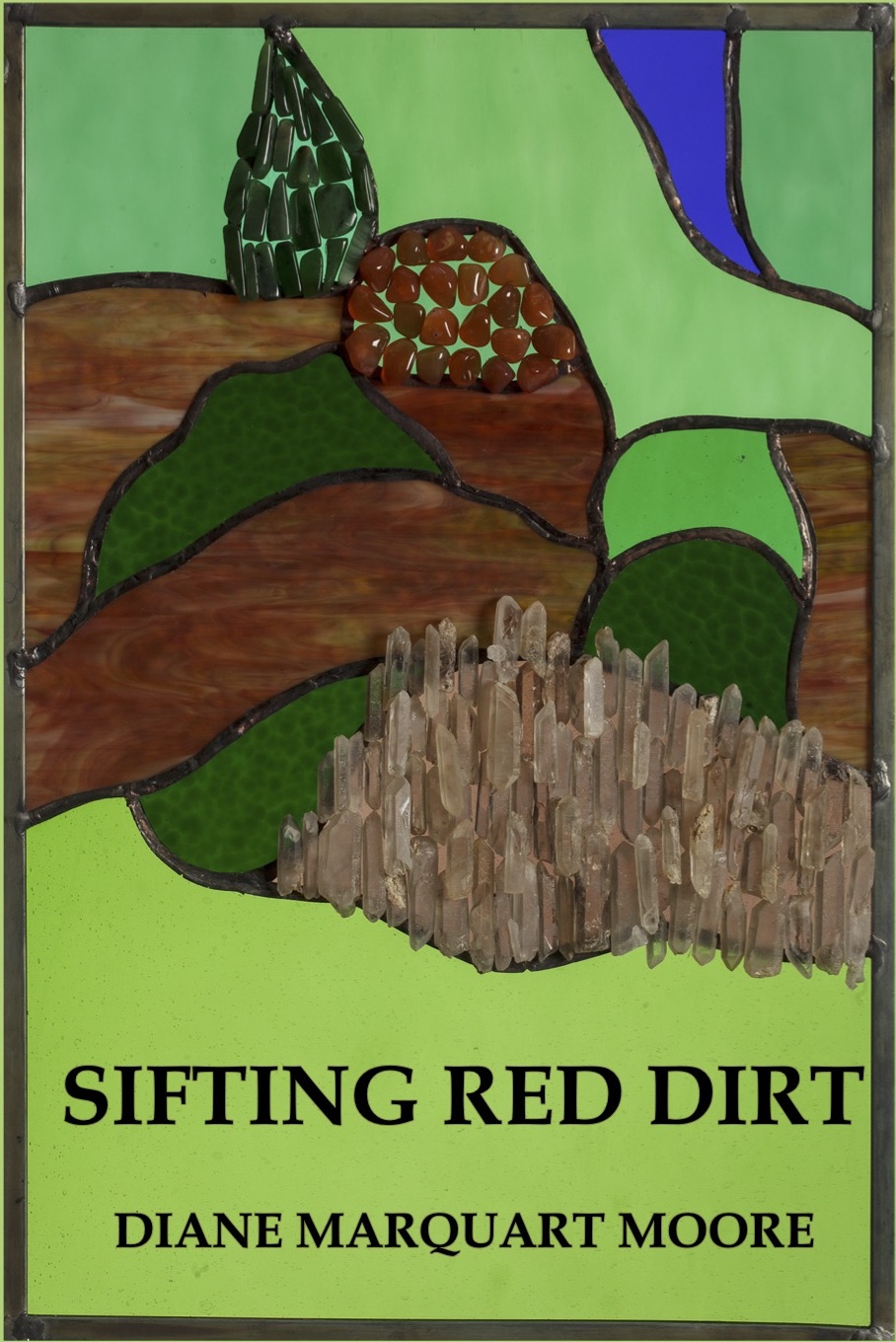
This week, I received the first copies of Sifting Red Dirt, my poetic offering for the year 2017. The cover, as usual, is a photograph of the unique glass work of Karen Bourque, a glass artist in Church Point, Louisiana. When I look at the beautiful glass pieces Karen renders to be photographed for the book covers of my poetry, I feel especially blessed to have her artwork in my home and on the book covers.

In the "Author's Note" of Sifting Red Dirt, I speak of the influence Karen has had on my work, and Border Press felt that the best introduction to this volume would be through the note about Karen's art being so compatible with my books:

"Last year I published a book of poetry featuring my Cajun ancestors about whom I had no knowledge until I reached my forties, and after the book, A Slow Moving Stream, appeared and I gave several readings, my maternal ancestors began to rival those paternal ancestors for inclusion in a book. They appeared in old photographs I had put away, in dreams, and in cogent memories...So I went to Mississippi where my great grandmother, Dora Runnels Greenlaw, was born and photographed a red hill near Brandon, Mississippi, then sent it to Karen Bourque of Church Point, Louisiana, who has rendered many of the wonderful glass pieces for covers of my books of poetry. Almost immediately, I was assailed with doubts about writing a book about them and announced I was finished before I began.

However, when I returned to Louisiana from my spring/summer stay in Sewanee, Tennessee and met for dinner with Karen and her husband, Darrell, former poet laureate of Louisiana, Karen gifted me with Brown Cotton, Red Hills, a wonderful glass piece. Karen gently placed her feet at my back, along with those deceased family members who had appeared in my dreams, and I began writing Sifting Red Dirt. Although it is among 46 books I could not have written without the support of Dr. Victoria I. Sullivan, owner of Border Press, during the last ten years Karen has become an intuitive co-creator in my work. Her glass pieces hang in my home in New Iberia, Louisiana and in the cottage at Sewanee, Tennessee, and one of the poems in Sifting Red Dirt is about her work."

Dr. Mary Ann Wilson, professor of English, University of Louisiana at Lafayette, best describes the poems in Sifting Red Dirt on the back cover as "resist[ing] an easy nostalgia but instead drill down to the core of feeling and memory...the poetry "taking us to the sources of personal and cultural identity — family and place..." Also, Dr. Darrell Bourque endorses the volume with a comment about the poems concerning "our mostly buried lives that shape us and define us in ways that are hardly explicable...Diane's story would not have been complete without those memories rising into language..."

Karen is working on another glass piece to illustrate one poem I've written about Prairie des femmes, Louisiana that will be among photographs of two or three glass pieces she created for my book covers. The photos will be featured alongside several of my poems in the fall/winter issue of Pinyon Review.

One of Karen Bourque's glass pieces is permanently exhibited in the Ernest J. Gaines Center, an international center for scholarship about the work of Gaines at the University of Louisiana at Lafayette; another was featured at the Louisiana Book Festival in Baton Rouge, Louisiana, and many hang in homes and churches throughout Acadiana. Her notes about the photographs of glass work on the covers of my books of poetry have appeared in several volumes and could be classified as "prose poems."


Tuesday, July 16, 2013

MORE ABOUT FLANNERY O’CONNOR

Dr. Mary Ann Wilson
A few months ago, I visited Andalusia, home of Flannery O’Connor, one of the foremost writers in the South. I came home with a thick volume of her work, including some of her “Occasional Prose” and wrote a blog about my visit to this peaceful property in Milledgeville, Georgia where O’Connor once lived and wrote. Since that time, I’ve had an abiding interest in her work and am sorry I missed a lecture last week entitled “Surprising Grace in the Writing of Flannery O’Connor” given by Rt. Reverend Henry Parsley, the retired 10th Bishop of Alabama and a former Chancellor of the University of the South. The lecture was sponsored by the Academy for Lifelong Learning which meets each month at St. Mary’s Conference Center here at Sewanee, Tennessee.
This week, on the heels of this lecture I received an e-mail from my good friend, Dr. Mary Ann Wilson, an English professor at the University of Louisiana at Lafayette, telling me about her latest connection to Flannery O’Connor’s work. Dr. Wilson was featured in a recent issue of La Louisiane, the magazine of the University of Louisiana at Lafayette, in which she was cited for discovering a 50-year old tape of an O’Connor lecture. The tape is a valuable recording of a talk O’Connor presented at Our Lady of Wisdom Catholic Church on the ULL campus just two years before she died of lupus during the 50’s.
Dr. Wilson was cleaning out her office files at the University when she came across a pink box with O’Connor’s tape entitled “The Catholic Writer in the Protestant South” (of which I have a print copy). She took the brittle tape to the University’s Center for Louisiana Studies and they used digitizing equipment to produce a 35-minute recording. The recording inspired Dr. Wilson to organize and coordinate a symposium that featured O’Connor scholars from throughout the U.S., and the audience heard parts of the recording during the sessions. The symposium was hosted by Our Lady of Wisdom’s Jeanmard Center in November, 2012.
Dr. Wilson reports that the tape captured the soft, South Georgia drawl of Flannery O’Connor, and applause and laughter punctuated the lecture O’Connor presented. Wilson teaches courses in Southern literature, many of them centered on Southern women writers, including O'Connor, this distinctive American writer of the twentieth century. She says that a colleague gave the O’Connor reel-to-reel tape to her years ago, and she forgot about it until she did a spring cleaning in her office.
Andalusia
After my visit to Andalusia in May, I read the particular essay which formed the basis for O’Connor’s lecture at ULL, “The Catholic Novelist in the South,” and re-read it after I received the article about Dr. Wilson. In the talk, O’Connor advocated that Catholic novelists in the future would be able to reinforce the vital strength of Southern literature, “for they will know that what has given the South her identity are those beliefs and qualities which she has absorbed from the Scriptures and from her own history of defeat and violation, a distrust of the abstract, a sense of human dependence on the grace of God, and a knowledge that evil is not simply a problem to be solved, but a mystery to be endured…”
O’Connor was a master at probing the mysteries of divine grace, and as a priest friend of mine said the other day at the breakfast table in St. Mary’s Convent, “We seem to find grace in everything she wrote, despite the depiction of characters who are driven to violence and their sometimes bizarre behavior…”

O’Connor scholars in the South are indebted to Dr. Wilson for rescuing this tape and getting it digitized for a permanent collection in the Edith Garland Dupre Library at ULL. The article about Dr. Wilson’s discovery appears in Volume 23, Number 1 of La Louisiane, a publication published twice a year at the University of Louisiana at Lafayette. 

Monday, July 8, 2013

MYSTICAL FOREST

While residing in this “mystical forest” in Sewanee, Tennessee, I’ve completed another book of poetry which is now available on amazon.com and, of course, at Border Press. I’m blessed to have the quiet time necessary to write while living on The Mountain, and some of the poems are about my life here. The title poem explores the feelings of an artist (my brother Paul) when he painted his perception of a mystical forest for his wife, Lori.
A section of the book focuses on another chapter in the ongoing “Going to Diddy Wah Diddy” saga, a saga fueled by postcards my mother bought on my childhood journey to California during the 40’s. Other poems focus on everyday life and people in Louisiana and on the Cumberland Plateau, as well as a poet’s struggle with the past and aging.
That’s a brief summary of the book. I’m not so self-aggrandizing as to review my own book, so I include here some of the wonderful affirmations and endorsements of Mystical Forest written by other authors, teachers, and poets:
Mystical Forest is a feast of a book. It finds its spiritual rhymes in poets as various as Donne and Herbert, as various as Hildegard, May Sarton and Mary Oliver. Diane Marquart Moore is a metaphysician who brings the sacred to this world she loves even with the dirt and grit ever in it; even with the hurt and wound ever a part of the mystical pact. Just as she loves and honors the imperfect world in these poems, so too does she love and honor whatever comes before and whatever comes afterward. If you should hear something like the birdsong of Olivier Messiaen and the risings in Arvo Pärt’s compositions when you read these poems, you are not just hearing things. Moore is that good.” –Darrell Bourque, author of Megan’s Guitar and Other Poems from Acadie, and former Louisiana poet laureate.

“‘A small world blooms/at the edge of a disturbed bay’ in numerous poems of Diane Marquart Moore’s newest collection, Mystical Forest. Whether in an affirmation of solidarity out of a history of abuse (‘Barbara’s painting’) in solitary prophecies received on a family pilgrimage by the young poet-to-be, or in a couple’s intimate twirl on the dance floor of the world (‘Dancing With the Stars’)–Moore’s poems illuminate small worlds with precision and poignancy as though one is entering the mystical purple light of her artistic mother’s ‘fragile dream.’ Is the real world truly the ‘backyard of paradise’? Could an owl’s hole in a tree offer a refuge of escape? Can a blast of Mozart sonatas evoke a world to counteract the doldrums of a gray winter’s freeze (‘Too Much Gray in the Day’)? These artfully crafted poems–‘words creating the plenty/of moments left standing’ – answer Yes.” –Isabel Anders, author of Miss Marple: Christian Sleuth; Becoming Flame; and Spinning Straw, Weaving Gold.

“With a poet’s craft, with a painter’s eye, Diane Moore’s evocative poems lead to places that are personal and universal. ‘Giving birth to simple insights,’ Moore writes – just one more reason to follow her on a rewarding journey.” –Michael Miller, author of Into This World.

“This wonderful collection sings of friends, family, and place, but also of loss, regret, and wonder – all part of a life well lived, richly imagined, and beautifully expressed. Its poems resonate with clear observation and earned wisdom. Whether tracing a childhood odyssey out west, or simply capturing the landscapes of her Louisiana and Tennessee homes, Diane Moore gives us a world that brings us back to our own with renewed clarity and insight.” –Mary Ann Wilson, Departments of English and Women’s Studies, University of Louisiana, Lafayette.

I’m humbled by the endorsements these fine writers have written about Mystical Forest and hope that you enjoy this, my 34th book. 

Sunday, February 17, 2013

ROCKING AT CASA AZUL


Poets' paradise
 “You rock!” a friend on Facebook wrote to me yesterday. She was referring to my poetry reading with Brad Richard at Casa Azul Thursday evening, and I know Brad and I weren’t the only poets rocking and reading at this regularly-scheduled poetry night in Grand Coteau, Louisiana. The open mic featured three seasoned poets: former poet laureate Darrell Bourque, reading from his forthcoming book, Megan’s Guitar and Other Poems from Acadie; poet Clare Martin, author of Eating the Heart First; and Patrice Melnick, owner of Casa Azul and a writer who is presently compiling her own collection of poetry. However, the performer who captured the limelight was Carol Rice, a budding poet who stole the show with her lyrics about a dead possum. It was a fun night, and I came away impressed with the work that Patrice Melnick is doing as director of the Festival of Words Cultural Arts Collective in this small town (pop. 1000) in south Louisiana.

Patrice calls her work with poets “The Casa Azul Series,” a program in its sixth year that has attracted poets from throughout south Louisiana and further afield. The program also draws an audience that participates in the poetry reading when Patrice passes around a piece of paper with an unfinished line on it, asking that members of the audience add to the line. Since the series at which I read was held on Valentine’s Day, the line for this occasion read, “My love is as…” and the hilarious poem was read at the conclusion of the reading by participant Dr. Mary Ann Wilson, professor of English at the University of Louisiana at Lafayette. The unfinished poem is a way of engaging the audience and furthers Patrice’s goal of building a community that supports poetry and the arts. She says that the engagement process has attracted professional and novice poets who read at open mic time, and it sometimes brings in poets who have never read their poetry for any occasion. Patrice has also established a documentary program, “Grand Coteau Voices: The Good, The Bad, The Complicated,” which features the stories of Grand Coteau citizens and provides a historical record of the townspeople’s lives. Chere Breaux began filming these stories in January, 2012.


Poets' stage at Casa Azul

Patrice migrated to Grand Coteau during a sabbatical from teaching English as an Associate Professor at Xavier University in New Orleans and moved to the “provinces” following Hurricane Katrina in 2005. She was a former Peace Corps worker in the Central African Republic, worked at Pelican Publishing in New Orleans for several years, and has written a riveting memoir entitled Po-Boy Contraband, that includes chapters concerning her struggles with a debilitating disease and commentary about how important poetry, Reggae, Zydeco, the Neville Brothers, and other music has been in treating her illness. Concerning the music important to her, she writes in her first book, Turning Up the Volume: “Like drunks sliding quarters into a jukebox to draw out the voices of Patsy Cline, Lyle Lovett, Townes Van Zandt, Willie Nelson, Nathan and the Zydeco Cha Chas and Lucinda Williams; all those voices wail from the car radio, howl from the neon lit jukebox in the corner. Those voices call inside my head like richly-feathered, hungry owls…”


Patrice Melnick, poet, writer, director
of Festival of Words
 I appreciate the comment about my poetry reading from the friend who says I rock, but last Thursday I was just one voice holding forth in the back room of a small shop painted a vivid blue hue that sits on the main drag of Grand Coteau, Louisiana. Under the arching branches of old live oaks, Casa Azul rocks every Thursday evening, bringing in new and old poets, children and elderly participants who are happy to have a venue in bayou country for celebrating the work of the Muse.

Brava Patrice – keep on creating the space for us to rock!

Monday, July 30, 2012

HIGHLANDER FOLK SCHOOL

Last week, we hosted dinner for Henry and Kathy Hamman, owners of Plateau Press here on the Mountain in honor of a visit from Dr. Mary Ann Wilson, professor of English, University of Louisiana at Lafayette. After dinner, we enjoyed a lively discussion about a school on the Cumberland Plateau that I had never heard mentioned during the five years I’ve spent at Sewanee. The Highlander Folk School, once located between Monteagle and Tracy City, Tennessee, not more then ten miles away, no longer functions but it has evolved into the Highlander Research and Education Center in New Market, Tennessee.
Henry informed us that we could still see the old Highlander Folk School structure in Grundy County, so the next day we went on a field trip to search for one of our regional historic sites. We located the plaque commemorating the school but never found the old structure. However, some time in the near future the Hammans have promised to take us to the location of the school that was established to “provide training for rural and industrial leaders and for the conservation and enrichment of the indigenous cultural values of the mountains.”
The Highlander Folk School was an amazing venture established in 1932 by Myles Horton, an activist; Don West, an educator; and James A. Dombrowski, a Methodist minister. During the 1930’s and 1940’s, the school focused on labor education and the training of labor organizers, but the staff later developed a literacy program for Blacks who couldn’t vote because they were illiterate. This program at Highlander Folk School later transferred to the Southern Christian School because the State of Tennessee threatened to close the Highlander’s doors.
The school played an important role in the Civil Rights Movement and such notable leaders as Martin Luther King, Rosa Parks, and Septima Clark, visited the school and were involved in its trainings. During the 1950’s, southern newspapers attacked the Highlander Folk School, accusing its staff of causing racial strife. The State of Tennessee forced the school to close its doors in 1961 after moonshine mysteriously appeared on its property, and the staff was falsely accused of being a communist training center.
An interesting account about the attacks on the Highlander Folk School by white supremacists appeared in 2003 in a senior thesis by Laura Grantmyre. It detailed white supremacist responses to anti-racist activities. The thesis reveals how white supremacy is interwoven with systems of gender and is embedded in certain cultures. “Charges of communism, atheism, and interracial immorality were used by white political elite of the South in their attacks,” Grantmyre wrote.
The Highlander Folk School closed its doors and moved to New Market following the adverse reaction to its mission, and during the 1960’s and 1970’s, it focused on worker health and safety in the coalfields of Appalachia and helped initiate the Southern Appalachian Leadership Training Program.
Eleanor Roosevelt, one of the notables who visited the school in its infancy, became interested in the Highlander Folk School’s objectives related to economic justice and equality. We look forward to the search for the site of a school that addressed issues of national and international importance – once located approximately eight miles away in a small rural community near Sewanee, Tennessee.