Showing posts with label Dora Runnels Greenlaw. Show all posts

Thursday, November 1, 2018

ALL SAINTS

Dorothy Greenlaw Marquart


Today is All Saints Day, and, in honor of those who’ve inspired our faith we recognize both ancient and recent family saints. I could probably drum up a list of women who have led me, intentionally and otherwise, into religious inquiry and active church work, but the most notable ones were two who were included in my second book entitled Their Adventurous Will: Profiles of Memorable Louisiana Women. Those profiles deserve a revisit today.

The first woman was, of course, my mother, Dorothy Greenlaw Marquart, and in Their Adventurous Will, I wrote: “One of her greatest legacies to me was a love of the Anglican Church to which she was deeply devoted after her conversion as a teenager. She single-handedly attempted to establish a mission church in my hometown of Franklinton, Louisiana with its predominantly Baptist population. The Episcopal church was never built, although a sign advertising the mission stood for a long time on a vacant lot which she had coerced an old family Franklintonite to donate. She didn’t convert enough Baptists, Methodists, or Roman Catholics to build the church and congregation but she did accomplish some consciousness raising about Anglicanism. While she was working on the project, the Episcopal Bishop of the Diocese of Louisiana introduced her to someone as that ‘woman with the red hot poker who gets people moving.’

“When I went home for her funeral, some of her friends and family members said to me: ‘She was too good.’ She probably wouldn’t have liked that remark; she didn’t think of her life as role playing or as some kind of martyr’s legend. She simply believed in St. John the Divine’s words: ‘Absolute self giving is the only path from the human to the divine.’ Friends and family also told me: ‘She was proud of you.’ I know she was. I am proud of her. She gave me the ability to perceive ‘tongues in trees,’ the sight to see ‘books in the running brooks, sermons in stone and good in everything.’ She also gave me a love of nature, music, humor, and imagination…”

Dora Runnels Greenlaw


“My great-grandmother, Dora Runnels Greenlaw, who died the night I was born and executed a literary and religious transfer to me (according to family members), was also a visionary who felt her life purpose to be that of a missionary and who spread the Gospel from a horse-drawn buggy of the kind used to transport country doctors to their house calls. Like the American poetess, Emily Dickinson, Dora Runnels was semi-reclusive, spending days writing verse in a back room of the old Greenlaw home in Franklinton and mysteriously appearing in the afternoons to venture forth on her missionary calls. The record of her talents can be found in a few pamphlets of verse which her son Edward published on a small printing press he owned and in a booklet which I discovered in the Louisiana Room of the Louisiana State Library entitled Memoirs of the Baptist Women’s Missionary Union of Washington Parish Association, published in the early 1900’s. 

“Like many of the subjects in Their Adventurous Will, Dora met with considerable opposition when she attempted to make her contribution to society…One day in 1908 she set out in her buggy drawn by faithful Nell. A female companion accompanied her and ‘kindly piloted her over the six miles from Franklinton to Spring Hill, over mud holes and through the beautiful pine forests.’… En route, the zealous women passed a Baptist minister who was traveling to Franklinton. The minister had been informed about the two women’s mission, and Dora expected a show of cordiality as he passed. She slowed her horse but the stone-faced pastor merely tipped his hat as the two buggies passed one another. Dora was hurt, puzzled, but suppressed her feelings and drove on toward Spring Hill. Finally, she turned to her companion, who knew the pastor well, and asked for an explanation of the minister’s behavior. ‘He does not believe in the organization of women. None of our pastors nor laymen do. They are sincere in their belief that women must keep silent and leave the work to men.’ At that time, Dora did not express her disapproval of the pastor’s attitude, but she later wrote in Memoirs of the Baptist Missionary Union: ‘The opposition of pastors was the mountain to be removed. The enormity of it strengthened my purposes.’ Following this incident she accelerated her missionary efforts and spearheaded the formation of missions in sixteen communities, serving as the superintendent of the Women’s Missionary Union in Washington Parish from 1908-1920. Her summation of the missionary effort was: ‘God had prepared the way and bidden his people to Go Forward.’”


In Their Adventurous Will, I attempted to portray “saints,” Louisiana women who took great leaps of faith and, in all cases, made something so that had been envisioned as impossible, moving their ideas from conception to being with extraordinary fervor and faith. The epigram in this book was taken from Sonnet 67 by Edna St. Vincent Millay and is deserving of space here: 

Upon this marble bust that is not I
Lay the round, formal wreath that is not fame;
But in the forum of my silenced cry
Root ye the living tree whose sap is flame,
I, that was proud and valiant, am no more;
Save as a dream that wanders wide and late,
Save as a wind that rattles the stout door,
Troubling the ashes in the sheltered grate.
The stone will perish; I shall be twice dust.
Only my standard on a taken hill
Can cheat the mildew and the red brown rust
And make immortal my adventurous will.
Even now the silk is tugging at the staff:
Take up the song;
forget the epitaph.


Monday, October 29, 2018

FROZEN RED DIRT

Red clay hills near Brandon, Mississippi

A friend of mine recently told me that I have a migratory spirit, and I have to agree with him. ‘Seems like when I’m in Sewanee, Tennessee, I make at least six visits to sites in surrounding states during my six-month sojourn. When I’m in Louisiana, I search for places to explore in Mississippi, Alabama, and Texas. I know the old adage, “A rolling stone gathers no moss,” but the idea of becoming a mossback has no appeal for me either. Last week, I stopped in Meridian, Mississippi to visit the MAX Arts Center there and had an envee to stay awhile but continued on to Louisiana. Since that visit to the magnolia state, I’ve been yearning to return to the birth site of my maternal great-grandmother in Brandon, Mississippi.

This morning I was reading an old edition of Off the Beaten Path published by the Reader’s Digest, and I discovered a notation about Flora, Mississippi, site of a Mississippi petrified forest. A photograph of what I call “frozen red dirt” had been placed beside the article, and I developed pangs to explore the only petrified forest east of the Rockies created from remains of primeval forests — driftwood buried in and preserved by silt and sand. I looked at the picture “long and long” before putting it on a list that I’d made to satisfy my migratory spirit. The photo showed deeply-eroded cliffs studded with petrified logs. According to the article in Off the Beaten Path, the red sands that identify them to me as “frozen red dirt” were river deposits in which the petrified process had begun —the vivid red dirt fascinated me.

Brown Cotton and Red Dirt by Karen Bourque

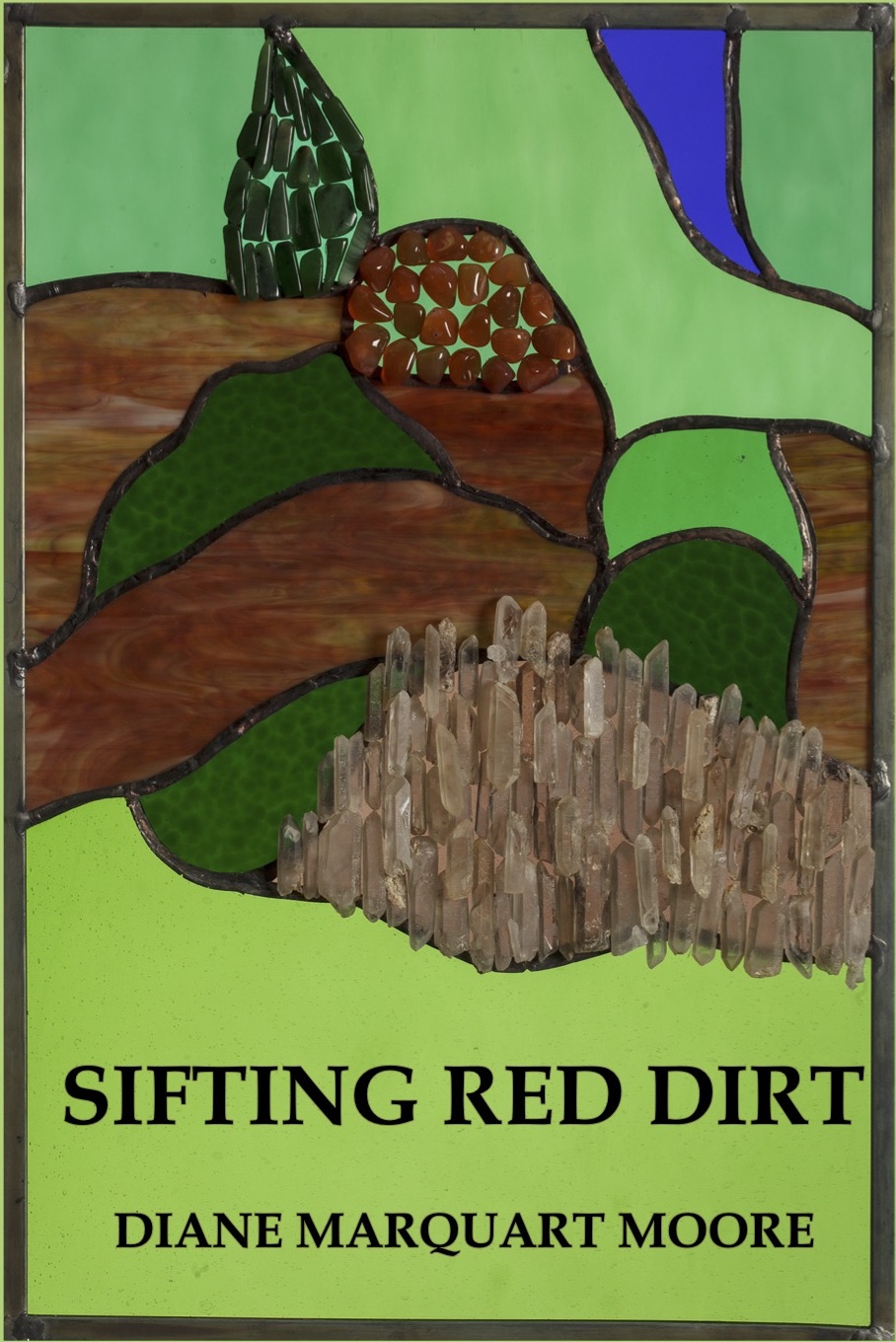
In 2017 I asked my friend Karen Bourque, glass artist in Church Point, Louisiana, to create a glass piece that I could photograph for a book of poetry I’d written entitled Sifting Red Dirt, and she gifted me with her version of Mississippi hills around Brandon, Mississippi where my maternal great-grandmother was born. The book contained a collection of poems about my forebears (the red dirt side that balances out my Cajun side).

After seeing the photo of the petrified forest in Flora (near Jackson, Mississippi), I went out on the glass porch where I keep some of Karen’s art and stood before the glass piece she entitled “Brown Cotton and Red Dirt.”

“We have to make a trip to a petrified forest in Mississippi,” I told my traveling companion, Dr. Victoria Sullivan. “The spirits of my Mississippi ancestors must be hovering in that area. The petrified formations are 36 million years old.”

“Your ancestors’ spirits hover everywhere,” she said. “They’re ubiquitous. Where are we going now?”

“Flora, Mississippi. It’s near Jackson.”

“Population under 2000, I’m sure.”

“How did you guess? I know you like cities, but the most interesting places are those less frequented.”

“Your ancestors were country hicks on both sides. They must have been afraid of tall buildings,” she said.

“It’s important to visit places that carry the spirit of your cultural identity,” I retorted.

Dr. Sullivan sighed and went to the computer. As publisher of most of my poetry writings, she keeps a file of photos that appear on the covers of my books, so I knew why she had sought out her computer. 

Pandora C. Runnels Greenlaw

“It’s under Sifting Red Dirt,” I instructed, and before I could continue, she brought up the photo that had been the model for Karen’s glass piece. “Just think about how arresting that frozen red dirt will be on another cover.” I began to recite the first few verses of “Pandora’s Legacy” (That was great-grandmother’s name, but she shortened it to Dora. As far as my family knows, she was pure-dee redneck, but whence the name “Pandora”??)

PANDORA’S LEGACY

Great Grandmother Dora Runnels
planted her feet in red dirt,
her happiness, not of this earth;
in barren places among soughing pines
she rode a path to martyrdom,
her boots making snail tracks in dust,
the traveling feet of a missionary,
a pilgrim marching toward Calvary.

The night I was born
she disappeared into earth
leaving me faded photographs,
the promise of another light beckoning.
She was an old woman gone mute,
puffs of red dust sifting into a grave,
the past slipping between her fingers
passing on her love, a bidding to me.

Dora Runnels knew her way
through red clay hills,
remote light guiding her,
narrow rails through empty towns.
Her life, now a silent movie reel
out of focus, slowly unwinds
each time I pass red mounds
and fallen needles…”


There are five more verses to this elegy, and as I re-read it, I pencil in “Flora” on my wander list, knowing that I may not be lingering in New Iberia beyond November before taking a trip. As I quoted in the epigram of Sifting Red Dirt: “As though memory/were a large orchestra/without a repertoire/till it began.” Erratic Facts, Kay Ryan


Thursday, March 2, 2017

SIFTING RED DIRT

This week, I received the first copies of Sifting Red Dirt, my poetic offering for the year 2017. The cover, as usual, is a photograph of the unique glass work of Karen Bourque, a glass artist in Church Point, Louisiana. When I look at the beautiful glass pieces Karen renders to be photographed for the book covers of my poetry, I feel especially blessed to have her artwork in my home and on the book covers.

In the "Author's Note" of Sifting Red Dirt, I speak of the influence Karen has had on my work, and Border Press felt that the best introduction to this volume would be through the note about Karen's art being so compatible with my books:

"Last year I published a book of poetry featuring my Cajun ancestors about whom I had no knowledge until I reached my forties, and after the book, A Slow Moving Stream, appeared and I gave several readings, my maternal ancestors began to rival those paternal ancestors for inclusion in a book. They appeared in old photographs I had put away, in dreams, and in cogent memories...So I went to Mississippi where my great grandmother, Dora Runnels Greenlaw, was born and photographed a red hill near Brandon, Mississippi, then sent it to Karen Bourque of Church Point, Louisiana, who has rendered many of the wonderful glass pieces for covers of my books of poetry. Almost immediately, I was assailed with doubts about writing a book about them and announced I was finished before I began.

However, when I returned to Louisiana from my spring/summer stay in Sewanee, Tennessee and met for dinner with Karen and her husband, Darrell, former poet laureate of Louisiana, Karen gifted me with Brown Cotton, Red Hills, a wonderful glass piece. Karen gently placed her feet at my back, along with those deceased family members who had appeared in my dreams, and I began writing Sifting Red Dirt. Although it is among 46 books I could not have written without the support of Dr. Victoria I. Sullivan, owner of Border Press, during the last ten years Karen has become an intuitive co-creator in my work. Her glass pieces hang in my home in New Iberia, Louisiana and in the cottage at Sewanee, Tennessee, and one of the poems in Sifting Red Dirt is about her work."

Dr. Mary Ann Wilson, professor of English, University of Louisiana at Lafayette, best describes the poems in Sifting Red Dirt on the back cover as "resist[ing] an easy nostalgia but instead drill down to the core of feeling and memory...the poetry "taking us to the sources of personal and cultural identity — family and place..." Also, Dr. Darrell Bourque endorses the volume with a comment about the poems concerning "our mostly buried lives that shape us and define us in ways that are hardly explicable...Diane's story would not have been complete without those memories rising into language..."

Karen is working on another glass piece to illustrate one poem I've written about Prairie des femmes, Louisiana that will be among photographs of two or three glass pieces she created for my book covers. The photos will be featured alongside several of my poems in the fall/winter issue of Pinyon Review.

One of Karen Bourque's glass pieces is permanently exhibited in the Ernest J. Gaines Center, an international center for scholarship about the work of Gaines at the University of Louisiana at Lafayette; another was featured at the Louisiana Book Festival in Baton Rouge, Louisiana, and many hang in homes and churches throughout Acadiana. Her notes about the photographs of glass work on the covers of my books of poetry have appeared in several volumes and could be classified as "prose poems."