Showing posts with label Their Adventurous Will. Show all posts

Friday, March 1, 2019

ABOUT BOOKS


Today marks the birthday of my great-granddaughters, Kate and Lillian, and tomorrow I'll travel to Baton Rouge to celebrate the occasion with them. This morning, in a telephone conversation with my daughter Stephanie, before I thought about what I was saying, I commented apologetically, "I'm just giving them books."

My mother probably turned over in her grave when I made this remark since she believed that books were the most valued possessions in any home. During WWII, she regarded them as more precious than rationed food.

In the introduction to my now out-of-print book, Their Adventurous Will, a volume about Louisiana women, I wrote that she read aloud to us every night and related how that nightly reading contributed to my development as a writer: "When I was three years old, she'd seat me, cross-legged in the middle of our small kitchen, and open for me giant editions of Mother Goose, A Child’s Garden of Verse, and Marigold Garden…She read aloud the entire series of Uncle Wiggly in the Cabbage Patch, The Little Colonel, Raggedy Ann and Andy, Greek Legends, Black Beauty and Grimm's Fairy Tales, even after all the children in our family had learned to read…"

In that same introduction, I wrote about another family member, my Godmother Dora, who built a library of books that would challenge my own 2,000-and-more book collection. "Books by mystics, theologians, poets, and Christian apologists crowded the bookshelves in her home," I wrote. "A visitor might be engaged in intent conversation with her, and she'd suddenly scurry away on her tiny feet, select a book from a shelf nearby and begin reading some lengthy passage. On the flyleaf of a small, yellow-gold volume entitled The Fruits of the Spirit by Evelyn Underhill, which Dora gave me in 1963, she inscribed in her elegant but often-illegible handwriting: "For Diane, for whom we wish the fruits of the spirit above all else…"
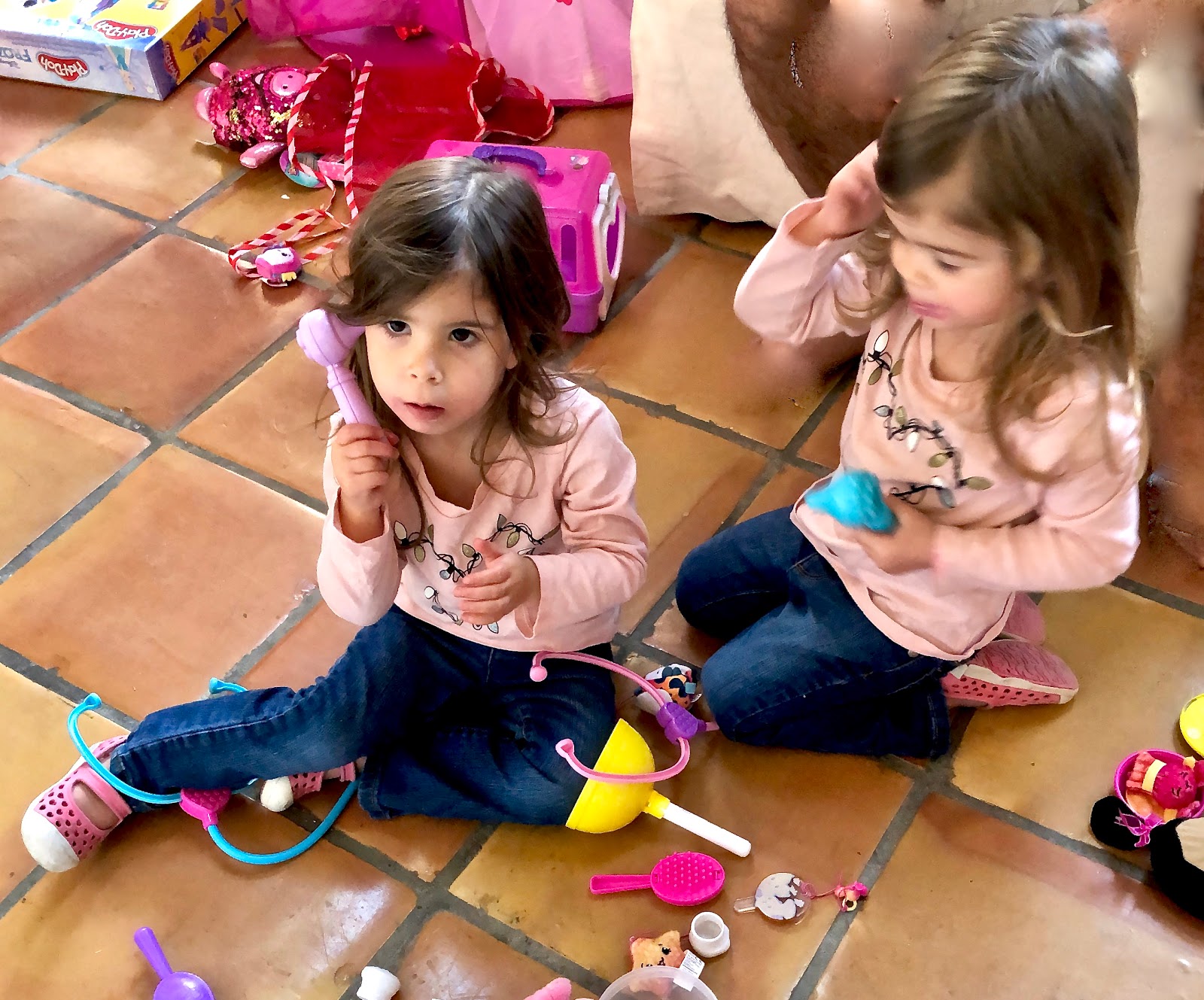
Lillian and Kate with Christmas toys, 2018

Dora was a stern critic of literature and had she lived to read my books, she would've referred me to those disciplined writers who put in their 10,000 hours before calling themselves poets. However, a friend recently told me that her band leader in high school often admonished, "practice won't make you a great musician if you practice wrong." 

Recently I loaned a copy of Their Adventurous Will to a friend and when she returned the book, I found a message on a sticky note within telling me that as she read the introduction about my mother, she journeyed back to her own childhood and the times her Mama had read to the family long after they could read themselves. "It was a special bonding time," she added.

Just yesterday, when I visited a funeral home to pay respects to an old friend, her daughter told me that in her mother's demise, she often requested that "someone read aloud to her." Her daughter would protest that there were mostly children's books available in the house. "I don't care," her mother had said. "Just read to me!" And the implication was that, like my mother, she probably enjoyed children's books as much as any contemporary novel or tome.

When Sister Elizabeth came down to New Iberia from the Convent of St. Mary in Sewanee, Tennessee last year, she did a "walk through" of my home and gave us her candid appraisal. "I always go into a home and find myself thinking about what their major interests are," she said. (Now there are many crosses scattered about and I'm a deacon, but she didn't list them as a major interest). 

Instead, she commented, "Books and art…you really value them." She was spot on. So now I'm wondering why I apologized about giving my great-grandchildren "just books," and this blog is an apology for making such a foolish remark.


As Piglet (in Winnie the Pooh) said to Eeyore: "Many happy returns of the day" to precious Kate and Lillian. May you always have an abundance of beloved stories of adventure, friendship, and fun in your home.


Thursday, November 1, 2018

ALL SAINTS

Dorothy Greenlaw Marquart


Today is All Saints Day, and, in honor of those who’ve inspired our faith we recognize both ancient and recent family saints. I could probably drum up a list of women who have led me, intentionally and otherwise, into religious inquiry and active church work, but the most notable ones were two who were included in my second book entitled Their Adventurous Will: Profiles of Memorable Louisiana Women. Those profiles deserve a revisit today.

The first woman was, of course, my mother, Dorothy Greenlaw Marquart, and in Their Adventurous Will, I wrote: “One of her greatest legacies to me was a love of the Anglican Church to which she was deeply devoted after her conversion as a teenager. She single-handedly attempted to establish a mission church in my hometown of Franklinton, Louisiana with its predominantly Baptist population. The Episcopal church was never built, although a sign advertising the mission stood for a long time on a vacant lot which she had coerced an old family Franklintonite to donate. She didn’t convert enough Baptists, Methodists, or Roman Catholics to build the church and congregation but she did accomplish some consciousness raising about Anglicanism. While she was working on the project, the Episcopal Bishop of the Diocese of Louisiana introduced her to someone as that ‘woman with the red hot poker who gets people moving.’

“When I went home for her funeral, some of her friends and family members said to me: ‘She was too good.’ She probably wouldn’t have liked that remark; she didn’t think of her life as role playing or as some kind of martyr’s legend. She simply believed in St. John the Divine’s words: ‘Absolute self giving is the only path from the human to the divine.’ Friends and family also told me: ‘She was proud of you.’ I know she was. I am proud of her. She gave me the ability to perceive ‘tongues in trees,’ the sight to see ‘books in the running brooks, sermons in stone and good in everything.’ She also gave me a love of nature, music, humor, and imagination…”

Dora Runnels Greenlaw


“My great-grandmother, Dora Runnels Greenlaw, who died the night I was born and executed a literary and religious transfer to me (according to family members), was also a visionary who felt her life purpose to be that of a missionary and who spread the Gospel from a horse-drawn buggy of the kind used to transport country doctors to their house calls. Like the American poetess, Emily Dickinson, Dora Runnels was semi-reclusive, spending days writing verse in a back room of the old Greenlaw home in Franklinton and mysteriously appearing in the afternoons to venture forth on her missionary calls. The record of her talents can be found in a few pamphlets of verse which her son Edward published on a small printing press he owned and in a booklet which I discovered in the Louisiana Room of the Louisiana State Library entitled Memoirs of the Baptist Women’s Missionary Union of Washington Parish Association, published in the early 1900’s. 

“Like many of the subjects in Their Adventurous Will, Dora met with considerable opposition when she attempted to make her contribution to society…One day in 1908 she set out in her buggy drawn by faithful Nell. A female companion accompanied her and ‘kindly piloted her over the six miles from Franklinton to Spring Hill, over mud holes and through the beautiful pine forests.’… En route, the zealous women passed a Baptist minister who was traveling to Franklinton. The minister had been informed about the two women’s mission, and Dora expected a show of cordiality as he passed. She slowed her horse but the stone-faced pastor merely tipped his hat as the two buggies passed one another. Dora was hurt, puzzled, but suppressed her feelings and drove on toward Spring Hill. Finally, she turned to her companion, who knew the pastor well, and asked for an explanation of the minister’s behavior. ‘He does not believe in the organization of women. None of our pastors nor laymen do. They are sincere in their belief that women must keep silent and leave the work to men.’ At that time, Dora did not express her disapproval of the pastor’s attitude, but she later wrote in Memoirs of the Baptist Missionary Union: ‘The opposition of pastors was the mountain to be removed. The enormity of it strengthened my purposes.’ Following this incident she accelerated her missionary efforts and spearheaded the formation of missions in sixteen communities, serving as the superintendent of the Women’s Missionary Union in Washington Parish from 1908-1920. Her summation of the missionary effort was: ‘God had prepared the way and bidden his people to Go Forward.’”


In Their Adventurous Will, I attempted to portray “saints,” Louisiana women who took great leaps of faith and, in all cases, made something so that had been envisioned as impossible, moving their ideas from conception to being with extraordinary fervor and faith. The epigram in this book was taken from Sonnet 67 by Edna St. Vincent Millay and is deserving of space here: 

Upon this marble bust that is not I
Lay the round, formal wreath that is not fame;
But in the forum of my silenced cry
Root ye the living tree whose sap is flame,
I, that was proud and valiant, am no more;
Save as a dream that wanders wide and late,
Save as a wind that rattles the stout door,
Troubling the ashes in the sheltered grate.
The stone will perish; I shall be twice dust.
Only my standard on a taken hill
Can cheat the mildew and the red brown rust
And make immortal my adventurous will.
Even now the silk is tugging at the staff:
Take up the song;
forget the epitaph.


Saturday, May 12, 2018

LOOKING BACK ON MOTHER’S DAY

Dorothy Greenlaw Marquart and son Paul

Tomorrow is Mother’s Day, and I plan to include a few excerpts about my mother from the introduction to Their Adventurous Will, Profiles of Memorable Louisiana Women, a book I wrote in 1984, in a sermon I’ll preach. Since the introduction is on my screen this morning, I felt that a redo of it would be appropriate to include in “A Words Worth” to celebrate this auspicious occasion:

“A few years ago, in the silence of too much winter, my mother passed away. Her death shocked and grieved me, and in attempting to transcend the offense of her death, I wrote a tribute to her in my column, “Cherchez la femme,” which was featured in the Daily Iberian, New Iberia, Louisiana. In writing about Mother, some of the qualities which marked her as an outstanding woman became more apparent to me and that recognition of her uniqueness moved me toward writing this book. She isn’t among the women highlighted in the following essays, but I feel that a small cameo of her life belongs in the introductory notes to this volume.

A friend and I were once discussing our mothers, and I asked her if she remembered the scene in Peter Pan in which Tinker Bell is dying and Peter asks for those in the world who believe in fairies to clap their hands.

“Well,” I told my friend, “my mother would have been the first to clap her hands.”

She was fantasy itself; she saw sprites dancing in open fires, drew pictures of gnomes painting the woodlands and created pastels of quaint cliff dwellings where other-world spirits lived.

My mother loved words and books. When I was three years old, she would seat me, cross-legged in the middle of a small kitchen, and open for me giant editions of Mother Goose, A Child’s Garden of Verse, and Marigold Garden, laughing at friends who often dropped in to proclaim that I was backward because I didn’t talk and only sat quietly, absorbing the book characters she knew I’d remember for a lifetime.


She read aloud the entire series of Uncle Wiggly in the Cabbage Patch, The Little Colonel, Raggedy Ann and Andy, Greek Legends, Black Beauty and Grimm’s Fairy Tales, even after all of the children in our family had learned to read.

Every month for years, Mother would take one of the three children in our family to Claitor’s Bookstore in Baton Rouge, Louisiana, to choose two books for our nightly reading session. She was the first family member to open the books, touching the pictures with credulous delight. My mother began to fly in the heavens long before Mary Poppins opened her first umbrella to make her wonderful flights! For her, I wrote my first story at age six. I remember only that the tale concerned a small child who opened a door in a tree and found herself in a fantasy world similar to Alice’s Wonderland.

My mother was one of the first Golden Eaglet Girl Scouts in the United States, an honor bestowed on her in the early 1920’s when Girl Scouting was in its infancy. She loved woodlands, flowers, and even garter snakes, one of which became her favorite pet when she camped-out, primitive style, in the Dismals of Alabama after winning a trip to Juliette Low Girl Scout Camp.

One of her greatest legacies to me was a love of the Episcopal Church to which she was deeply devoted after her conversion as a teenager. She single-handedly attempted to establish a mission in my hometown of Franklinton, Louisiana, with its predominantly Baptist and small Roman Catholic population. 

The church was never built, although a sign advertising the mission church still stands on a vacant lot which she had coerced an old-family Franklintonite to donate. She didn’t convert enough Baptists or Roman Catholics to build the church and congregation but she did accomplish some “consciousness-raising” about Anglicanism. While she was working on the project, the Episcopal Bishop of the Diocese of Louisiana introduced her to someone as “that woman with the red-hot poker who gets people moving.”

When Mother was a teenager, she exemplified the phrase which accompanied my graduation picture in my high school annual: “Large, divine and comfortable words.” She loved the syllables and accents of words and would roll them out at inappropriate times as she did following a Baptist Church service when she filed out the door and shook the minister’s hand.

“Dr. Gayer, that was really an excruciating sermon,” she remarked, thinking she had expressed a highly complimentary description of his delivery.

“Well, yes, Miss Greenlaw,” he answered, “come to think of it, it probably was.”

My mother was the only Protestant Jewish mother I knew. When one of her five children became ill, she prepared chicken soup, grape juice ice (grape juice poured into an ice tray and frozen, then sliced), milk toast and caramel pie. In the manner of a traditional Jewish mother (which she wasn’t), taking care of the family was probably her singular life goal. Even after my brothers had grown up and married, they came home to her when they were ill and upset. She died while still looking after two of them.

She was one of the most sensitive persons I’ve ever known; yet she was tough in the tenacious, weather-beaten way of those trees she loved so well.

When I went home for her funeral, some of her friends and family members said to me: “She was too good.” She probably wouldn’t have liked that remark; she didn’t think of her life as role-playing or as some kind of martyr’s legend — she simply believed in St. John the Divine’s words: “Absolute self-giving is the only path from the human to the divine.”
Friends and family also told me: “She was proud of you.” I know she was. I’m proud of her. She gave me the ability to perceive “tongues in trees,” the sight to see “books in the running brooks, sermons in stone and good in everything.” She also gave me a love of nature, music, humor, and imagination.

Mother was buried in a dress with bright red buttons because she not only loved red, she lived red. Vivacious, garrulous, she was a woman who talked back to life situations which would have felled me years ago.


Back in the mid-1960’s, I wrote a poem about my father which was published in American Weave, a literary journal, and my mother showed the tiniest bit of jealousy that I hadn’t published something about and for her. I told her then that I would write a poem about her. I never did. But Their Adventurous Will is for her. Somehow, I think she’ll be able to read it, even without her glasses.”

Happy Mother's Day!

Thursday, March 8, 2018

TREE HUNTING AGAIN

Redbud at Chicot State Park (photo by Victoria I. Sullivan)

Some tree huggers I know are still hiking on wooded trails at age 82, but I have to admit that I struggle to make treks through forests at my age. I’m sure that Louisiana’s famous botanist, Caroline Dormon, who “carved trails through the woods, scooped out a reflection pond and planted hundreds of wildflowers, trees, and shrubs”* was a brisk walker until she reached at least 80, but I was sorely tested on a two-mile-trek looking for a crabapple in bloom yesterday in the Louisiana State Arboretum near Ville Platte, Louisiana. I discovered a blooming redbud for which I’d been searching, but the crabapple blossoms were too high to photograph, and we turned back on the PawPaw Loop Trail before I attempted to climb any steeper hills.

The Louisiana State Arboretum is a 600-acre preservation area of 5 1/2 miles of hiking opportunities for real hikers and covers a bottomland hardwood forest and a Beech-Magnolia Forest, and we enjoyed the hour in this nature preserve, despite my bum knee. I’m writing a book of poetry that Dr. Victoria I. Sullivan is photographing for me. She has spent the last forty years identifying trees and plants for me and always attempts to provide opportunities for me to engage in outdoor exercise. I was disappointed that I couldn’t get a photo of the crabapple and saw only a few white flower petals beneath one of the tallest crabapple I’ve glimpsed in my 82 years.

In the introduction to Let the Trees Answer (the book of poetry and photos about trees) I pay tribute to my mother who loved the woods. I relate that one of her paintings showing a gnome standing beneath a tree, holding a paintbrush and palette, hung in her bedroom until the 1980’s, and that piece of art symbolized her love of woods and the mystical connection to creativity my mother certainly felt. I also pay tribute to my father who would announce a cease fire for arguments at the meal table when I was growing up by saying “Look at the trees,” pointing to the three tall pines in the backyard of our home in Franklinton, Louisiana.

I wrote a lot about trees in the essay on Caroline Dormon in Their Adventurous Will, a book about memorable Louisiana women. Dormon lived on a 120-acre tract of piney woods called Briarwood near Saline, Louisiana and, according to its owner, harbored a “dark place” in its deepest parts where the devil’s snuff box grew and which Dormon would dramatically tap for naturalist visitors so that the fungus expelled a cloud of spores and impressed them with the mysteries of plant life.

In the heart of the Arboretum at Chicot State Park, I could almost hear Dormon talking about hybridizing plants so they would be immortal (she believed this) and scouring the backwoods for seeds and cuttings to put in her own woods. An adventurous soul, she probably would've devised some way of climbing one of the larger trees near the crabapple I discovered so she could take a photo of the blossoms. I was happy to see that the Arboretum featured a Caroline Dormon Lodge on the Walker Branch Trail in a Beech-Magnolia Forest that contained a covered bench where visitors could sit and listen to the trees talking.

*Southern Living Magazine, July, 1992


Tuesday, November 28, 2017

IT’S TIME FOR CLOVIS


Mary Alice Fontenot photographed by Debbra Sperco Piehler

The Christmas season approaches, and this morning I began thinking about gifts for the great-grandchildren in my family. For me, a list of Christmas gifts for the little ones includes Clovis Crawfish books, so I searched the cardboard box that contains desk copies of all the books I’ve written for a copy of Their Adventurous Will a book that features memorable Louisiana women and contains an essay about the creator of Clovis, Mary Alice Fontenot. Mary Alice died at the age of 93, and I estimate that her output included eighteen books about Louisiana, the most notable ones about critters native to southwest Louisiana bayou country. I sat down to read my own essay about this woman who wrote and read aloud memorable folk tales at school and library performances for children in Louisiana, beginning in 1959. 

I have a copy of Mary Alice on tape being interviewed by me somewhere in research material between New Iberia, Louisiana, and Sewanee, Tennessee. I couldn’t find the tape, but the interview with Mary Alice recorded in the introduction to the essay of Their Adventurous Will was sufficient to bring up cogent memories of that live 1983 interview. Actually, I was introduced to Clovis Crawfish in the early 1960’s when I began haunting the Iberia Parish Library. Ruth Lefkovits, the parish librarian at that time, introduced me to the books about this Cajun creature and informed me that if I was interested in writing, I should meet Mary Alice Fontenot, the creator of Clovis. “She’s a master storyteller,” she said, “and she frequents libraries a lot.” After I read one of the books in the Clovis series I became fascinated with the French-speaking crawfish who enchanted children in Acadiana. He seemed to know more about the Cajun landscape than the people who netted him and his progeny every spring during the crawfish season in Louisiana.

I didn’t meet Mary Alice until 1976 when I attended an autograph party for her book about Clovis Crawfish and Etienne Escargot, the snail. At that time I interviewed her for a feature story I’d been assigned to write for the Daily Iberian in New Iberia. When I walked into the meeting room of the New Iberia Library, Mary Alice was seated at a long table with a child on her lap, reading quietly from her book about Etienne Escargot. She had a soft-speaking storytelling style, punctuated by lively hand flourishes. Her characters seemed to be the gentlest creatures in bayou country, moving to help one another in their survival efforts, protecting the smallest critter from screaming blue jays, finding food for a starving ant, and singing, always singing, about their triumphs over natural disasters. Mary Alice finished her story, signed two books, put her arms around a child who was glued to her side and began telling the story about Etienne again — this time for me. The entire interview was made up of her storytelling.

“Clovis Crawfish symbolizes the Cajun people of south Louisiana,” she explained with a flourish of her hands in typical ‘if you tied my hands, I couldn’t talk’ French fashion. “I try to endow him with those traits that are common to the Acadians —concern for others, willingness to help with problems, and the courage to tackle situations that threaten the lives or happiness of their friends. At the same time, Clovis must maintain his reputation as a bon vivant.” Most of this accomplished raconteuse’s stories include nature study; she selected subjects that could be found in any child’s backyard and breathed into them her own sense of wonder — Jocette the Junebug, Lizette Lizard, Dennis Dirt Dauber, the Curious Crapaud, to name a few.

Mary Alice lobbied for the preservation of French in Louisiana long before the advent of CODIFIL (Council for the Development of French Louisiana) for which she was an avid supporter. The first six books in the Clovis series were once translated into French at the Bi-Lingual Center of Alice Boucher School in Lafayette, and a few hardbound copies remain as evidence of the venture. Mary Alice also wrote a two-volume history of her native Acadia Parish, which is a definitive work on this rice-growing parish of southwest Louisiana. The first volume won the 1976 Louisiana Literary Award given annually by the Louisiana State Library Association to the author who makes the most significant contribution to Louisiana literature. She also edited a history of Church Point, Louisiana and Mercedes Vidrine’s cookbooks, Quelque Chose Piquante (something spicy), Quelque Chose de Doux (something sweet) and recipes that appeared In Vidrine’s “Eunice Demi-Tasse,” a column that formerly appeared in the Opelousas Daily World

Memorabilia about Mary Alice Fontenot has been placed in the “Women in Louisiana Collection” at the University of Louisiana at Lafayette. She’s been titled everything from a Louisiana folk heroine to the Cajun ambassador for children of Louisiana. No doubt about it, Mary Alice Fontenot’s place in the genre of juvenile fiction in the South has been firmly established. French words, nature study, and a unique application of the Golden Rule remain the salient characteristics of her tales about swamp creatures.


For a more comprehensive essay about Mary Alice Fontenot, readers can still find my article about this memorable Louisiana woman in a used copy of Their Adventurous Will on amazon.com As I wrote in the beginning of this blog, my choice of Christmas gifts for children include Clovis Crawfish books, and I know several great-grandchildren who may be introduced to Cajun critters this Christmas.

Thursday, February 11, 2016

LOUISIANA WOMEN: Their Lives and Times

In the mail this week, a gift arrived from good friend, Dr. Mary Ann Wilson: the second volume of Louisiana Women, a book that records the contributions of outstanding Louisiana women from the eighteenth century to the present. Essays by southern scholars include the history of women who struggled to not only sustain their sense of self-worth but to “follow their bliss” in art, politics, and cultural pursuits. Edited by Mary Farmer Kaiser and Shannon Frystak, the volume covers four major aspects of Louisiana women’s history that have affected the cultural, social, and political progress of the bayou state: Women and the Politics of Identity; Women and Work; Women and the Arts; and Organizing Women.

Louisiana Women is one of those bedside table books that provides a look into rich histories that have often been overlooked or hidden, such as the profiles of Lulu White, infamous Storyville madam, and voodooienne Marie Laveau, as well as well-researched essays about famous female artists, writers, musicians, and supporters of the arts.

I was particularly interested in the essay about Cammie Henry, a supporter of the arts in Louisiana, a woman who intrigued me and about whom I wrote in my own version of outstanding Louisiana women, Their Adventurous Will. I was grateful to Lucy Gutman and Shannon Frystak, authors of this essay, for citing “The Mistress of Melrose,” my essay about Henry, and I learned new information through the authors’ insights about Henry being an embodiment of the Lost Cause movement in a region that sought to recapture a lost heritage. She is described as being a woman who “used the leverage of a revered cultural movement that celebrated the Confederate tradition to emancipate herself from the restrictions of a gender-prescribed position, while simultaneously sustaining and expanding her status as a revered traditional southern lady.”

In the essay entitled “The Evolution of a Plantation Mistress and Chatelaine of the Arts,” the authors credit Cammie Henry with the revival of native crafts, for hosting writers, artists, and photographers through the Natchitoches Art Colony and for preserving the history and heritage of the Cane River and the Isle Brevelle Creoles of color. Among the notables who sometimes lived and worked at Melrose: William Spratling, a Tulane University professor of architecture; artists Alberta Kinsey and playwright Natalie Scott; Lyle Saxon, an author Henry described as “magnificent and knit into my soul;” authors Sherwood Anderson, Harnett Kane, and Francoise Mignon…the list of luminaries who visited or lived at Melrose at various times is formidable.

Dr. Wilson’s essay about contemporary writer, Rebecca Wells, entitled “The Divine Saga Deep in the Heart of Louisiana,” takes the reader deep into central Louisiana territory, delving into the life of the author of Divine Secrets of the Ya-Ya Sisterhood, a novel which Wilson relates created a “powerful sisterhood that replicated itself across the country…the author herself identifying the hunger for sisterhood and community as the driving force behind the book’s rise to prominence.” Interestingly, Wilson defines the theme of this book as forgiveness, quoting from the theologian Henri Nouwen: “Forgiveness is the nature of love practiced among people who love poorly. That hard truth is that all of us love poorly. We need to forgive and to be forgiven every day, every hour – unceasingly…”  I was intrigued by Wilson’s comment about Wells’ recognition of the idea of sisterhood or women’s communities as a “necessary antidote to our depersonalized, isolated postmodern condition.” She highlights Wells’ articulation of this idea of female bonding in The Divine Secrets of the Ya-Ya Sisterhood: “I didn’t write the book because I had a group of friends like the Ya-Yas. I think I wrote it because I wanted one.” In this essay about Wells Dr. Wilson conveys the idea that Wells has accomplished in her contemporary writing what many outstanding writers accomplish – “she has [begun] with the regional (central Louisiana) and made it speak to and for a larger humanity.”

Lucinda Williams, the colorful Lake Charles Louisiana musician; Lindy Boggs, congresswoman and majority leader of the House; Cora Allen, member of the Calanthe Temple Commission; Sarah Towles Reed, labor union lobbyist, and educational reformer…the stories in Louisiana Women reveal the perspectives of eighteen scholars who have documented the activities of women who exemplified the courage and faith to pursue seemingly impossible projects and contributed to the history and culture of Louisiana.

I wish that I could highlight all the essays but perhaps this is a small titillation to read the profound stories in this volume featured in a series about Southern Women: Their Lives and Times, which includes many of the southern states, published by the University of Georgia Press.


Brava, Mary Ann!