Showing posts with label poetry books by Diane Marquart Moore. Show all posts

Monday, February 8, 2016

STREET SKETCHES

Karen Bourque
Karen Bourque, glasswork artist
When a writer/poet commissions Karen Bourque to illustrate the theme of a book by creating a new glasswork, Karen responds by bringing all of her intuitive gifts to the project, and the resulting cover for the book is a masterpiece.  I know because she has rendered glasswork pieces that I’ve photographed for the covers of four of my books of poetry. Karen, who works in a studio behind her home in Church Point, Louisiana, not only creates the glass piece, she always writes an accompanying text that explains the symbolism of the stones and other objects contained within the artwork. I’ve begun to include a Note By the Artist in the books for which she creates covers, and I feel they enhance the themes represented in the poetry.

In a few weeks, Street Sketches, perhaps the only book of poetry that I’ll produce this year, will be published, and for this volume, Karen created a brilliant glass piece entitled “Lumina.” Karen says that this piece is entitled “Lumina” because it is compositionally and metaphorically about light, and “each source is a beginning point for further contemplation, a possible departure point in a meditation
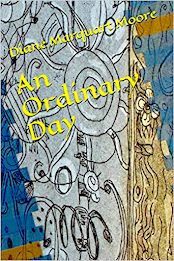
 front cover of Street Sketches
on light: a red light as a signal to stop, look and listen to what is happening on or in street lives in cities and towns across the globe that often go unnoticed…the moon, a yellow jasper cabochon, a stone of endurance, perseverance, and tenacity…attracts others for friendship or to help with a goal…a street lamp, an agate cabochon which is a stone of strength and removes and releases energies of resentment and bitterness…a final source of light in the work emanating from the steeple of a church at the end of the street with a small cruciform encased in paler glass surrounding it. The steeple, the cross and the surrounding light suggest the power of spirituality or connection to a higher power…”

Each time I obtain the glasswork of this talented artist, Vickie Sullivan and I enjoy a visit with Karen and Darrell Bourque, her poet husband (former poet laureate of Louisiana) and we’re immersed in visual and verbal art for at least three hours. Each time before I visit, I say that I’m not going to write any more books, and each time I leave the habitat of these two inspirational artists, I return home, pondering a theme for another book…

Border Press describes Street Sketches in the following blurb:

“Alleyway, cobblestone, asphalt or concrete, streets are shared by all types of people who engage in diverse interactions; they are places of commerce or are residential in nature where aggregates of cultures gather. In Street Sketches, Moore captures the atmosphere and people who traverse streets that she has lived on or visited… from the busy streets of Ahwaz, Iran where she lived and observed beggar street people spreading their household goods on an Oriental rug and using it for a residence… to the elegant boulevards of Paris, Munich, and New York City, places where contrasting life in an urban environment takes place. She also probes the “Thoroughfares of the Mind,” “troubled roads winding among weeds/beside the ruffled waters of old lakes/and back alleys inside the brain. /Scandals and undisguised tragedies/mingling in closets of paranoia.” The concluding poem, “All Roads Lead to Home” reflects on her homesickness for streets everywhere she has lived and visited, lamenting that she “would probably spend a lifetime sitting at a window overlooking the streets of all those places, sketching what I viewed with words that express languishing nostalgia…”

Street Sketches is available on amazon.com or can be ordered by writing to Border Press at borderpress@gmail.com or P.O. Box 3124, Sewanee, TN 37375.


Wednesday, April 15, 2015

A LONELY GRANDMOTHER

By the time I get ready to travel to Sewanee, Tennessee this week-end, I hope that the Louisiana monsoons will have abated and won't follow me, and that all will be dry on The Mountain at my arrival. And by the time I've settled into my Sewanee retreat, A Lonely Grandmother, my latest book of poetry, should have made its debut with Border Press Books. It's No. 40 among my book publications, not counting one lost manuscript of a novel that was put away in an attic and the rats must have consumed (it was my raciest endeavor, so...). The new book of poetry will probably be on the market before my 80th birthday in May.

I told a good friend that A Lonely Grandmother has experienced so many birth problems, Grandmother has probably grown lonelier than ever, waiting for her debut. But she's about to emerge, and straight from the publisher's blurb: "A Lonely Grandmother emphasizes that no matter the period in human history, grandmothers have always been important, cherished women in the family constellation. In this volume of poetry, a maternal grandmother calls the poet's family 'a tempest in a teapot,' but is only showing concern for her grandchildren's dysfunctional upbringing. A stern but forgiving figure in the poet's early life, Grandmother Nell comes to realize that "the children grown/Absolutes will not keep her company."

This is a poetic tribute to a grandparent that spans a family history from the poet's childhood to adulthood and ends with a meditative prose piece that serves as closure: "She closed the heavy door behind me. When I reached the sidewalk, I looked up at the cupola on the roof of the old house. A phantom flew out of the window beneath it and disappeared in the sky."

The beautiful cover of A Lonely Grandmother, which depicts the cupola on my deceased Grandmother Nell's Victorian home in Franklinton, Louisiana, is Vickie Sullivan's photograph of a glass piece conceived and rendered by Karen Bourque, an exquisite glass artist from Churchpoint, Louisiana. Cover design is by grandson Martin Romero, who is a landscape architect practicing in New Orleans, Louisiana. Martin is also an accomplished graphic artist.


A Lonely Grandmother is now available online at amazon.com, or from Border Press, PO Box 3124, Sewanee, TN 37375 for $15 plus $4 shipping and handling.

Thursday, April 3, 2014

APRIL IS THE MONTH FOR POETS AND POETRY

Although I read and write poetry every day, every month in the year, I'm always excited to see that the Academy of American Poets commemorates April as National Poetry Month. The Academy has been sponsoring this observance since 1996 and encourages schools, libraries, publishers, and poets to celebrate poetry during April through readings, workshops, and festivals. This year, members of this supportive organization have suggested that poetry lovers carry poems in their pockets and read them during casual encounters with friends, co-workers, and other people they meet on the street on April 24. 

I own approximately 400 books of poetry and house most of them in my bedroom here at Sewanee, Tennessee, and when I'm in Louisiana, I suffer pangs of withdrawal from the lack of availability of my books. However, right now, just as the "blooming yellows" appear—daffodils and forsythia, our first signs of spring—I'm in my Tennessee poetry library again and am happy to be in the company of bards ranging from Shakespeare to Charles Simic.

I teethed on Robert Louis Stevenson's A Child's Garden of Verse, thanks to my mother, memorized Henry W. Longfellow's poems in the third grade, and had an epiphany about becoming a poet when I was eleven. The epiphany occurred as I was sitting at one of those old fold-up seat desks reading "Hiawatha," and as I read the poem, I experienced the same sensation that Emily Dickinson said she felt when she read a good poem—as if the top of her head had blown off. I also received the revelation that I could write a poem. We had just moved into a new stucco bungalow in Franklinton, Louisiana, and I wrote the poem about this new home, the sight of which gave me an overwhelming feeling of security after traveling in the West the preceding summer, "gypsying," as my wanderlust father described my childhood odyssey to California.  

I only remember that two of the lines of the poem I wrote described the home as being "away from the town's noisy din/safe from the roar of the cotton gin," unimpressive lines to mark the advent of the life of a poet, but enough expression to make me think that I could write poetry. And, by the way, this early effort is one of the few rhyming poems I've penned during my lifetime.

I didn't become serious about writing poetry until I was 29, and my first published poem appeared in The American Weave in 1967 when I was 32. I was paid from the Hart Crane Memorial Fund and felt as though I had arrived in the world of poetry. Five years later, I received an award for inspirational poetry during the Deep South Writer's Conference but, again, time passed and I read more poetry than I wrote. During the early 1970's, I became serious about writing poetry while I sojourned in the desert of southern Iran and have remained dedicated to the craft and to publishing my work for almost forty years.

A friend once told me that no one is successful at any endeavor until they put in their 10,000 hours of practice, and I think that measure is probably a good marker for success in writing poetry that engages people. A better measure is that of writing a poem a day, and I feel that the ritual of writing is a spiritual act, as well as an act requiring discipline and study.

My poems will probably never be recited by third graders or sit on the shelves of academicians in the university realms, but the writing of them is still as exciting as the day I wrote that first poem when I was eleven and said to myself: "I can do that! For me, poetry provides what Jacque Maritain declared:  "You cannot attain eternal life through poetry but it is as essential as bread to the human race as it fits us for the life of the spirit."

PUBLISHED POETRY BOOKS OF DIANE MARQUART MOORE:  In A Convent Garden and Other Poems; Mystical Forest; Everything Is Blue; Post Cards From Diddy Wah Diddy; Alchemy; Old Ridges; Rising Water; The Holy Present and Farda; Grandma's Good War; Afternoons in Oaxaca; The Book of Uncommon Poetry; Counterpoint; Your Chin Doesn't Want to Marry; Soaring; More Crows; Just Passing Through; The Beast Beelzebufo (children's poetry); and A Moment Seized. 


Poems have appeared in The Daily Iberian, Yaddasht Haftegy, American Weave, Trace, Pinyon Review, Interdisciplinary Humanities, Southwestern Review, and other journals.