Showing posts with label Nashville. Show all posts

Monday, August 22, 2016

DOWN IN THE VALLEY

I grew up and have lived in Louisiana most of my life and now live on one of the highest elevations in New Iberia (25 ft.) part of the year and Sewanee, Tennessee (2,000 ft.) the other part. I find it strange when “Sewaneeans” say “I’m going down to the Valley to shop,” and they’re referring to several towns, the peak elevations of which rise 1,000 ft. Now that I live during the spring and summer on The Mountain, the elevation of a town like Cowan, Tennessee, which peaks at 954 ft., doesn't seem to be much of a valley.  

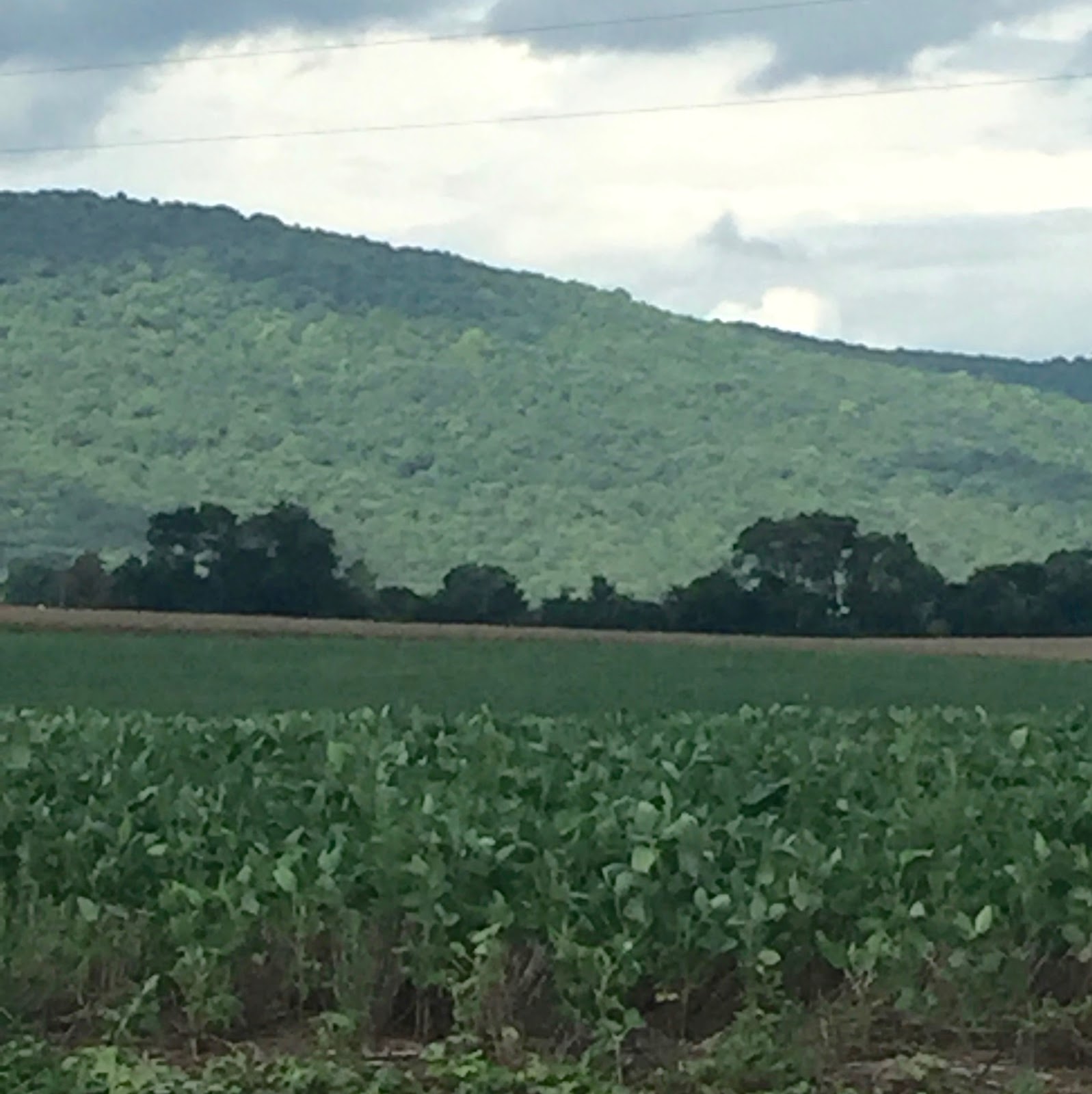
At the western base of the Cumberland Plateau, which juts out in ridges that create small valleys, stands the town of Cowan, which drains via Boiling Fork Creek (a dry bed the first year I glimpsed it), a tributary of the Elk River. I love to drive through the little town on the way to Winchester, Tennessee for groceries, and I don’t ever remember much water running through Boiling Fork. I’ve experienced perhaps two downpours while shopping near Cowan. Many of my poems include the landscape and vegetation of the Valley where corn, soybean crops, pastures of yellow rapeseed, and rolls of hay dot the fields.

Cowan’s claim to fame can be traced to the mid-19th century when it became the site where railway lines met the Nashville to Chattanooga trunk of the Nashville, Chattanooga and St. Louis Railway, and trains traveled through the Cowan Tunnel. Pusher engines assist
ed trains to climb the steep ascent to the Cumberland Plateau, and are still being used today. When I pass the station on my trek to Winchester and see the engines, I wonder if they were the prototypes for The Little Engine That Could, a children’s classic with a moral about what a positive attitude can do for a machine (or a human) wanting to achieve success. It was a book popular during my childhood and is still found in most contemporary libraries.

Last week we stopped at a renovated restaurant renamed “The Valley Cove Bistro” in Cowan and discovered an excellent menu for a restaurant in a small town of 1,770 people, including classic French Onion Soup, the original Corner House (former name of the restaurant and a Tennessee Back Road Heritage property) Gazpacho, Grilled Salmon and Cucumber Wrap, and Apple Rose Puff Pastry (the latter filled with Maple Custard served with Vanilla Bean Ice Cream). I asked about the Chef and was told he’s a native of the Valley area.

Further down the road in the Valley, we stopped at a fruit and vegetable store supplied by Amish farmers from Lawrenceburg, Tennessee and purchased ears of sweet corn, a cantaloupe the size of a watermelon, and home-grown tomatoes. The store was attached to Lapp’s Greenhouse, a nursery where we’d bought herb plantings earlier this summer, and which have survived the drought.

I read that one of the characteristics of a valley is “low land” and that most of them are deep and narrow, but this one must be an old one because it isn’t steep sided like younger valleys  still being uplifted to create mountains.

When we travel home from the Valley, we often try to guess how many degrees cooler the temps are at the higher elevation of The Mountain, and today The Mountain proved to be seven degrees cooler. However, I hasten to mention a major advantage of living in the Valley: real estate is $100,000 cheaper down below than on The Mountain! The main thoroughfare of Hwy. 41A running through Cowan is lined with lovely homes and businesses housed in quaint buildings that were built during the town’s heyday when the railroad came through.

Photographs by Victoria I. Sullivan


Tuesday, May 20, 2014

ON THE TRAIL TO NASHVILLE

A Tennessee trail
At least every two years, my daughter Stephanie and her husband Brad come up to The Mountain at Sewanee for a tour of Tennessee, preferably Nashville, as Brad is a guitar enthusiast and likes to visit the guitar shops. Stephanie is a big country music fan so we spend Saturday evening at the Grand Ole Opry. En route to Nashville, we veered off course at Bell Buckle, moon pie capitol of Tennessee (and probably the world!) to eat lunch at the famous Bell Buckle Café in a town that boasts a population of nearly 400 people. It's also known for the famous Webb School, which has turned out a passel of Rhodes scholars.

My godfather, Markham Peacock, attended Webb School during his high school years under the supervision of founder "Sawney" Webb and traveled from his home in the Mississippi Delta to Bell Buckle on a train that was called "The Dixie Flyer." After lunch when we continued our en route search for serendipity, Brad went into the Gallagher Guitar shop, home of world class guitar makers, which is housed in a nondescript brick building on the main street of Wartrace, (population 600). As we wandered around the "hub" of this small town, I noticed a sign labeled "The Dixie Flyer." It was located trackside on CSX's Nashville-Chattanooga mainline where 25 trains whiz past daily. I'm an inveterate train lover and lingered in five rooms containing operating HO, N, and O gauge model trains and railroadiana where I discovered a framed photograph of the old Dixie Flyer on a wall in the front room of this shop. It rode on the seat beside me while we toured Nashville every day!

Herons by Chihuly installed
at Cheekwood
For starters, the Nashville visit centered on the Grand Ole Opry, but we stepped into another culture when we toured Cheekwood Botanical Gardens and Museum where we viewed a fascinating display of contemporary Japanese Bamboo Art organized by the Clark Center for Japanese Art and Culture and International Arts and Artists. The exhibition contains 38 works of 17 contemporary bamboo artists and masters of woodblock printing. The selections in the woodblock display were from the era of shin hanga, which focused on the images of fashionable women, sometimes depicting them in landscape scenes. Shin hanga was an artistic form used in Japan from the 1800's until the middle of the 20th century, and the Bamboo Art Exhibit rivaled the Chihuly glass sculpture outdoor exhibition we had viewed at Cheekwood several years ago.


For me, the highpoint of the Nashville visit was the Frist Center for the Visual Arts, which occupies a historic landmark—Nashville's former main post office built in 1933-34. The Frist Center is housed in a building reflecting classical and Art Deco style architecture and was constructed with a goal of providing permanence and stability, but the construction was streamlined with cast aluminum doors and grillwork, colored marble and stones on the floors and walls. The old post office, built during the administration of Herbert Hoover, was purchased and restored during the 80's through the efforts of the Metropolitan Nashville government and Dr. Thomas Frist, Jr. The majority of it is rented to the Frist Center for the Visual Arts, which opened in 2001.

The exhibits we viewed included Steve Mumford's War Journals, the work of a New York-based artist who visited occupied Iraq and war zones in Afghanistan, capturing in drawings, watercolors and journals the figures of Allied soldiers and people living and working in that area of the Mideast. He spent ten years recording life in a war zone, and some of the renderings show wounded civilians and soldiers being treated in the Baghdad Emergency Room or receiving therapy at medical centers in the U.S. The sketches of war zones are stylistic, personal renditions that extend to images of the prisoner detention camp at Guantanamo Bay, including the abandoned Camp X-Ray where prisoners were subjected to interrogation techniques such as waterboarding. The entire exhibit was a haunting depiction of war and its horrors. We also saw an exhibit of Francisco Goya's 81 prints depicting the Peninsular War of 1808-1814 between Spain and Napoleonic France—etchings that focused on the negative effects war has on ordinary soldiers and civilians.

Although Marty Stuart is known as a country music star—one that I enjoy—he has been photographing people and places in the South since he first toured with bluegrass performer Lester Flatt at the age of 13, and the third exhibit we saw contained photographs that reflected his surprising talent for visual art. Perhaps the most arresting photograph was the portrait of Johnny Cash shortly before his death, a portrait that portrayed the icon of country music with a dignified expression on his battered face much like that of a Puritan preacher.
79 is fine


On May 18, we celebrated my 79th, compliments of Brad and Stephanie, at Ruth's Chris Steakhouse, but we all agreed that although Tennessee offers premier steak and barbecue, its bread pudding couldn't equal Cajun country's version of this dessert!