Showing posts with label Cowan. Show all posts

Thursday, August 15, 2019

A BIT OF BIRDING

Bird Bath in Our Yard, Sewanee


Instead of singing “Where Have All the Flowers Gone?” this morning, I think there should be a new refrain: “Where Have All the Birds Gone?” For the past several days, I haven’t seen any of our usual visitors to the bird bath, even after we cleaned the bath and filled it with reverse osmosis water (water that contains no pesticide, herbicide, or arsenic and which the birds usually love). When I step outside, I hear only one faint “cheep” coming from the vicinity of the thrasher habitat by the drive. The wooden fence on which they love to perch is woefully empty. Of course, the weather has been sweltering for The Mountain, but warm temps haven’t altered their behavior during the eleven summers we’ve been living here at Sewanee. We suspect that deadly pesticides are being used on the campus vegetation and have caused the demise of our lovely friends but were told otherwise the other day. However…

Perhaps we should do what a former friend of ours did while she resided in New Iberia years ago. She captured two well-known birds and caged them — a mockingbird and a blue jay, two birds that she claimed could sing louder than any outdoor members of their flock. Emily, who was a male mocking bird, lived in the kitchen of Sally’s home and serenaded visitors with an enthusiastic variety of notes, often repetitive ones, interspersed with imitations of the blue jay that resided in her bedroom. We appreciated Sally’s enthusiasm for the caged birds that seemed not to mind being eccentric, not “resting upon the air, subduing it, surpassing it, are the air,” as John Ruskin once wrote about our feathered friends.

Sally developed a new hatching project during the time that she housed the caged birds. A friend brought her three round eggs about six inches in diameter, weighing from two to three pounds apiece and asked her to incubate them for hatching. They weren’t blue jays or mockingbirds and were an unusual species to have been born in old Louisiana — ostriches. Now, an ostrich egg hatches within 40 days. The mama ostrich sits on them all day while the papa sits up nights keeping them warm. If the egg doesn’t have a mama or a papa, an incubator is a good stand-in. Sally, a scientist who researched mammals, had access to an incubator in a lab that kept the eggs at 98.5 degrees Fahrenheit, and Sally turned them daily.

The eggs, when hatched, were to be returned to the owner who'd launched Sally in this hatching project. But we worried a lot about their loyalties. When birds hatch, they go through the process of imprinting. The person around when the birds break through into the world and who handles them at birth becomes their natural caretaker.

Now Sally’s blue jay talked to her every morning, and her mockingbird delighted her with a song in the evening, but somehow we couldn’t visualize the long-necked ostrich, which can take 15-foot steps at 40 miles per hour, whizzing through Sally’s household without causing some disruption. We submitted the advice to Sally that on the 40th day, she should stick her hands in her pockets, call in a handler and vamoose in 15-foot steps at 40 miles per hour to escape imprinting the newly born. 

Flamingos in Chinese exhibit, Huntsville Botanical Garden


The last time I visited Sally’s home, I didn’t see any evidences of baby ostriches and actually, the caged birds had been liberated. I was glad that they’d been set free. Meanwhile, I’ll keep watching the bird baths and sit on the porch listening for the cries of beloved birds. I hope that they’ll want a bath soon, or at least they’ll come and sit on the fence surrounding my backyard like they usually do. However, if they don’t show up soon, I’m going into the leaseholder’s office and threaten to bring over one of the irascible emus I often see in a yard in the Cowan valley and loose it from captivity. Talk about a commotion, as we Cajuns say!!


Photographs by Victoria I. Sullivan


Thursday, May 9, 2019

BETWEEN THE ROCKS

Savage Falls Trail by Andy Gay

Andy Gay of Cowan, Tennessee wears a lot of hats — musician, minister, photographer, writer, painter… I was introduced to him at St. Mary’s Convent, Sewanee, Tennessee when he and his wife Mary Ann began attending services in the chapel there. A former Presbyterian minister, Andy began playing his guitar in the Convent’s special programs about environmental issues, and he’s been a guest preacher at several St. Mary Sunday services. At breakfast in the refectory, we often talk with him about Ghost Ranch, New Mexico where he and Mary Ann have been vacationing for over thirty years. We only recently discovered that he has been creating paintings of Orphan Mesa, Canyon de Chelly and other sites near Ghost Ranch, which is, of course, the territory of the famed artist, Georgia O’Keefe. 

Andy’s passion for painting the natural landscapes of southern middle Tennessee; Alaska; the Isle of Skye, Scotland; Ghost Ranch, and other areas, worldwide, has resulted in a fascinating exhibit at the Artisan Depot Gallery in Cowan, Tennessee. There, we learned that he has also exhibited his art in the Tennessee All State Exhibit at the Parthenon Gallery in Nashville, Tennessee. As a retired minister, he claims time to paint, pursuing work in transparent watercolors after exploring the art of acrylic and pastel chalk painting. 

Andy’s exhibit at Artisan Depot Gallery was inspired by places he’d often visited or lived and dates back to the 1990’s; however, his venue at the Gallery is a “first.” Viewers learn that whatever the setting, Andy says he looks Between the Rocks (the title of his exhibit) where “the great and tiny, the hard and the delicate, the momentary and ancient, co-exist in beauty and are illumined by the multifarious moments of changing light and texture…”

Readers can see that the commentary accompanying paintings in this exhibit is as poetic as Andy’s paintings and reveals Andy’s writing talents; e.g., a description of “Into the Light” on the Savage Falls Trail in the Savage Gulf Natural Area, Tennessee : “On this trail to the falls one passes through masses of light filtered through rhododendron, and laurel stands bracketed by shaded passages. This bridge carries us from one issue of light into another. Every bend harbors some kind of mystery, no matter how many times you have been there…” The eloquent text reminds me of John Muir’s Wilderness Essays and, like Muir, it reflects the writer’s passion for places of endless variety that inspire wonder — natural formations, weather changes, light shows…

Andy’s description of the painting, “Sundance:” expresses his fascination with scenes of his New Mexico visits: “During the monsoon season, when clouds tower and sift the sky over Chimney Rock, light dances. Celestial celebrations go into the night in the forked lightnings over Pedernal, and to the east, the Milky Way unfolds itself, spilling stars now and again into our world…”

Andy reports that he has probably been inspired to paint more Shake Rag Hollow scenes in Sewanee, Tennessee through the years than any other region he’s visited. He writes that “the sun, in the last hour of the day, finds a path, here and there, to penetrate to the forest floor, spilling out in pools of light in the darkening wood. At the last, especially in September and October, the light becomes golden. You may step into these little pools of gold and bathe in them…”

Between the Rocks is a show that lovers of outstanding landscape art will appreciate. Whether Andy is writing songs and playing them, indulging his passion for watercolor painting, nature writing, or preaching an eloquent sermon, in my lexicon he’s a Renaissance man whose art shows “beauty in all its forms, both novel and familiar.”* 

*From Wilderness Essays by John Muir


See the Artisan Depot Gallery website for hours, exhibit announcements, and events scheduled.


Monday, May 6, 2019

LEAVE A LITTLE SPARKLE WHEREVER YOU GO!

By Frances Perea

That headline is the leitmotif of the artist Frances Perea, and visitors to the Artisan Depot Gallery in Cowan, Tennessee would agree that her newest collages reflect a whimsical spirit and strong interest in mythical/magical subjects; e.g., folklore surrounding fairies. Perea has captured the spirit of these creatures in various art forms, but one glimpse of her trading cards of fairy collages made me laugh aloud. I also thought of my mother who believed that these magical  beings could tell fortunes, prophesy births, foretell deaths, and intervene in household “goings-on.”

Perea also paints religious icons and attributes her inspirations for folk art to Latin American artists like Frida Kahlo of Mexico whom she regards as her most serious Muse. However, her latest creations reflect a whimsical spirit just on the edge of being mischievous. She’s also written a pamphlet that relates How the Fairies of Lullymore Came To Live in America and features a poem by Yeats on the back cover that begins with the lines: “Fairies, come take me/out of this dull world…” 

In antithesis to former stories about sinister fairies in folklore, Perea’s creatures are more well-intentioned and are generally protective beings who dance on household hearths. Actually  my mother claimed they danced in the flames of various space heaters in our home before central heating put them out of business.

by Frances Perea

Frances Perea is a native of Santa Fe, New Mexico and became involved in art at San Jose City College in San Jose, California. She began to exhibit in El Gatito Gallery in Los Gatos, California, then returned to Santa Fe and painted designs on furniture and pottery. She relates that one of her pieces was bought by Bono from the Band U2 and shipped to Ireland. Later, she initiated a line of religious icons and sold them through various museums, including the famous Smithsonian Institute, and through shops and galleries throughout the U.S. After she and her husband moved to Winchester, Tennessee, she began exhibiting through the Franklin County Arts Guild at the Artisan Depot Gallery. Perea also has a site called My Art Place on Etsy showcasing her collages, fabric art, recycled and digital art, and jewelry.


by Frances Perea

I’m trying to find frames small enough for the fairy trading cards shown on this blog and named the two I purchased after my two daughters who often read my blogs. I’m wondering if they can identify themselves in the pictures shown. The cards “leave a little sparkle” in my mornings, and I’m transported by Perea’s depictions of the diminutive sprites that inhabit her Tennessee fairyland.


Monday, October 1, 2018

SUNDAY AFTERNOON ART


Print of Frances Perea painting, The Storyteller

Yesterday afternoon amidst a cloud of family problems, delivered via telephone, I escaped to one of my usual refuges in Cowan, Tennessee — The Artisan Depot Gallery, an arts and crafts center sponsored by the Franklin County Arts Guild. It’s a small gallery facing the highway leading to Winchester, Tennessee and has the kind of atmosphere that uplifts me. The Guild provides artists in Tennessee a venue for their work in downtown Cowan and is run by members who volunteer their time to keep this gallery open. Those members organize shows and work to promote art education, including scholarships for budding artists and workshops for artists of all ages. 

Frances Perea is one of my favorite artists who exhibits her work at the gallery, and I was drawn to a wall where her "Santos" (saints) works hung. Perea was inspired by the Mexican artist, Frida Kahlo, and creates a variety of art that includes collage, mixed media, folk art, digital art, recycled art, and jewelry. She calls Frida Kahlo her "muse;" and a fellow member of the Artisan Depot says Perea was raised Roman Catholic, and the influence is portrayed through her Santos. She's also inspired by Latin American folk artists. One of her art shows at the Artisan Depot featured Dia de los Muertos (Day of the Dead), a traditional Mexican celebration that takes place in November and honors the spirits of the dead by inviting them to visit on that day.

I bought a happier picture, in which Perea "channeled" Kahlo’s spirit entitled "Story Teller." I stood before the work several times, absorbing the fun and light-heartedness of the rendering. It was bright, colorful, and representative of a playful spirit — just the qualities I needed to absorb. Perea keeps the originals of her work and sells only prints, along with pottery and furniture decorated with her designs.

Section of Silk Scarf created by Christi Teasley

I moved through the gallery leisurely and found a wall of silk scarves made by Christi Teasley, a Monteagle, Tennessee artist and textile creator. The scarves were products of a process called contact printing, eco-wrapping, eco-bundling, or eco-printing after an Australian artist, India Flint. The scarf that I purchased was dyed with onion, avocado pit, Japanese maple, string, alum, and iron mordant in which plants and cloth are heated, a fascinating technique also called "natural mark making" with plants on cloth. Teasley is an artist/educator who discovered the process of printing fabric as a high school student at St. Andrews Sewanee school. She continued her studies in textile dyeing at Rhode Island School of Design. She taught art at St. Andrews for many years and now teaches natural mark-making on cloth with plants at Shakerag Workshops (Sewanee) and operates Teasley Textiles, a textile design studio in Monteagle where she specializes in cloth created with ecologically-sustainable methods.

Miniature painted on rock by Diana L. Lamb

Diana L. Lamb, a member of the Artisan Depot Gallery, acted as a docent while I was browsing, and before I left, I couldn’t resist buying one of the rocks with miniature design on it that she creates. "I'm buying this," I told her, "because I admired the miniature art created by Irani artists when I lived in Iran." Lamb calls herself a craftsman, rather than an artist, but I chided her just as she had chided me when I said I wasn’t an artist. "What are you then?" she asked. "I'm a poet." She laughed and declared, "Then you’re an artist." Only one piece of Diana’s rock art had been displayed, or I probably would have bought a boxful. 


By the time I left the Artisan’s Depot, I had three pieces of art in hand, was considerably cheered, and found myself quoting a famous comment by Frida Kahlo that Frances Perea loves: "Nothing is absolute. Everything changes, everything moves, everything revolves, everything flies and goes away."


Thursday, April 12, 2018

TRAIN TREK

Cowan Railroad Museum, photograph by Victoria Sullivan

Trains have always fascinated me, and one of the activities on my bucket list is a ride on the Orient Express. Many of my poems have featured trains and train depots, subjects about which I thought of writing and photographing until I discovered a book already published about train rides, dinner trains, museums, and depots entitled Tourist Trains Guidebook that I found in Bryson, North Carolina, site of the Great Smoky Mountains Railroad. This railroad was created from a portion of Southern Railway’s Branch and hugs the Tuckaseegee and Nantahala Rivers, ascends a mountain at Red Marble Gap, and zooms out over a 700-foot trestle at Fontana Lake.


Closer to home is the Cowan Railroad Museum in Cowan, Tennessee that I tried to visit today, a place that houses photographs, relics, and memorabilia from the steam age in a century-old depot. Vickie photographed the exterior of the historic depot for this blog, but I've never been inside and won’t be able to visit until May when it re-opens. I’ve learned that there are displays of figures in period costumes, model trains, and 1,000 interesting items for first-time visitors. I’ll have to schedule a May tour, but meanwhile, today, I could hear the trains “whooing” as we lunched in the Fiesta Mexican Restaurant beside the rails, across the way from the Cowan Museum. I was grateful for the scant sunlight and a diversion from illness.

This afternoon, as I write, I look at the end poem in Just Passing Through, a volume that contains some of my train poems, and I feel even more strongly about the lines in the end "snippet" entitled “End Times” that I wrote in 2007. The single verse actually describes a dismayed reaction to tribal quarrels I’ve observed that still persist in certain “corners” today.


      END TIMES
Not burned to death
or frozen to death
but warred to death,
the planet excelling in hate,
a desperation to own too many corners,
saying too little about love,
Lewis’s explication of agape
falling on truculent ears
that listen to a different drummer —
the rumble of cannon.


On several trips to the West, I became enchanted with a historic train that runs through the desert from Santa Fe, New Mexico along the spur to the city of Lamy. The train I saw was a working freight train, and I wrote about it in ”The Santa Fe Is,” in Just Passing Through, the chapbook mentioned above:

    THE SANTA FE IS
No covert traveler,
the train boils through High Desert,
red, blue, and yellow freight cars,
imperatives on the landscape
traveling everywhere.
In the pinpoint of my eye,
miniature boxes of color
fret empty plains,
make me aware of destinations,
distant mountains.
We pass small stations
snoring at track side
while the bright colored cars sway
on miles and miles of track
like ants relocating,
good times left behind,
mirages passed,
a lonely figure waving
from the engine window,
face turned toward
an indifferent there going on forever…


Monday, October 9, 2017

TREASURE AT ARTISAN DEPOT

Autumn Glow
Some days when we go down to the Valley at Cowan, Tennessee, we wander into the Artisan Depot, an art cooperative sponsored by the Franklin County Art Guild, and Saturday we ignored the rain to make a trip to Cowan where we discovered an artist whose eclectic work warranted a “shout out” in today’s blog. 

Frances Perea, a native of Santa Fe, New Mexico, migrated to Winchester, Tennessee almost twenty years ago and brought with her a talent reminiscent of Frida Kahlo. She tells most people who drop in at the small Cowan gallery that the famous Mexican artist is her “Muse,” and in 2012 she established a Frida Kahlo Fan Club. Saturday, Perea appeared with a small tray of cinnamon rolls to feed drop-ins and showed us the display of her work that includes full-size paintings and boxes of mythical cards which intrigued me. 

In her work, Perea mixes religion with fantastical elements from pre-Columbian and Roman Catholic mythology. After moving to San Jose, California, Perea studied art at San Jose City College and painted her eclectic designs on pottery and furniture, then began painting New Mexico religious icons. Although she sometimes refers to her work as “quirky,” it has gained noteworthy recognition through sales of a line of prints, ornaments, and New Mexico icons to the International Folk Art Museum and The Smithsonian Institute.

House Guardian
I was taken with Perea’s trays of cards and settled on one entitled “House Guardian” featuring an angel surrounded by a floral design; it will join the mezuzah in our kitchen that watches over our cottage here at Sewanee. I also selected a beautiful landscape card featuring a tree with flame-colored leaves entitled “Autumn Glow” and would have purchased more if I had had my checkbook with me. 

Perea also teaches art workshops at the Artisan Depot and encouraged me to introduce the idea of poetry readings on the stage of this art gallery. She left before I could interview her further, but I hope to return for a second look at the folk art of this talented Tennessee artist, perhaps to buy more take-home treasure. 

Tuesday, July 4, 2017

HOW GREEN IS THE VALLEY


Rain falls on the 4th of July, threatening the flag raising, Arts and Crafts Fair, the cake contest, Cornhole Contest, the parade, and the Air Show, not to mention the fireworks blowout at Sewanee, Tennessee where I live part of the year. However, for Valley farmers near Cowan and Winchester, Tennessee, I give thanks for the recent heavy showers.

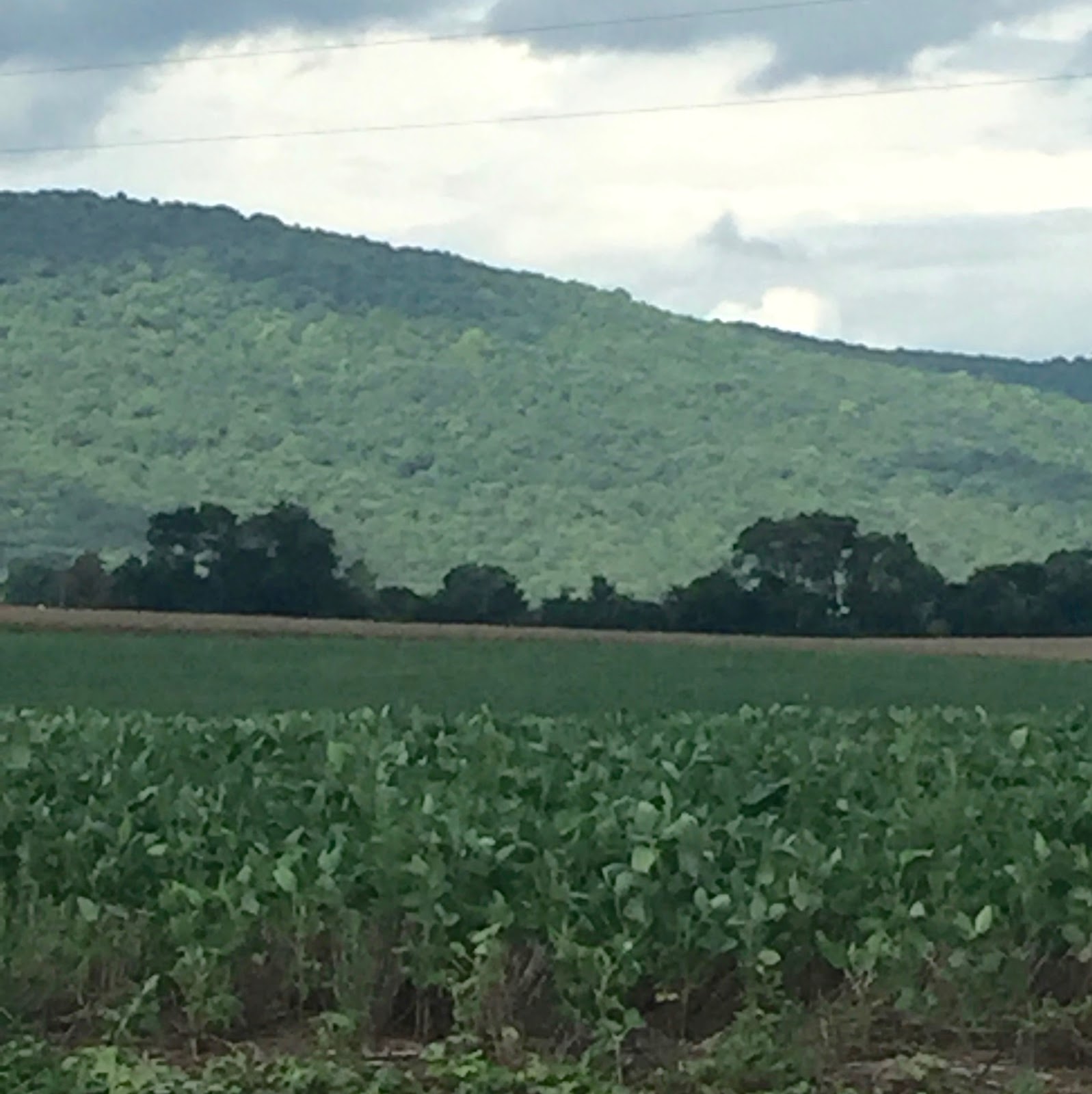
I’m glad I went down to Lapp’s in the Valley to garner my week’s supply of corn yesterday. This small market of plants and produce has been selling yields of the sweetest, most tender corn I’ve tasted in many a year, and the fields, amply watered by rain this year, are still a robust shade of green. In fact, the entire valley is a verdant carpet right now, and not all the ironweed and milkweed along roadsides have been sprayed or mowed down. However, recently we did have to search for Chicory plants to photograph for a book of poetry I’m writing.

Tennessee harvested 830,000 acres of corn last year, and if the Valley is any indicator of production, growth should exceed that harvest in 2017. I missed National Corn Cob Day June 11, but I appreciate the hoorah given this succulent vegetable. Coupled with barbecue ribs, corn on the cob is the quintessential food for 4th picnics, and I have six ears on the kitchen counter waiting for consumption.

The corn sold at Lapp’s is homegrown in fields behind his flower and produce market, and he should know how to cultivate this plant because he formerly lived in Amish country near Lawrenceburg, Tennessee where farming is part of the Amish lifestyle. Some of Lapp’s produce includes giant tomatoes that exceed the size of the usual store-bought mushy-fleshed tomatoes, and when cooked make delicious homemade tomato sauce for pasta.

Lately, I’ve enjoyed riding down The Mountain from Sewanee to The Valley — Cowan, Winchester, and Tullahoma — a drive that reminds me of coming out of the desert onto the curving road leading to Big Sur, California in the spring/summer. Sometimes I envision living in the Valley where I can look up at The Mountain, rather than living on the Cumberland Plateau and searching for places where I can peer over the bluff at the Valley below; however, I have no desire to live on the bluffs near Sewanee because I’ve heard that winds and storms in these areas are fierce.

Rumors are that property in the Valley is $100,000 cheaper than on The Mountain, but, alas, temps in the summer are often as much as eight degrees hotter. Yet, when I round the curve near Winchester and see the green fields (unfortunately, some of which are brown from herbicide enthusiasts) stretching out in the foothills of the Cumberlands, and the red barns gleaming on the landscape, I have a yen to drop down into a more pastoral setting … where I can buy fresh, sweet corn every day when it’s in season.

Happy 4th! Hope your picnic lunch includes a sweet ear of corn!


Photographs by Victoria I. Sullivan


Monday, August 22, 2016

DOWN IN THE VALLEY

I grew up and have lived in Louisiana most of my life and now live on one of the highest elevations in New Iberia (25 ft.) part of the year and Sewanee, Tennessee (2,000 ft.) the other part. I find it strange when “Sewaneeans” say “I’m going down to the Valley to shop,” and they’re referring to several towns, the peak elevations of which rise 1,000 ft. Now that I live during the spring and summer on The Mountain, the elevation of a town like Cowan, Tennessee, which peaks at 954 ft., doesn't seem to be much of a valley.  

At the western base of the Cumberland Plateau, which juts out in ridges that create small valleys, stands the town of Cowan, which drains via Boiling Fork Creek (a dry bed the first year I glimpsed it), a tributary of the Elk River. I love to drive through the little town on the way to Winchester, Tennessee for groceries, and I don’t ever remember much water running through Boiling Fork. I’ve experienced perhaps two downpours while shopping near Cowan. Many of my poems include the landscape and vegetation of the Valley where corn, soybean crops, pastures of yellow rapeseed, and rolls of hay dot the fields.

Cowan’s claim to fame can be traced to the mid-19th century when it became the site where railway lines met the Nashville to Chattanooga trunk of the Nashville, Chattanooga and St. Louis Railway, and trains traveled through the Cowan Tunnel. Pusher engines assist
ed trains to climb the steep ascent to the Cumberland Plateau, and are still being used today. When I pass the station on my trek to Winchester and see the engines, I wonder if they were the prototypes for The Little Engine That Could, a children’s classic with a moral about what a positive attitude can do for a machine (or a human) wanting to achieve success. It was a book popular during my childhood and is still found in most contemporary libraries.

Last week we stopped at a renovated restaurant renamed “The Valley Cove Bistro” in Cowan and discovered an excellent menu for a restaurant in a small town of 1,770 people, including classic French Onion Soup, the original Corner House (former name of the restaurant and a Tennessee Back Road Heritage property) Gazpacho, Grilled Salmon and Cucumber Wrap, and Apple Rose Puff Pastry (the latter filled with Maple Custard served with Vanilla Bean Ice Cream). I asked about the Chef and was told he’s a native of the Valley area.

Further down the road in the Valley, we stopped at a fruit and vegetable store supplied by Amish farmers from Lawrenceburg, Tennessee and purchased ears of sweet corn, a cantaloupe the size of a watermelon, and home-grown tomatoes. The store was attached to Lapp’s Greenhouse, a nursery where we’d bought herb plantings earlier this summer, and which have survived the drought.

I read that one of the characteristics of a valley is “low land” and that most of them are deep and narrow, but this one must be an old one because it isn’t steep sided like younger valleys  still being uplifted to create mountains.

When we travel home from the Valley, we often try to guess how many degrees cooler the temps are at the higher elevation of The Mountain, and today The Mountain proved to be seven degrees cooler. However, I hasten to mention a major advantage of living in the Valley: real estate is $100,000 cheaper down below than on The Mountain! The main thoroughfare of Hwy. 41A running through Cowan is lined with lovely homes and businesses housed in quaint buildings that were built during the town’s heyday when the railroad came through.

Photographs by Victoria I. Sullivan