Showing posts with label Anne L. Simon. Show all posts

Tuesday, February 11, 2020

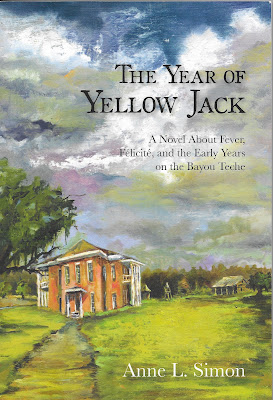
THE YEAR OF YELLOW JACK


Anne L. Simon has “found her oeuvre” in historical fiction. Her recent novel, The Year of Yellow Jack, is a fascinating story about New Iberia, Louisiana — the successes and tragedies of families living in this south Louisiana town of Bayou Teche country during the 19th century. 

The Year of Yellow Jack emerges as a regional story with a universal message and is the result of Simon’s meticulous research and lively imagination. Simon’s story is told in realistic voice about a social system that prevailed during this antebellum period in southern history and includes both wealthy and enslaved characters — the Bérard and Duperier families and their antecedents, and a Haitian woman of color named Félicité.

Both the “Foreword” and “Historical Notes” in this volume indicate the depth of research and dedication to an intriguing project Simon pursued for three years and provide a sampling of her accomplished expository style. The novel is narrated in three parts and covers the multicultural mix of south Louisiana — French, Spanish, African, English, and Attakapas who settled the towns of New Iberia and St. Martinville. In this mix, Henri Frederick Duperier and Hortense Bérard emerge as major characters who marry and build a home on the banks of Bayou Teche and are joined by Félicité, the enslaved woman of color from Saint-Domingue.

Simon’s research of colonial New Iberia and St. Martinville, Louisiana includes descriptions of the prevailing attitudes toward the enslaved during the early 1800s; e.g.,the rumination of Hortense Duperier: “When I was a small child, we had many slaves in our household. Patterning my behavior on that of my mother, I expected the slaves to do without question whatever they were asked to do, even when asked by a child. I could not recall any open discussion of their inferior status. Occasionally Maman corrected my behavior. She instructed me to be courteous at all times, not out of respect for the role the slaves played in our lives, but because courtesy was expected of people of privilege. I accepted the world I had been born into as normal. I gave little thought to the personal lives of those who lived behind the woods that separated us from them…”

Simon’s descriptions of Teche country landscape during the 19th century are succinct and skillfully done through the device of dialogue; e.g., Grandpa Bérard’s : “It was springtime in Teche country, and beautiful. The Garden of Eden, we thought. Untouched forests, not like the worn-out land we’d left behind in France. Oak, willow, and cottonwoods lined the bayous, giant cypress and tupelo trees thrived in the wetlands. Natural meadows spread to the west…” 

The major event that tied families of privilege in New Iberia and St. Martinville and the enslaved Félicité occurs in Part III of this novel when Félicité functions as a healer during the siege of yellow fever that strikes these communities. Using non-traditional medicine in the forms of hydration and herbs (fever tea), Félicité saves many lives and helps to "wash clean New Town (New Iberia)" of this deadly disease.

Interspersed in this narrative about Hortense Duperier and Félicité is a salute to Frederick Duperier — his valuable part in incorporating the town of New Iberia. The relationship of early settlers and the Atakapa Isak Nation, or the Attakapas are also included — facts corroborated by Simon through a record in the St. Martin Parish courthouse that shows Bernard, chief of the Atakapas, granting land to Hortense Duperier’s Grandfather Bérard  Such discoveries indicate Simon’s investigative abilities as well as her persistence in ferreting out facts that enhance the narrative. 

Scholarship and vision intertwine throughout this intriguing novel. Photographs included in The Year of Yellow Jack indicate the close relationship that Félicité had with the Duperier family of New Iberia — one of them features the Duperier family plot that shows Félicité’s grave marker as she is buried alongside her appreciative and respectful family.

The Year of Yellow Jack will intrigue south Louisiana residents, but its range is far-reaching in that it corroborates a major contribution made by an enslaved Haitian woman during the colonial period of American history. It also shows the bravado and competence of a widow who overcomes financial reverses and takes her place in history as an enlightened woman who refuses to be deterred by social mores. As I said, Simon has found her oeuvre in historical fiction, and The Year of Yellow Jack celebrates her place in this genre. Just as we celebrate Anne’s contribution — Brava, Anne!

Anne L.Simon was educated at Wellesley College, Yale, and LSU Law School. She was elected as a general jurisdiction trial court judge, and after mandatory retirement served in ad hoc and pro tempore appointments by the Louisiana Supreme Court, as an Appellate Court Judge for three Indian tribes in Louisiana, and was the Louisiana Court Improvement Fellow for the Pelican Center for Children and Families. She has authored three crime novels, entitled Blood in the Cane Field, Blood in the Lake, and Blood of the Believers "loosely based on her experiences."

Published by the University of Louisiana at Lafayette Press.

Note:  I am familiar with stories about the scourge of yellow fever through the Anglican Sisters of the Community of St. Mary at Sewanee who, every year, relate the legend of “The Martyrs of Memphis,” the story of  Anglican Sisters who nursed yellow fever victims in Memphis, Tennessee during the siege of 1878. I was drawn to Simon’s story because of historical similarities. However, my initial interest in Félicité began with a strange telephone call from a psychic named John Russel in San Angelo, Texas who called me one evening during the 1980s and asked if I knew why he was receiving psychic messages including my name and someone named Felicity in New Iberia. I told him I didn’t know anyone named Felicity, but I later remembered the marker honoring Félicité’s work with yellow fever located near the New Iberia Library. I never heard from this caller again. However, he had piqued my interest in the enslaved healer, and, later, I included Félicité as a character in a young adult novel entitled Flood on the Rio Teche that was more imagination and less factual than Anne Simon’s meticulously researched work of historical fiction.


Sunday, April 12, 2015

BLOOD IN THE LAKE

A friend in Washington, D.C. who was once a resident of New Iberia, Louisiana recently wrote that she had heard from several sources that Teche country was undergoing some kind of "literary renaissance"—authors were launching their books in all corners of Acadiana. I agreed with her, and yesterday I attended another notable launch by retired District Judge Anne Simon, the book signing of Blood In the Lake. This novel is a legal thriller that combines the author's intelligence, humor, and knowledge of the law and is a fascinating read by a professional expert in courtroom drama. She's also a cogent example of an author whose writing style has been influenced by romantic Teche country: "We could barely see the bayou through the trees—a shimmering stream of dark roast coffee undulating half a football field below the house... The Bayou Teche in south Louisiana casts a spell, an inspiration for poets and a perfectly legal narcotic for the enchantment of those lucky enough to spend time on her shores..."

Blood In the Lake is the second of Simon's crime novels and is a story combining exciting courtroom scenes, moral dilemmas, romance, rich settings, and a line-up of colorful characters. The protagonist, Mandy Aguillard, an intern in the office of a New Iberia District Attorney, is drawn into a hunt for the killer of her grandfather, the patriarch of the Boudreaux clan who is victimized by principals in an illegal drug trade centered near Lake Peigneur. Mandy shows the action of the hunt in a strong voice that creates an empathetic connection to the Boudreaux family, harnessing the plot and moving it forward in well-constructed flow.

Mandy becomes romantically involved with Tom Barnett, a District Attorney who is the prosecutor in the case against her grandfather's killer. As the protagonist, Mandy provides the reader with a sense of immediacy that builds intense suspense, and Simon handles this expertly, carrying the reader toward impending disaster and ultimately placing Mandy in a dangerous situation that ends in a tragic denouement, which seems right for the story.

Simon's descriptions of bayou country involve all five senses, and she treats the reader to strong images; e.g., a nugget of information about Louisiana's Great Egret: "To my left, a Great Egret strolled through the muddy shallows. He stopped. Drawing up one twig-thin leg, he dangled his skinny, three-inch long, coal-black toes above the mirrored surface of the lake. Stretching his neck, he rotated slowly to survey the scene. Satisfied to find everything in order, he tipped his head ten degrees and pointed one beady eye downward into the murky water covering his feet..." Here, geography segues into vivid description without disturbing the flow of the story—the description assists the plot without overcoming the story line.

While the major characters in Blood In the Lake are portrayed as investigative personalities involved in the legal profession, Simon also achieves authenticity in her Cajun family characterizations; e.g., a scene with "PawPaw," Mandy's grandfather: "PawPaw loved his coffee hour with the boys. Every morning, around eleven o'clock, he and a half-dozen of his buddies gathered at Thibodeaux's Grocery in Coteau—not another town, just the settlement to the northwest. They tipped back in wooden chairs and propped their boots up on an old pot-bellied stove. The stove would've been cold in the late summer, but it crackled with fire in the winter. The boys at Thib's had very little concern for national or international affairs. Once they'd exchanged information about the height of the sugarcane and the going price for sugar and rice, they moved on to the political maneuvering for the next election. PawPaw would say it used to be so simple to know how everyone stood on the issues and to keep track of who supported who when everyone was either Long or an Anti-Long. Now things were all mixed up. You couldn't predict how a politician would turn out. They'd tell you one thing and do another..."

A long passage about 'Tienne, a family member who had spent two tours of duty in Vietnam, that ends in the poignant words, "I sat there safe under a tin roof and sent them out, one after another—to die," provides a traumatic experience in the story line that nuances the Boudreaux's "personal code" or the "character" of the family that produces the protagonist Mandy.   

A house fire and injury to a woman living in a trailer on Captain Cade Road near New Iberia, adds to the villainous atmosphere and to the suspicion that a sociopath operates in the quiet countryside surrounding the Queen City of the Teche. Dialogue in Blood In the Lake gives the reader a flavor of regional speech and stands the test of being read aloud. Mandy's voice is especially distinct and helps reveal motives, as well as develops the mood of the novel. She bears out Michael Connelly's adage: "There is a quality of redemption to anything that is true character...where a personal code is forged..."

Simon's experience in the courtroom and her passionate interest in the justice process makes this legal thriller a "must read," and she takes her place in the evolving "literary renaissance" in New Iberia, Louisiana of which my friend in Washington, D.C. spoke. The brilliant cover painting of Blood In the Lake was rendered by Nan Landry, also of New Iberia, and sets the tone for this arresting crime story. Another of Landry's paintings appeared on the cover of Simon's first crime novel, Blood in the Cane Field.


Brava Anne and Nan. May your tribe of readers increase!

Monday, May 26, 2014

BLOOD IN THE CANE FIELD

A few years ago, Anne Simon, a retired district judge in New Iberia, Louisiana, shared with me the news that she had been writing short stories and novels for many years; however, I had to wait several more years before she allowed me to read any of her writings. I knew that she had written many articles and briefs in her practice as an attorney and a judge, and I was prepared to read well-written prose, but what I found was polished creative writing that reminded me of the late Erle Stanley Gardner's Perry Mason series.

Last month, Anne's crime novel, Blood in the Cane Field, made its debut, and I suspect that it will become a runaway publication, perhaps a candidate for the Mystery Writers of America's Grand Master Award. This crime fiction publication, the first in a planned series of crime/courtroom stories, features murder and courtroom action that reflect Anne's legal and investigative abilities, as well as her experience as a noteworthy judge in south Louisiana.

The opening scene of Blood in the Cane Field reveals two bloody bodies lying in sugar cane stubble, discovered by a Texaco oilfield worker's dog, Praline. The action moves from this bloody scene to the narration of Public Defender John Clark III who becomes engaged in defense of Danny Howard, a surly, depressed teenager who has spent his first years of life at the edge of the Atchafalaya Basin in south Louisiana and who has been a participant in a party with the two murder victims. Danny is suspect because of his angry responses to racial slurs made about his dark skin, although he insists that he is white. As the Public Defender investigates the murder, he discovers the teenager's true parentage and attempts to counsel both the teenager and his mother.

The plot centers on Danny's confrontation with the death penalty twice and John Clark's investigation and attempts to keep Danny off Death Row. When John finds major exculpatory evidence in similar killings that have taken place in a nearby parish, the plot becomes highly suspenseful. Romance is interwoven in the story via the appearance of Medley Butterfield, a Mississippi woman with a questionable past, and John falls in love with her despite his resolve not to form a committed relationship. The couple uncovers evidence of political corruption and underground criminal activity that places Medley in danger, and the surprise denouement will delight those who like to see good legal representation/investigation rewarded and romance problems resolved.

Blood in the Cane Field reveals the author's fascination with the Cajun countryside—Anne's home for fifty years. Her descriptions of the area express her appreciation for the natural landscape and wildlife; e.g., "...Driving rain soon billowed folds of white gauze before our eyes, turning the sunlight to dusk, obscuring the trees that a few minutes before had been a radiant backdrop to the scene across the water...a short twenty minutes later the misty curtain rose, and returning sunlight sparkled through the last of the raindrops. White specks dotted the sky as flocks of egrets and ibis came in to roost. Hundreds of birds. They landed in the trees, pulled in their necks, tucked their beaks under their chest feathers, and settled down for the night. Then came the roseate spoonbills, an armada of pink sails heading for port..." (That last sentence is pure poetry!)

Names indigenous to Cajun country are sprinkled throughout the novel and are reflective of the nicknames that Cajuns often assign to their offspring: "Ti-Boy," "Snap-Dog," "Nee Nee"... Although Anne grew up in New Jersey, it's obvious that she feels strong affection for her adopted home in Louisiana, and she accurately depicts colorful folk aspects of south Louisiana culture in this piece of crime fiction. Blood in the Cane Field is an amazing first book in her Blood Crime series and signals the debut of a noteworthy Louisiana writer. It's a page turner—336 pages of fast-paced fiction!

Anne Simon was educated at Wellesley, Yale and Louisiana State University Law Schools and practiced law with her husband, raised a family, then became the first female judge in the Acadiana area.


Brava Anne! May your book writing become so voluminous that it exceeds Erle Stanley Gardner's 80 Perry Mason novels!