Tuesday, June 18, 2019

FOUR RAVENS


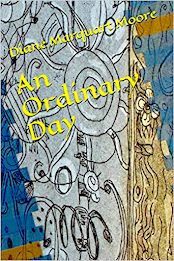
I was reading E. B. White’s One Man’s Meat yesterday when Four Ravens, a book of poetry by my friend and editor Gary Lee Entsminger, arrived. I had just finished reading about White’s wife complaining that she didn’t quite understand poetry, and he told her that a poet’s pleasure is to “withhold a little of his meaning, to intensify by mystification, zipping the veil from beauty but not removing it.” Entsminger’s new book of poems certainly bears out White’s assessment of poetry while reminding us of his awe for nature and organisms and, at the same time, embracing metaphysical thoughts in many of his musings.

I particularly liked Entsminger’s poems about his wife, Susan, who is an artist and who drew the raven on the cover of Four Ravens and sketched this bird in simple line drawings throughout the book. In “Second Reality,” Entsminger reveals the force of Susan’s work as an artist in a poem that shows his respect and devotion to his talented wife: “…sky reflects through the window/smudges resemble puddles/bright yellow circles simmer/like sunflowers six feet high./…When did she realize her sketches/said something words cannot explain/as objects came together without touching/the way they once reigned.” 

The Entsmingers live in a rustic cabin on a plateau in Colorado and exemplify the philosophy of a “Thoreau-like” life, doing tasks that the modern world would call drudgery, including the task of cutting wood. For a winter fire that Susan performs in the poem “Oak,” as husband Gary watches: “Paté done he glances out the window/sees the girl still building trail/work not easy but satisfying/attention focusing her energy/as the waning light casts/shadows of unfamiliarity/she picks up her tools/and goes to the woodpile/stacks the oak/looks at him/through the window/already smelling smoke.” Such poems often concentrate on every day, revealing the couple’s devotion to sustainability and uncomplicated dramas that occur in their daily life together.

Another poem that exemplifies Entsminger’s concern for the environment and objection to a chemical that has proven to poison human life on a large scale is one entitled “In Murdoch’s Ranch and Home Supply,” in which the poet speaks out about Roundup, “buckets and thickets/poisoning everyone/around him…long ago people here/knew to grow/sun-loving crops/in a leafy moon/roots herbs berries/learning how to eat.” 

In “Guide,” readers could surmise that Entsminger is inspired to portray his wife at musical play (Susan also composes and plays guitar and other string instruments): “Bare shouldered/mountain maiden/plucks melodious/strings of sunshine/drawing the youth/who listens/to her paintbrush/glistening/in a meadow/he has climbed to/dawn after dawn/Knowing he’s there/she stops playing/sets aside her psaltery.” The imagery in this spare poem is reminiscent of a long haiku, another rich drama in everyday experience.

Gary’s oeuvre is not without wryness in the pithy lyrics entitled “Cowgirl” placed within the opening pages of Four Ravens, when a mysterious woman roams mountain slopes: “misplaced perhaps/or meant to be/alpine chic/and lengthy curves…in this gentle range/no one spends/their lives/on indifferent things/she rises now and sings/as the cows look up/still chewing patiently/ready to follow her/down to the milking/She looks across the meadow/seeing something we don’t see/and tips her hat to me. “

This book is the second collection of poetry Gary Entsminger has published and contains new work as well as older poetry that adds to an abundance of original nature lyrics and existential musings that constitute a profound volume of rewarding reading. 

Four Ravens is available from Pinyon Publishing, 23847 V66 Trail, Montrose, CO 81403 (www.pinyon-publishing.com).


Saturday, June 8, 2019

TIME WAS, TIME IS…


In E. B. White’s Writings From the New Yorker, 1927-1976, White includes an essay entitled “Disillusion” in which he writes about aging humans hanging onto or “groping toward things that give us a sense of security.” He names clocks in telegraph offices as vanguards of the correct time, and when he passes a clock in a telegraph office that has lost time, he feels that life is slipping away from him. This entry was written in 1929, but it carries the same message for me 90 years later — a thought underlined in a quatrain of The Rubaiyat of Omar Kayaam: “Whether the cup with sweet or bitter run, the wine of life keeps oozing drop by drop; the leaves of life keep falling one by one.”

Unfortunately, I’m a time watcher, and I think at 84, it’s too late for me to develop a new behavior unless this behavior slips up on me when I’m not looking at clocks. There are five clocks in our house here in Sewanee, Tennessee, not including the clock on the computer and in my iPhone, and the only one I feel I can count on, like White’s clock in the telegraph office, is my iPhone. However, I use these clocks for a variety of activities. The clock radio in the bedroom is fast, so this means I can sleep ten minutes longer (I don’t have to punch in at an office but am shame-faced if I’m not at my desk at 8 a.m.). Two clocks in the kitchen advertise two different times: the one on the stove is a bit early and announces breakfast when I’m really hungry; the other on the opposite wall is ten minutes behind the correct time and means I still have time to dawdle before breakfast preparations begin... and so on. 


My good friend Janet Faulk-Gonzales, who, bless her, always manages to be late, often reminds me that too much emphasis on heeding time could bring disastrous results similar to what she refers to as “walking off the porch,” a story that appeared in a book entitled Porch Posts we co-authored several years ago. 


Painting by artist Paul Schexnayder for Porch Posts

Painting by artist Paul Schexnayder for Porch Posts


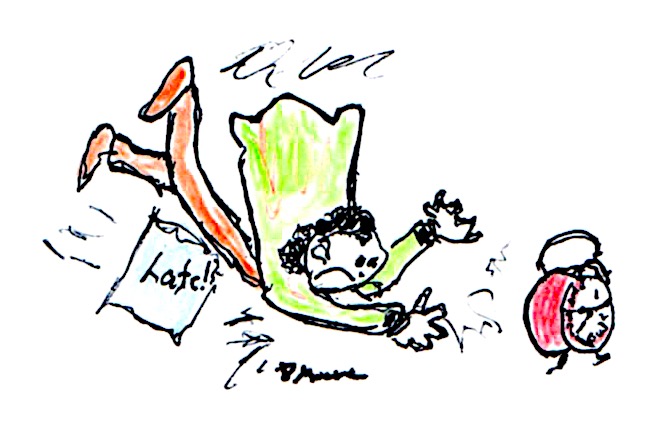
In the essay, “The Pacing Porch,” I relate how I obsessed over being on time for school every morning while my brother and sister chanted “Hup two, three, four, hup two, three, four,” and I paced the front porch in a frenzy until I walked right off the porch, treading air for a few moments before falling with a loud thunk. I was nine years old at the time, and ‘though this event chastened me and my impatience for a day or so, I was back at it a few days after the “flying high” moment. I never fell off again, but I figured out how many paces I could make before reaching the dangerous edge.


Diane's sketch for blog Time Was, Time Is...

Diane's sketch


Although there’re many synonyms for time; e.g., flash, spell, instant, jiffy, twinkle, wink, etc., my favorite is “jiffy,” which resonates with my translation: “joyfully on time.” I’m one who couldn’t abide using such an instrument as an hourglass —what if the sand got damp? Or someone gave me a genuine cuckoo clock from Switzerland and visited often to see if I had hung it even though I was made nervous by such a loud announcement of an entire hour gone forever? The silent, digital hands on a cell phone keep me attuned to movements of day and night in the revolving universe and suit my time watch quite well.

Let’s face it — some people watch second hands; some people  watch minute hands; and some people watch hour hands on the clock. Then, some people lose all sense of time, and the latter isn’t in my DNA. It’s now 9:37 a.m., and I’ll end this reflection on the passage of time by 9:38. Whew, I made it!


Wednesday, June 5, 2019

LINES FROM NORTH CAROLINA

"Blue Ridge Parkway Sunset" by Cindy Lou Chenard


If travelers want to indulge in visual overload, Asheville, North Carolina, home of the River Arts District, (aka RAD) , is THE destination. RAD is a place where 23 industrial and historic buildings have been renovated to accommodate 200 artists who have set up their studios inside. Here, artists work in a variety of mediums — fiber, metal, paint, wood —producing some of the South’s finest art in old warehouses along a mile of waterfront on the French Broad River. 

We spent three days in Asheville, sampling art and international cuisine, and managed to catch the last show of Neil Simon’s “Proposals” at the Flatrock Playhouse in Hendersonville, North Carolina, thirty minutes away from Asheville. The visit to the playhouse was a hairy experience as we lost our way for a few minutes on the return trip to the motel in Asheville., arriving at 11 p.m. with my anxiety at high levels and vowing never to attend functions in unfamiliar places after dark again. 

My favorite visit (the fourth one in recent years) remains the River Arts District where I encountered Cindy Lou Chenard who creates two-and three-dimensional contemporary landscapes and abstracts. I was attracted to the use of horizontal lines in her work which she calls “Art Des Couches De Bois,” (Art in Layers of Wood) I purchased two cards, one entitled “Blue Ridge Parkway Sunset;” the other named after one of my favorite contemporary hymns, “Morning Has Broken.”

"Morning Has Broken" by Cindy Lou Chenard


A former weaver, Cindy Lou begins the process of creating her art with a photograph or sketch of a mountain landscape or an abstract design. In the process of creating these scenes, she scales her design to a desired size and transfers the layout to pieces of thin birch plywood. Using either a bandsaw or scroll saw, she cuts out shaped pieces of wood, sands and paints the pieces, then assembles and secures layers and custom frames her three-dimensional artwork. I was drawn to the purple, yellow, and orange colors in the two cards that showcased her work and talked awhile with Cindy, long enough to meet her husband and a huge dog weighing over 130 pounds that plopped down in front of me. Mr. Chenard, a French Canadian, listened to our stock lecture on Cajun Country, and we passed a good time reviewing the merits of French cuisine for him.

A North Carolina native, Cindy Lou has a BS from NCSU School of Design and exhibits her work in the River Arts District and Woolworth Walk in Asheville. Her work is reminiscent of Georgia O’Keefe’s landscapes and creates a grand sense of space in viewers.

When we returned to the motel, I was surprised to see the vivid orange and yellow line designs in carpeting throughout the halls and rooms and wondered if decorators for the new motel had taken a leaf from Cindy Lou’s beautiful work.