Thursday, April 14, 2016

ONLY THE ONE SKY

When I received and read a copy of Pinyon Publishing’s recent release of a volume of poetry, Only The One Sky by Dabney Stuart, I kept thinking about another book of poems entitled Call and Response, an exchange in poetic form written by Louisiana poets Darrell Bourque and Jack Bedell. Both books represent a kind of counterpoint and harmony that flows between two poets to create a spiritual synthesis, embracing past and present in a medley of poems. In the case of Only the One Sky, Stuart has a conversation that focuses on joy and loss with an ancient poet from the Tang Dynasty of eighth century China.

Stuart names his connection “the old poet,” and transcends the boundaries of time, reaching back to antiquity for his subject, Wang Wei, who once wrote to his friend P’ei Ti about walking “hand in hand, composing poems as we went…down twisting paths to the banks of clear streams.” Although the poets have diverging personalities and sensibilities, they share communications that complement each other and in their listening and speaking, the reader is treated to meditations on nature, breath, family, Stuart’s musings about “the filtering years, ineffable ways/that have gentled us to this life: magic,/ grief and error, the lifting of veils./ Gratitude. Elation./ A butterfly, an unfolding shadow.”

In the old poet’s poem “Something Like That,” Stuart likens his feelings about longing to a passage from a Conrad novel, lamenting “I have no idea what I long for. /The old poet shifted on his dinghy seat./Only that I long for it./I don’t long for it because it’s impossible/ to attain, but because it’s impossible/for me not to long for it, whatever it is…”  I was reminded of the Sehnsucht of Simone Weil’s passage in Waiting for God: “When we possess a beautiful thing, we still desire something. We do not in the least know what it is. We want to get behind the beauty, but it…like a mirror sends back our own desire for goodness. It is a…mystery that is painfully tantalizing.” In Stuart’s passage there is a sense of the poet remembering fleeting joys, yet he is aware that we seem to be separated from that which is desired, as Corbin Carnell points out in Bright Shadow of Reality, “a ceaseless longing which always points beyond…” Stuart masterfully uses the “old poet” to personify this quest for the secret that remains hidden to us.

Stuart captures the images of wandering and nature in an exquisite poem, “Not the Same,” as the old poet ruminates about his life by the river. “It is always, the same and not the same./The cluster of willows at the near bend/turns yellow in autumn. Its bare branches/flow in the small breezes. He dreams of them./ Sometimes he wakes, uncertain in the darkness,/lies quietly on his cot, listening/for the silence to break, an owl leaving,/the river bearing itself, the willows shushing.”

Using a more contemporary voice, Stuart roots us in his home place with “Porch Screen,” providing the reader and his old poet friend a glimpse of domesticity: “Once your hair fell across your face, tilted aside./My finger to your chin, a brushing kiss…/Someone to talk with, to share the rabbit stew,/the porch screen flaring with late afternoon sun.” The poet crosses the divide in time between the old poet and the younger one with dialogue featuring affection that connects both poets in the shared blessing of an evening meal.

In Only The One Sky Stuart speaks to poets, living and dead, who have transported readers into a spiritual dimension, creating his own inscriptions about a journey filled with the sight of  radiance everywhere, the sacrament of poets’ connections, and the “atmosphere of infinite suggestion.”* 

Dabney Stuart has been a resident at the Rockefeller Center in Bellagio, Italy, has held a Virginia Artists Fellowship, two fellowships from the National Endowment for the Arts, and a Guggenheim Fellowship. In 2006 he won the Library of Virginia Poetry Prize. His work is in the audio and video archives at the Library of Congress.

Only The One Sky is available from Pinyon Publishing, 23847 V66 Trail, Montrose, Colorado 81403 and from amazon.com.


*A.C. Bradley. Oxford Lectures on Poetry.

Monday, April 4, 2016

PODOPHYLLUM: MAYAPPLE MAGIC

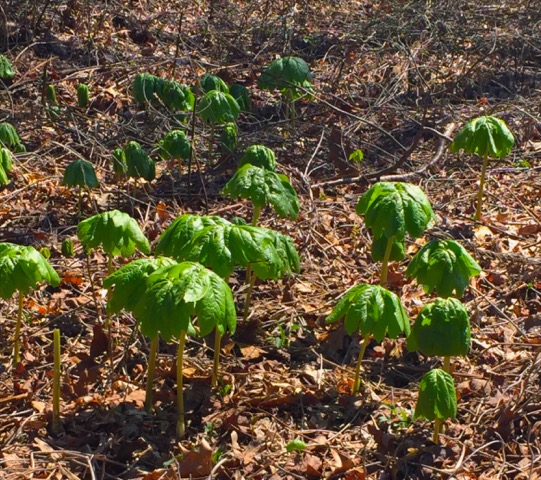
Mayapples along Templeton Way
Yesterday, following Sunday Eucharist at the Chapel of St. Mary’s, we rode past a patch of plants with peculiar green leaves, and I asked resident botanist, Dr. Victoria Sullivan, to turn around and make an identification of the patch for me. At first, I thought we had come upon a group of plants unlikely to be growing on the Mountain – pitcher plants prevalent in south Louisiana bogs. However, when we retraced our steps and examined the colony of green plants with their umbrella-like leaves, Dr. Sullivan identified them as a colony of Mayapple, minus the flowers that appear in early May. The umbrella-like leaves protect large white flowers that bloom this month and in May.

Mayapples were once called “witches umbrellas,” and some believed that the plants were poisonous, apart from the ripe fruit that can be used as a cathartic and purgative. Actually, the fully-ripe fruit, which turns yellow in late summer and is often called wild lemon, can be made into jams and jellies, even pies. But rinds and seeds are poisonous.

When I first glimpsed the colony of Mayapple, I thought immediately of my mother who believed in fantastical beings – mystical-like gnomes, elves, and other wee folk she painted into oil renderings and who could have taken shelter under the umbrella-like Mayapples. She would have believed the stories about the English version of this plant, the Mandrake, one of which reports that the mandrakes are alive and scream when pulled from the ground. Their screams were reputed to drive people insane. Mother believed in magical beings, but she shied away from stories about dragons and mermaids, thinking that the dragon with its fish scales, giant horns, and alligator tail might frighten us. Instead, she chose to read aloud to us each night chapters from Peter Pan, Cinderella, Alice in Wonderland, and a story that ultimately did frighten me – that of Snow White – and was the Mayapple the apple she consumed that caused her to fall into a sleep from which no one except a prince could rouse her?

Mother Dorothy wasn’t too far off base in her perceptions about magical creatures. After Dr. Sullivan had identified the Mayapple, I found a poem entitled “Mandrakes” by Minnie Wait that could have been written by my mother:

“Down in the shady woodland
Where fern fronds are uncurled
A host of green umbrellas
Are swiftly now unfurled.
Do they shelter fair people
From sudden pelting showers
Or are the leaves but sunshades
To shield the waxen flowers?”

Scientists are now studying and deriving anti-tumor drugs from the toxic tubers of the Mayapple. American Indians often boiled the roots from this plant and used the water to cure tummy aches. Also, the Podophyllum peltatum can be applied topically to warts. I wonder if the south Louisiana traiteurs have used it as a remedy to cure warts – a healing for which they are famous.


Whatever the uses of this magical-looking plant, my sighting provided fodder for a blog about a field of bumbershoots along the path to St. Mary’s on a sunny Sunday morning and inspired photography by Dr. Sullivan.

Saturday, March 26, 2016

WHERE THEY “PASS A GOOD TIME”

Japanese Magnolia with
Fleur de Lis
Harnett T. Kane says that Louisiana is a place that seems unable to make up its mind whether it will be earth or water and so it compromises — it’s both! He has more complimentary things to say about the state in which I was born, and I appreciate his reflections about the bayou country and how its waters have shaped the life and history of south Louisiana and its people. I’ve just vacated New Iberia, Louisiana where I live half the year and was feeling a bit homesick while traveling the road to my second home on the Mountain at Sewanee, Tennessee when I received an e-mail that contained an article from The Washington Post about the ten happiest cities in America. I wasn’t surprised to read that the #1 place was taken by Lafayette, Louisiana, a city 18 miles up the road from New Iberia.  As I read on, I discovered that four other Louisiana cities were among the top ten: Houma, Lake Charles, Shreveport, and Alexandria.

It seems that despite all the woes associated with an ailing budget, Louisianans living in smaller cities are satisfied with where they live as contrasted with larger cities like New York, Detroit, Jersey City, etc. Actually, the research done by economists Edward Glaeser and Oren Ziv at Harvard and Joshua Gottlieb at the University of British Columbia revealed more about the unhappiest cities than it did about the happiest cities and why residents in Louisiana are so happy with their way of life, except for the fact that they live in the Sun Belt. (They didn’t mention the humidity or the monsoon season in my native state, but, then, no climate in the U.S. is ideal).

I’d have to write several blogs to inform the researchers why south Louisianans are so satisfied with Lafayette and south Louisiana, but, again, Harnett Kane has a lot to say about the joie de vivre of bayou country, describing lowlanders as “calm, intermittently excitable, and romantic in temperament…with laughter in their eyes, a joke on their tongues…social beings above all…”  Perhaps those personality traits account, in large measure, for south Louisianans’ satisfaction with life, and their outlook would be good wherever they lived, in my opinion.

I’ve read a lot about authors (e.g., Thomas Wolfe) who move abroad to gain the perspective to write about the place that birthed them, and there are times when I think that when I moved my writing desk to The Mountain, I gained a broader perspective about the bayou country from whence I’ve come. I hope this is true because I’m presently working on a book of poetry about bayous, and I’m far removed from the streams of Louisiana that have been celebrated in songs and poems. Fifteen hundred or so miles of the Louisiana coastland are gradually eroding, oil companies have intruded into the state’s waterways, hurricanes have battered the fecund landscape, but “down there” we’re still eating soft shell crabs, shrimp, crawfish, alligators, turtles, “anything that moves,” enjoying year-round festivals in every area of the state and expressing genuine thankfulness for the “good life.” South Louisianans celebrate the multi-cultural aspects of their cities — French, Spanish, English, Scot, German, Indian, Creoles, Black, Vietnamese, Mexican, and Laotians reside, side by side, and enrich the language and culture of this part of the U.S.


I think that the researchers who published the article about the happiest people in the U.S. should probably spend several years among residents of Louisiana and come up with some hard data about why they’re so happy. Chances are if they get as far down as Bayou Teche country and taste bayou waters, they’ll be drawn to return, perhaps to live among the people with unique names like Dede, Ba, Ta-Ta, La-La, Ti-Ti, Ti-Coo, and Noo Noo who have drawn so much attention to their way of life.

Photograph by Victoria Sullivan