Showing posts with label Dr. Victoria Sullivan. Show all posts

Thursday, October 6, 2016

BIRDS, CHAPTER 2

A few days ago, I wrote a blog about a variety of birds splashing in clean water that my friend, Dr. Victoria Sullivan, had put in the bird bath in the front yard. She kept filling the bath with water from the reverse osmosis filtered water tap in the kitchen, but yesterday she decided to fill the bath via the garden hose as the process for filling was so much easier. But the result wasn’t the same! To our surprise, no birds appeared for their morning bath. We waited, checking hourly for the appearance of our feathered friends. By afternoon, we decided to change the bath, filling it with purified water again. Voila! One by one, the sparrows, cardinals, catbirds, nuthatch, titmouse and other small species took turns splashing in the bird bath until supper time, then departed before dusk for their home in the clump of blackberry bushes by the drive.

“How did they know that the water was purified?” I asked Vickie.

“Maybe those small heads have more brain power than humans think they have.”

“I guess because they live here at Sewanee, the bastion of elitism, they think they’re entitled to pure water.”

“Or maybe they’re just spoiled for me and my ministrations,” Vickie concluded.

Dr. Sullivan is a botanist, not an ornithologist, so I consulted my old friend, Google, and the only answer that made sense for me was a simple one: birds don’t like the additives in ordinary tap water. In fact, some bird lovers relate that they’ve seen birds drinking from mud puddles before they’d drink from bird baths filled with ordinary tap water. Think of it – chlorine, fluoride, and other chemicals pollute water that even birds disdain; in fact, many of them become ill from drinking tap water. Unfortunately, there’s no water control board in the bird world, so they’re on their own about finding good water sources.

There are many reasons for humans to watch the behavior of birds, including, it seems, that of learning good health habits. One cardinal was so grateful for the return of purified water, he dared to walk up to the herb bed by the front door and peek in. He was accompanied by a catbird who looked as if she wanted to engage in a flirtation, but the cardinal wasn’t playing. When the catbird turned her head, the cardinal lifted wing and flew off.

“If St. Francis of Assisi could get birds to sit on his shoulders, perhaps we have a chance to befriend them,” I told Vickie.

The reply to this was downright insulting. “But he was a person who had given up all the luxuries of this world, and those birds sensed his holiness.”

“I guess his stance of poverty means no allowances for purified water,” I said dejectedly.

I've written many bird poems, most of them about crows and grackles, but here’s an old “snippet” (as distinct from a full-bodied poem) from A Moment Seized that’s a bit more inclusive. It’s entitled “Spring Feathers”:

“Mockingbird shrieks in the spring air
making a stand-off with a plump jay,
too much the warrior in his incaution.
A brief fight and they glide away,
reminders of fleeting friendship.
In their tiny brains spring is a code,
a minute groove in mockingbird, robin, sparrow
foretelling the resurrection—
light out of shadow,
bloom out of folded bud,
sooth in the heart of a pistil,
the brief flurry of feather.”


Glasswork of Painted Bunting by Karen Bourque, glass artist, Church Point, Louisiana. Photographed by Dr. Victoria Sullivan as it hangs in a window of our Sewanee house.  


Monday, April 4, 2016

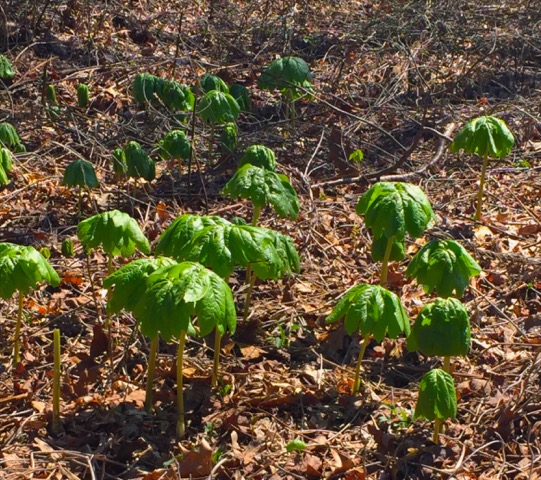
PODOPHYLLUM: MAYAPPLE MAGIC

Mayapples along Templeton Way
Yesterday, following Sunday Eucharist at the Chapel of St. Mary’s, we rode past a patch of plants with peculiar green leaves, and I asked resident botanist, Dr. Victoria Sullivan, to turn around and make an identification of the patch for me. At first, I thought we had come upon a group of plants unlikely to be growing on the Mountain – pitcher plants prevalent in south Louisiana bogs. However, when we retraced our steps and examined the colony of green plants with their umbrella-like leaves, Dr. Sullivan identified them as a colony of Mayapple, minus the flowers that appear in early May. The umbrella-like leaves protect large white flowers that bloom this month and in May.

Mayapples were once called “witches umbrellas,” and some believed that the plants were poisonous, apart from the ripe fruit that can be used as a cathartic and purgative. Actually, the fully-ripe fruit, which turns yellow in late summer and is often called wild lemon, can be made into jams and jellies, even pies. But rinds and seeds are poisonous.

When I first glimpsed the colony of Mayapple, I thought immediately of my mother who believed in fantastical beings – mystical-like gnomes, elves, and other wee folk she painted into oil renderings and who could have taken shelter under the umbrella-like Mayapples. She would have believed the stories about the English version of this plant, the Mandrake, one of which reports that the mandrakes are alive and scream when pulled from the ground. Their screams were reputed to drive people insane. Mother believed in magical beings, but she shied away from stories about dragons and mermaids, thinking that the dragon with its fish scales, giant horns, and alligator tail might frighten us. Instead, she chose to read aloud to us each night chapters from Peter Pan, Cinderella, Alice in Wonderland, and a story that ultimately did frighten me – that of Snow White – and was the Mayapple the apple she consumed that caused her to fall into a sleep from which no one except a prince could rouse her?

Mother Dorothy wasn’t too far off base in her perceptions about magical creatures. After Dr. Sullivan had identified the Mayapple, I found a poem entitled “Mandrakes” by Minnie Wait that could have been written by my mother:

“Down in the shady woodland
Where fern fronds are uncurled
A host of green umbrellas
Are swiftly now unfurled.
Do they shelter fair people
From sudden pelting showers
Or are the leaves but sunshades
To shield the waxen flowers?”

Scientists are now studying and deriving anti-tumor drugs from the toxic tubers of the Mayapple. American Indians often boiled the roots from this plant and used the water to cure tummy aches. Also, the Podophyllum peltatum can be applied topically to warts. I wonder if the south Louisiana traiteurs have used it as a remedy to cure warts – a healing for which they are famous.


Whatever the uses of this magical-looking plant, my sighting provided fodder for a blog about a field of bumbershoots along the path to St. Mary’s on a sunny Sunday morning and inspired photography by Dr. Sullivan.

Friday, December 12, 2014

MORE OF KAREN BOURQUE'S ARTISTRY

On Wednesday, we not only brought home good memories of hanging out in Arnaudville, Louisiana, with Darrell and Karen Bourque, we acquired another glass art piece by Karen, whose work hangs in our Sewanee, Tennessee and New Iberia, Louisiana homes. The latest acquisition is a rendition of the Pickerel Weed, an aquatic plant with brilliant blue flowers, densely clustered on a long spike with heart-shaped leaves, that attracts bees and butterflies.

Karen was inspired to create the stained glass piece using blue dog-toothed amethyst after reading Why Water Plants Don't Drown by Victoria Sullivan and discovering the lovely illustration for the Pickerel Weed rendered by Susan Elliott, artist and co-editor of Pinyon Publishing.

In the text accompanying the glass work, Karen explains that no blue stone felt right for the flowers, so she chose the dog-toothed amethyst to represent them. She attributes qualities of spirituality and contentment to the amethyst and relates that it has calming, protective powers of healing, divine love, and inspiration and that it enhances psychic and creative abilities. We have hung this art that represents "the peace of the perfect peace which was present prior to birth" in the sunroom and can look out and see it each morning at breakfast time.

I always enjoy the texts that accompany Karen's work as they are small inspirational pieces she chooses to use in her interpretations of objects in nature and the personalities who commission the work, as well as to foster creativity in those who acquire the glass work. She is married to the poet Darrell Bourque, and they're well suited to each other because she matches his gift for writing poetry with her visual poems in glass.

Karen has done glass pieces for many homes throughout Acadiana, for the Louisiana Book Festival, for the Ernest Gaines Center at the University of Louisiana at Lafayette and other art centers. Much of her work focuses on the natural world and spirituality—on those images that give meaning and harmony to human experience.

We now have five of Karen's glass pieces, three of which are at Sewanee. One of the more recent pieces is a rendition of a porch that was photographed and appeared on the cover of Porch Posts, a collection of essays and stories that I co-authored with Janet Faulk this year. I will be autographing this book at A&E Gallery in New Iberia Saturday, Dec. 13, 1 - 3 p.m., along with Vickie Sullivan who is debuting her sequel to the speculative novel Adoption entitled Rogue Genes.

Porch Posts' cover is Karen's interpretation of a painting done by the late Elmore Morgan, Jr. which shows the bare outlines of a porch open to the air that might have been a place to sit and watch the sunset and fireflies winking on a summer night.

Karen handles commissions for glass work created in her studio in Church Point, Louisiana, and if you're interested in her work, she can be reached at 337-684-3542 or 337-351-2219.

Photograph of the Pickerel Weed by Victoria I. Sullivan, author of Why Water Plants Don't Drown, Adoption, and Rogue Genes.


Tuesday, November 25, 2014

SPECULATIVE FICTION (?)

Recently, I read an article in The Week regarding the possibility of finding conditions favorable for life forms on other planets and was startled when I discovered astrophysicist Stephen Hawking's viewpoint about looking for these life forms. The startling statement was that Hawking believes any signals we send out could cause a visit from a far superior alien civilization intent on either destroying or colonizing planet earth.

The article reminded me of passages in Victoria Sullivan's new speculative fiction book, Rogue Genes, a sequel to Adoption. Both books concern a species of scientifically engineered humans called "polyploids" who have multiple sets of chromosomes, which endow them with large size, phenomenal strength, and superior intelligence. The polyploid characters become mature adults by the age of six and are eventually banished to a reservation in a community called "Polysomia." They receive no respect from diploids (ordinary human beings with only two sets of chromosomes), are declared to be another species, and denied rights of ordinary humans because of their conspicuous differences.

This passage from Rogue Genes caused me to wonder what our attitude toward the discovery of alien creatures would be: 

"Mary lay awake a long time dreaming of a just world that accepted polyploids. Perhaps separation was the only way. The British, Americans, and Europeans had separated themselves from the native peoples in colonial Africa and other parts of the world. The colonizing Americans made no attempt to merge cultures. Native Americans were severely oppressed and required to give up their culture, religion, land, and mores in order to survive. And still they were treated as second-class citizens and when they fought back they were isolated on reservations. After generations, surviving natives began mimicking the attitudes of the colonizers by despising their native ways. 

"How did this apply to polys [polyploids]? Would polys be the colonizers, superior in understanding the modern world? Although outnumbered, polys were superior in nearly every way...the intellectual and physical abilities of polys were far superior to diploids. [Mary] could scan a book as fast as she could turn the pages and remember every word. Where did that ability fit into the diploid world? How could diploids compete with that? Where did that leave diploids? How could polys be taught to respect a truly inferior group?...
 

"Only in the purist of religions are people exhorted to love one another. Jesus sought out, mingled, ate, and talked with the oppressed. But the message of Christianity had been distorted throughout history to exclude and rid the world of the 'other.' In the name of Christ, crusaders killed infidels. Churches seemed to be more about excluding sinners, judged by a list of accepted behaviors... 

"Fighting for your people was age-old. Either you suited up and did what you needed to do or you died out or died inside from depression or addiction like some American Indian tribesmen had done and still do. For American Indians, the option to interbreed with whites had led to their extinction as separate cultures. That wasn't an option for polys..."

Sullivan, a biologist, has posed similar questions to those of Hawking in this fascinating speculative fiction, and readers who enjoyed Adoption will find an action-packed read in Rogue Genes that redefines a world which has touted itself as "inclusive."


Available at http://www.amazon.com/Rogue-Genes-Victoria-I-Sullivan-ebook/dp/B00OARFVLC or order from Border Press Books (http://www.borderpressbooks.com), PO Box 3124, Sewanee TN 37375.

Tuesday, October 21, 2014

ROGUE GENES

In 2010, Pinyon-Publishing released Adoption, an intriguing novel by Dr. Victoria Sullivan that appealed to many fans of science fiction. Those fans have been asking for a sequel to this work of speculative science, and this week, Border Press announced the publication of Rogue Genes, the awaited sequel.

Adoption explored the idea of a superhuman race resulting from an in vitro fertilization at a clinic in Louisiana and featured six-year old Mary, a giant adopted by Val, a professor of biology who becomes a detective and protector of the brilliant and beautiful child. Val's research on plant genetics provides insights into the super race that is soon shunned by the government and a public that wants to destroy the very different "species" of humans.

In Rogue Genes, Sullivan continues the story of the superhumans, known as polyploids, who have been banished to Polysomia, a village in southwest Louisiana. Middle-East terrorists who want to use the boys as warriors in their country have captured six five-year old polyploid boys. At five, the boys resemble conventional humans, known as diploids, but they will soon become nine-foot giants. Because of an influenza infection of their diploid parents, the boys carry genes for healing wounds and regenerating limbs, and for synthesizing Vitamin C to keep them healthy.

Serious questions arise. How did kidnappers enter the village of Polysomia the night of the kidnapping? Will government agencies help to find the boys? And who killed a diploid girl and buried her along with a large sum of money in the woods near the Polysomia guardhouse? Was the killer a polyploid and the money a pay-off from the kidnappers? How does a full grown polyploid named Simon, who has violent tendencies, figure in the conflict?

Rogue Genes is a vivid page-turner that continues the exciting action of superhumans who are maligned by the world into which they are born, posing ideas about prejudice, scientific inquiry, and the appropriate treatment of people who cause citizens to become uncomfortable with human differences ... citizens who wish to eliminate creatures who don't fit into physical and social pigeonholes. Sullivan achieves an action-paced work of speculative fiction and presents underlying spiritual questions about man's inhumanity toward differing fellow humans.

Sullivan is an author and botanist. She studied biology at the University of Miami and has a Ph.D. in biology from Florida State University. She has published poetry, flash fiction, numerous botanical papers, and non-fiction articles. She held a faculty position in the Department of Biology, University of Louisiana at Lafayette for 20 years. She is a resident of Sewanee, Tennessee and winters in New Iberia, Louisiana.

Candace Birch, aka "Quala," rendered the beautiful painting entitled "DNA" on the cover of Rogue Genes.


Rogue Genes is now available on Kindle ($2.99) and in print ($17.50) online at Amazon. Include shipping and handling of $4.50 to order from Border Press, PO Box 3124, Sewanee TN 37375.