Showing posts with label Walter Anderson. Show all posts

Monday, January 7, 2019

WHAT WALTER INGLIS ANDERSON INSPIRED


When more gloom than sun surrounds Teche country, rain falling daily and cold following, I am grateful for the art on the walls of my house, especially the prints of Walter Anderson’s work. This Mississippi artist who suffered from mental illness but who did not let this illness stay his hand from drawing and painting was a humble man who had a reverence for nature and knew that painting, drawing, creating block prints, sculptures, poetry — was not about competition: it was about Art. As he wrote, “his object in being was realization — to realize everything from the smallest object in nature to the most casual acquaintance…”

For several years, my friend Dr. Victoria Sullivan and I traveled to Ocean Springs, Mississippi to research books and articles and to explore Anderson’s habitats. We also visited the Walter Anderson Museum of Art so many times, we could have become docents for this wonderful place. We were preparing for an article Vickie would write about the botany in his work, and I to compose a poem — both scheduled to appear in Interdisciplinary Humanities, a publication sponsored by the National Association for Humanities Education. The entire journal was devoted to Walter Anderson, and the editor, Lisa Graley, a professor at the University of Louisiana at Lafayette, declared that “never before have we worked with a group of authors from such diverse backgrounds who were so enthusiastic about one singular subject…" She also wrote that “through the efforts of Anderson’s mother, he was brought up in an environment where the creation of art was a way — not just of life but of living…”

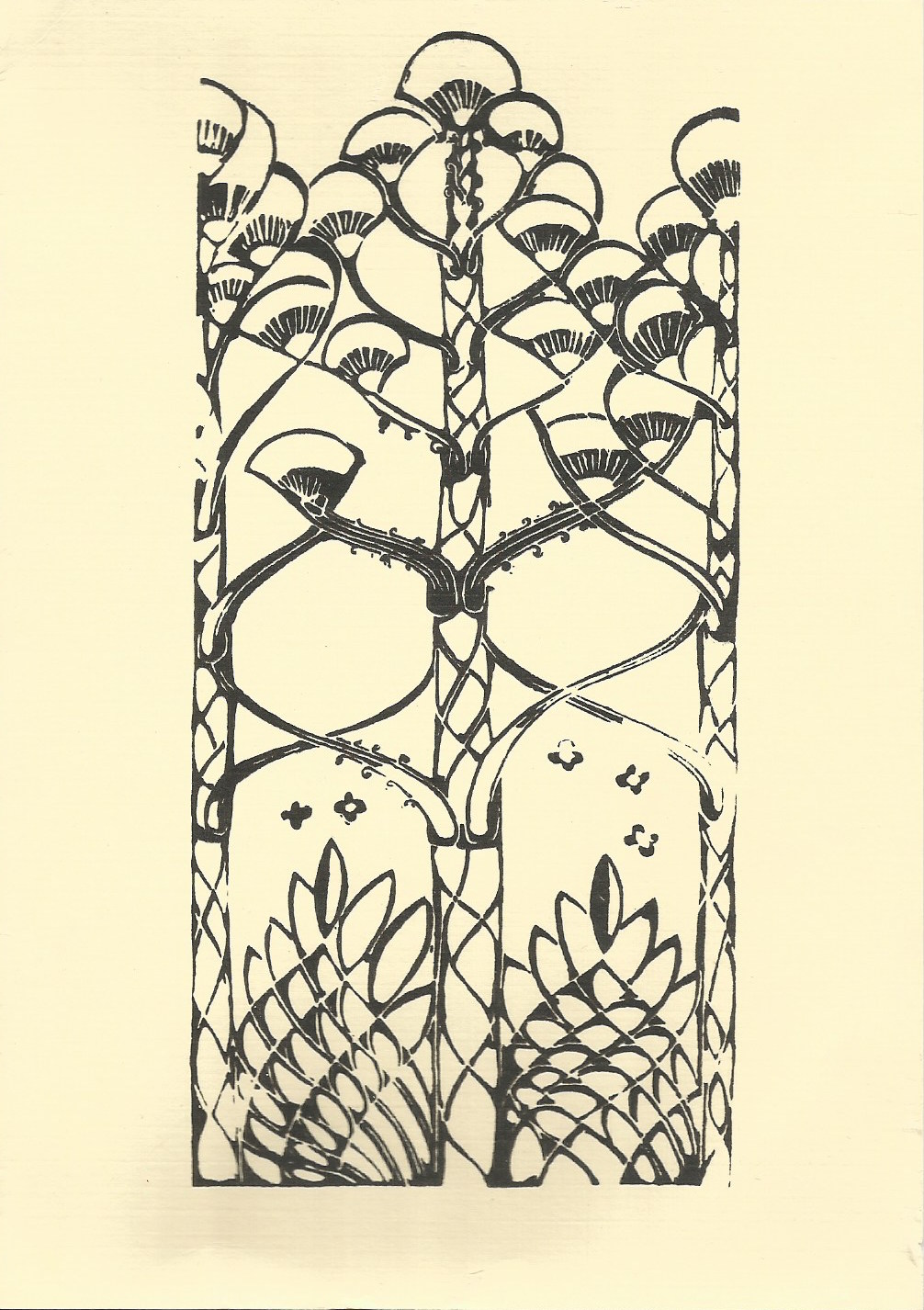
Vickie’s article, “Plant Life ‘Realizations’ in the Murals of Walter Anderson” covered 12 pages, while my poem, “On First Looking into Anderson’s Refuge,” was spread across two. Vickie studied, in depth, lines and forms which Anderson used to depict flora and fauna —trees; e.g., slash pines, which Anderson had captured in a linoleum block print, Chinese tallows (shaped like a woman’s head and shoulders) in another linoleum block print, and wrote extensive, elegant descriptions about the murals from Walter Anderson’s Shearwater Cottage, describing colors and forms of plants; e.g. pipeworts and Yellow Flowered Pitcher Plants, Wood Lily and pink Morning Glory flowers. She also described Sweet Gum and Red Oak trees, and flowering Dogwoods that Anderson painted in the murals for the Community Center in Ocean Springs (another place we frequented during our explorations). She included Anderson’s own writings about his activities from his journals, especially the Horn Island accounts. 

“I live and have my being in a world of Shape and Color,” the artist wrote about his work accomplished during sojourns on Horn Island where he studied plant and animal life. Vickie expressed her admiration for him in a concluding thought that “his spiritual thoughts had moved from turbulent (referring to his mental condition) to recognition of a mystical element within himself. The mystical sense from which he painted interprets nature’s manifesting light.” 

My own poem published in the Interdisciplinary Humanities contained four verses, the second and fourth of which appear here:

II.
He stopped caring for humans,
they were abstractions, pure forms
to people his myths, fantasy props
drawn in hooks and curves,
an ancient language,
signs and symbols, pictographs,
lines trapping the emergency of moment,
claiming history, organic and watchful;
he did all of this wearing a crumpled felt hat,
managing to tip it in gentlemanly gesture
to unknown women
(for whom he had no desire),
to unknown men
(who offered no campfire camaraderie),
alone in a pure world
whose tragedy was a dead animal,
calamity, a hard storm;
he, the eye of God piercing cloud banks
over an island beckoning shipwrecks,
the hand of God poised over unblemished page,
following shorebirds…”

IV. 
At the cottage, a disheveled figure,
he fell asleep in thickest night,’
left hand on the page of fantasy,
right hand clutching pen
after sketching a fairy tale,
re-designing legends,
he lived there too,
bringing whimsey to vague parchment,
using both hands,
scratching literature into visuals,
words unfolding, then folding outward,
transposed into another art.


These excerpts are only the tip of the iceberg in the story about Walter Anderson but I know that The Interdisciplinary Journal containing essays, poems, memories about him was Lisa’s hope for readers to visit the museum and see Anderson’s stunning murals. I think of those warm, eventful days we spent exploring the world of this brilliant artist, and each time I sit at the breakfast table and look up at a print of his“Walls of Light,” some of the gloom of these winter days dissipates. 


Friday, October 19, 2018

TO THE “MAX”

Mississippi Arts and Entertainment Experience (MAX)

We stopped for an overnight in Meridian, Mississippi, Land of Red Dirt and a city near the place of my Grandfather Greenlaw’s birth in Brandon Mississippi. We were en route from Sewanee, Tennessee to New Iberia, Louisiana, and yesterday we had a mission: to see the world class MAX (Mississippi Arts and Entertainment Experience) newly opened in April this year. At a cost of $45 million, this center showcases the talents, past and present, of Mississippi artists in the fields of music, dance, visual arts, literature and storytelling, theatre, pottery, and other work in arts and entertainment. The MAX features innovative and interactive exhibits of notables like Willie Morris, Charley Pride, Oprah Winfrey, William Faulkner, Walter Anderson, Eudora Welty, Muddy Waters, Marty Stuart, Craig Claiborne, and many other artists and craftsmen, chefs, writers, and musicians, as well as consummate storytellers born and raised in this rich southern culture. 

As we drove into the parking lot at the MAX, I noticed an old hotel up the street that appeared to be in the stages of reconstruction and wondered if it was the Hotel Meridian where my grandfather had stayed while doing business in the automobile industry during the early 1900’s. At the desk, I asked a docent about the location of the old Hotel Meridian. “You’re standing on it,” she said. “It was demolished and this museum was built on the site.”

Manny and Melanie Mitchell of Meridian had donated the Meridian Hotel to the MAX project, and a board of directors approved the purchase of the Montana building next door to be included in the 58,000 square ft. exhibit space. The Mississippi Arts & Entertainment Experience contains a broadcast studio, art studio, multi-purpose area, gift shop, and an outdoor performance area and courtyard. 

The 20-yr. MAX project, from conception to completion, began with the Mississippi legislature providing seed money for an ambitious arts museum and gained momentum with major donations from the Phil Hardin Foundation and the Riley Foundation. In 2011, LPK Architects of Meridian, Canizaro Cawthon Davis of Jackson, Mississippi, and the internationally-recognized museum planning and design firm of Gallagher & Associates of Washington, D.C. formed the team that would create the remarkable museum. Other specialists who could add content from their communities in Mississippi became involved. 


The MAX is an inspiring project that has already begun to attract young people from elementary and secondary schools where they may be seen swaying to a juke joint band in an exhibit, or standing transfixed before the screen showing Horn Island and a simulated rowboat in which the artist Walter Anderson (my favorite) rowed out to the island to discover the subjects for his wildlife paintings. In 2019, the Jim Henson Exhibition entitled “Imagination Unlimited” will explore native Mississippian Henson’s work for film and television, including The Muppet Show, Sesame Street, and other shows that have delighted young people.

The exhibit of Shearwater Pottery, established by Walter Anderson’s brother, Peter, in business since the 1920’s, features pottery crafted from two clay bodies: a white-bodied clay obtained from Tennessee, and a buff-bodied clay made from local Mississippi and Alabama sources. The pottery is decorated or glazed from one of Shearwater’s distinct glazes. I’ve visited this store, as well as the Walter Anderson Museum numerous times, and my birthday and Christmas gifts have included prints from the Anderson museum.


Meridian, Mississippi may not have been on a tourist’s radar prior to the construction of the MAX, but it’s worth a stopover of two or three hours browsing in this inspiring museum. Tommy Delaney, Board Chair of the MAX, has written that he feels the MAX will become the catalyst for economic growth for Meridian and Lauderdale County, Mississippi, and Meridian is now poised for serious consideration by businesses looking for quality locations.


Thursday, November 19, 2015

FAREWELL TO PINES

Every time I turn into my drive lately, three freshly-cut stumps reproach me. They are the remains of 75 ft. pine trees that had been in my front yard for thirty-seven years – tall, cheerful pines that survived several severe hurricanes with few scars to their scaly, alligator bark. I will miss their whispering voices when south winds blow in, but they shouldn’t have intruded on the plumbing in my home.

When we returned from The Mountain in Tennessee a few weeks ago, the roots of these straight-trunked, sun-loving beauties had extended their fingers across the entire length and width of the yard and reached deep into the maze of plumbing lines that ran under the front lawn. One of them had gradually overpowered the edge of the drive leading to the rear of my home as most of my friends enter by the back door, and I had begun to get serious complaints about their near-misses of the tree when they backed out.

 My tall, cheerful pines had to go.

Pine trees have always been part of my life. During my childhood in Franklinton, Louisiana, after we returned from a long summer trip gypsying in California, my mother was drawn back to the piney woods of southeast Louisiana where my grandfather had settled after he left Hazlehurst, Mississippi, another pine tree habitat.

My great-grandmother had been raised in the piney woods of Brandon, Mississippi where names like Pine Lake Road, Shady Pines RV Park, Pine Ridge Circle, and Southern Pine Electric Power abound. Residents in these parts, who already have thick stands of pines on their property, have been advised by experts at the Mississippi State University Forest and Wildlife Research Center to use herbicides to kill off the noxious weed forests of kudzu in that area and to replace them with more pine trees to increase land value. People in those parts seem to know how to live alongside pines without fear of hurricanes, plumbing failures, lawn damage, and I guess I should have taken lessons about pine location from my grandfather back when…

Walter Anderson's Etching: Concept of Pine
My trees were slash pines, and they were young compared to some venerable ones that live to be between 100 – 1000 years of a — they obviously tolerated the poorly-drained soil in my neighborhood, which most pines do not. One summer on a visit to California, my botanist friend, Vickie, and I turned off on a road leading to the oldest bristlecone pine tree in the U.S., an ancient specimen 4600 years old, but we were forced to turn around before reaching it after ten miles or so because of intense heat and no water in the car.

I will miss picking up the cones with my grandchildren who’ve always been attracted to them when they came to visit, filling their wagons and transporting their prickly cargo to the coulee behind my home. These pine cones are heavy with symbolism and are reputed to represent the Third Eye of the Soul and enlightenment, so I’ve slain some totems of spirituality by having cut down the trees that bear them. One legend attributed to pine cones is that they were actually the fruit from the Tree of Knowledge of Good and Evil in the Garden of Eden, so you can see I’ve really felled the bearers of true enlightenment. The Pope of the Roman Catholic Church, whose sacred staff has a pine cone atop it, might be appalled!


The sight of those tall beauties must have had some mystical influence on creativity because the Muse has not been visiting me so often since the demise of the pines, and I haven’t even been able to write a Eulogy for Pines. This is the best I can do for my old friends. I will miss the clean, sharp smell of pine needles that often energized me when all else failed and I stepped outdoors to breathe their scent … but, alas, I am inured to indoor plumbing.  

Saturday, July 4, 2015

LIGHT ON A RAINY DAY

/FRAMED PRINT OF PAINTING BY WALTER ANDERSON SITTING ON MANTLE
Print of painting by Walter Anderson

On this rainy day in Sewanee, Tennessee that seems to be the way the weather will be for nigh on a week, I go on Facebook.com and see a picture of my grandson Martin teaching my great-grandson Alex how to golf (my great-grandson is four years old!). They're staying at the Villa of Hickory Hills in Mississippi where his godmother and I took Martin at age five, and for many years after, to enjoy golfing and the nearby Gulf. It's there at Gauthier, Mississippi that I first learned about the artist Walter Anderson whose home was in Ocean Springs on the Mississippi Coast, only a few miles away from Gauthier.

When we owned the timeshare at Gauthier, I always visited the Walter Anderson Museum where I became enchanted with the murals of Anderson's "Walls of Light" at the Shearwater Cottage. Today, as rain falls in heavy sheets from a gray sky, I think of Anderson's walls of light and stand before a print showing part of the cottage mural that hangs in my living room here at Sewanee, the flaming colors lighting up an otherwise dull day. Anderson, who saw color everywhere, captured the light of the sky, trees, and grass and wrote: "the dawn was magnificent. Sky was vermilion and blue and all the tree trunks turned pink and the grass peach color. Then I heard the cranes for the first time...metallic and in perfect keeping with the setting..."

Anderson was a brilliant New Orleans-born painter, a southern artist who was both mystic and madman. He trained at the Pennsylvania Academy of the Fine Arts and later painted radiant pictures of the surrounding Mississippi landscape and its wildlife, often working under a makeshift shelter on Horn Island in the Mississippi Gulf. He painted the murals in the Ocean Springs Community Center and created designs for pottery, pictures of animal life, hundreds of hand-colored linoleum block prints, and after he died, when family members went into the cottage where he lived, alone, beside their home, they discovered hundreds of watercolors he had never shown. In a wooden chamber he called "the little room," Anderson had painted the ceiling and walls with birds that burst into flame, plants that became butterflies, a sun on the ceiling, and cats stalking prey in tall grass.

/COVER OF WALLS OF LIGHT, BY ANNE R. KING
I admire Anderson's work as that of a great artist who worked in all mediums and mastered all of them, but it is his paintings of nature and the mystic quality evident in his murals that enchant me. Anne King describes him as a "paradox in life, torn between the responsibilities of the concentric, a term he used to denote the social order of the workaday world, and the bliss of the eccentric, a state of oneness with nature as the artist-creator..." (Walls of Light,The Murals of Walter Anderson).


Anderson developed his love of nature and the arts at a young age when he accompanied his father and brothers hunting and fishing on Lake Pontchartrain and in the marshes of Louisiana, and he also spent time observing nature while vacationing at his mother's family home on the Mississippi Gulf Coast. In all these places, he developed his vision of nature that would become realized in his art.

Beneath the copy of the mural painting in my living room are his words about the melding of nature and art: "The Third poetry is sometimes never written but when it is, it's by those who have brought nature and art together in one thing."

I envy Martin and his little family as they enjoy the Villas of Hickory Hills...mostly because I miss my favorite art show in the Walter Anderson Museum of Art where Anderson created a rich vision of the natural world.


Note: Dr. Victoria I. Sullivan, a botanist, describes the flora and fauna in all of Anderson's murals in an article entitled "Plant Life 'Realizations' in the Murals of Walter Anderson," published in Interdisciplinary Humanities, 2004-2005. One of my poems entitled "On First Looking Into Anderson's Refuge," was published in the same issue.