Showing posts with label Sophie's Sojourn in Persia. Show all posts

Wednesday, August 1, 2018

TANKS AHOY


I have a close British friend of over forty years standing whom I befriended during my sojourn in Iran in the 1970’s and with whom I still correspond. She left Iran shortly after the Iranian Revolution erupted and now lives in Bulkington Wiltshire, Great Britain or the United Kingdom or whatever designation is appropriate for what I used to simply call England. Anne is a few years younger than I am and much younger in spirit as you will discover from reading this blog. Not long ago she emailed me explaining that she had made a bucket list (which includes many risk factors) and was trying to “tick off” items before she reached 80 years of age. 

At the top of that list was her desire to drive a tank. Don’t ask me why because she was only a few years old when WWII occurred, and she wasn’t old enough to remember tanks lumbering through England. Anyway, her good friend, the Rev. Maureen Allchin, photographed the tank venture, and Anne forwarded a few of the photos just before she boarded a cruise ship bound for Iceland and Greenland where she promised to wave at me — her favorite gesture associated with her friendship with me, the armchair traveler. This year, she waved from the Arctic Circle, and the year before last, she waved from an around-the-world-in-several-months cruise.

Anne taught me to drive a Paykan automobile with a stick shift on the floor when we were together in Iran because she was the only human calm enough to ride with me through neighborhood roads in Ahwaz. These roads had what seemed to be a dip every other block. I would drive into the dip and pull out with loud gear grinding; however, Anne sat beside me, calmly imitating the Queen’s wave as I startled passersby who glimpsed the Paykan disappearing in the dips noisily and re-appearing with even louder grinding noises. But after three lessons with Anne, I was able to drive alone over the bridge that crossed the River Karun and visit with her on the other side. If you’ve ever had a Brit for a friend, you know that you do what is expected of you and you do it with good humor. 

An example of Anne’s wry humor written during the 1980’s: “Sarah was given an indescribable plastic wind instrument for her birthday. So we spend our afternoons following the score of ‘Mary Had A Little Lamb’ and God Save the Queen.’ (Yes, God Save the Queen from this indescribable plastic wind instrument). Wouldn’t you like for her to cross the pond and bring it with her for a long visit?”

I always look forward to Anne’s e-mails from wherever she is waving. The tank episode was slightly shocking to me, but it’s probably in line with Anne’s indomitable spirit. While we were in Iran, she talked me into joining a party of twelve children and four adults from the congregation of Good Shepherd Church in Ahwaz on a train bound for Tehran’s Garden of Evangelism (described in my books, Iran in a Persian Market and Sophie's Sojourn in Persia). The trip took sixteen hours, and most of our ride took place during the long night that we wove in and out of mountain tunnels on a narrow track between 7,000 - 9,000 ft. high that overlooked deep ravines in which I could see no bottom. Anne slept through the entire trip.

To return to the tank, I’m not sure what items are left on Anne’s “Perils of Pauline” list, but I wouldn’t be surprised if skydiving wasn’t close to the top.


Photographs by the Rev. Maureen Allchin


Thursday, November 13, 2014

RE-ISSUE OF BOOK EVOKES MEMORIES

This morning, Victoria Sullivan, publisher of Border Press, and I were discussing a re-issue of my first book entitled Iran In A Persian Market. I began to reminisce about the flight to Tehran from London that my daughters and I made when we joined my husband who worked as a petroleum engineer with the National Iranian Oil Company in Ahwaz, Iran.

"I don't think things were as volatile in the 70's as they are in the Mideast now," I said, "but I do remember being herded off the plane in Tel Aviv, daughters in tow. We were greeted by soldiers holding machine guns and were placed in stalls where we were thoroughly searched. Later, someone on the plane who had previously traveled the route said that the so-called search for a bomb on the plane was only a cover-up for sales at the duty-free shops in the airport." Here's an excerpt from Sophie's Sojourn in Persia, a young adult novel I wrote, documenting this incident:

"We were supposed to be on the ground twenty minutes, and Mother told us we could stay on the plane. The captain's voice boomed over the intercom. 'All passengers must clear the plane. Take the buses to the terminal and wait for further instructions. Please clear the plane quickly. Carry all hand luggage with you...'

"As we walked down the steps toward a long bus resembling a trolley car, my mother gasped. Six soldiers wearing khaki uniforms stood in front of the bus, machine guns resting in their hands. They glared at us. The sun beat down on them, and great wet spots spread from their underarms. It was very hot....

"'It's only a checkpoint of some kind, I'm sure,' Mother reassured us. An old woman wearing a felt hat grabbed my mother's free arm and held on. 'Are we going to be shot?' she asked. Her voice quavered with fear... 'Of course not,' my mother said. 'They're probably checking the plane to see if it needs repairs or something...'

"Inside the terminal, dark-skinned women dressed exactly like the men soldiers herded us into a back room. It was filled with stalls that had dirty white curtains for doors. A woman motioned for the three of us to go into a stall. 'All of you can go in together,' she said to my mother. 'When you get inside, strip down to underclothes. Leave your bags with me...' She went over to my mother and felt her underclothing all over. My mother turned red and said pleadingly, 'You don't have to search the children that way.' The woman smiled. 'It's my job to search for weapons. My name is Leah...'

"The woman had put our bags in a corner of the stall and began to go through them. When she opened Suzy's bag (Suzy was a fictitious name for my youngest daughter) and pulled out a rubber octopus, she let out a piercing scream. The octopus dangled from a dirty string that Leah held in her hand as she ran from the room screaming and giggling...Leah and several other women ran from stall to stall, dangling the rubber animal for all to see. ...Finally, the woman took the octopus to the guard at the entrance to the room. He unbuttoned his shirt and took out a knife. Holding the octopus in the air with one hand, he slashed it three or four times in the head, then dropped it into Leah's hands. 'No explosive here,' Leah said, throwing the octopus to Mother...

"The old woman in the felt hat came over and patted Suzy on the top of her head. 'There, there,' she said. 'I just talked to Mrs. Seton.' She gestured toward a woman with bright red hair and a sharp nose sitting nearby. 'She says there was talk of a bomb threat, and that's why we had to clear the plane. They had to take out all the seats and search thoroughly. We should be leaving in thirty minutes...'

"Suzy stopped crying, but my mother's face got this tight look, and a bluish ring appeared around her mouth. 'Bombs? Who would do such a thing?' she asked. 'We aren't Arab spies!'
Mrs. Seton spoke up. 'Most of us are going somewhere in the Mideast to work or to be with husbands who work there. I don't think there was a real threat. Do you notice how many people bought gifts at the duty-free shops? I think it was a trick to get us to buy their wares...

"We boarded the plane and took off... It was evening, but the sky was blue, blue, with hardly any clouds in it. I looked down at the soldiers still standing on the airfield with their hands on the machine guns and wondered if we'd get the same kind of welcome in Tehran..."

At the time of the incident I accepted that explanation for being herded off the plane because the Israelis wanted us to shop at the duty-free stores; it was a reassuring thought for me and my young daughters, and this morning I continued to relate the experience as if all had been well during the time we spent in the airport. A few hours later, when I researched the Israeli-Palestinian situation of 1973-74, I was shocked to discover that in September of 1974, fifteen months after our encounter in Tel Aviv, a TWA jet with 88 passengers traveling from Tel Aviv to Athens, crashed into the Ionian Sea after Palestinian militants detonated a bomb hidden in the luggage compartment. The crash killed all the passengers and crew members aboard!! 

Forty-one years later, I stand guilty of "ignorance is bliss," since heretofore I believed that the investigation of the plane was a ploy to stimulate interest in duty-free goods. In any case, during the first three months in Iran when I experienced cultural shock, I avoided reading or talking about political incidents that resulted in severe consequences anywhere in the Mideast and buried the memory until I returned Stateside. I then recorded the cause of the Tel Aviv incident the way a fellow passenger had explained it when we finally resumed the journey to Tehran. The delay in Tel Aviv caused us to arrive at midnight at Mehrabad Airport and to experience another uneasy introduction to our sojourn in the Mideast.


However, I did overcome cultural shock and have written three books about our two-year stay in Iran, the last one being The Holy Present and Farda, a book of poetry recording the more fascinating aspects of this Mideastern culture and its history.

Thursday, September 26, 2013

RUMINATIONS ABOUT PERSIAN RULERS

A few days ago, I attended morning services at St. Mary’s Chapel as I usually do on Tuesdays. It was a day overhung with thick fog, and I confess that my mind was as befogged as the outdoors when the lector began reading the Old Testament lesson. I was jolted awake by the names Cyrus and Darius, two Achaemenid kings who reigned over Persia during the fifth and sixth centuries BCE. I lived in Iran (contemporary name for Persia) during the 70’s and read a lot of history about the Persian Empire when it was at its apex during the two kings’ reigns, so the names caused me to pay more attention to the reading about Cyrus freeing the Jews from Babylon captivity and supporting the beginning of the rebuilding of the Jerusalem temple. I remembered that Darius, who followed Cyrus, continued generous funding for the reconstruction of this temple. This great Persian king ruled over forty different ethnic tribes in a domain that stretched from India into the Balkans, and his empire covered three million square miles.
Darius supported faiths and religions that were “alien” as long as they were peaceable, sometimes giving grants for their religious work. He favored Greek cults, supported Elamite priests, built the temple for the Egyptian god, Amun, and restored many other Greek temples that had been destroyed. In Persia he built Persepolis and Susa, promoted learning, agriculture and forestation, earning his name as the greatest of Persia’s kings. One of the sites I visited at Naqs-e-Rustam bore several inscriptions on Darius’s tomb, which was carved out of rock face, and the one that impressed me read: “I am Darius the Great King, King of Kings, King of countries containing all kinds of men. King in this great earth far and wide…”
The day following my reminiscences about Darius, I picked up the newspaper and read that the new president of Iran, Hasan Rouhani, has informed the UN General Assembly that he seeks to work with the international community, and Iran stands ready for “constructive engagement.” He has also freed political prisoners, replaced the military with the foreign ministry to lead nuclear negotiations, even acknowledged Jews worldwide by wishing them well on Rosh Hashanah. To me and many Americans, his words sound encouraging.
Having lived in Iran for two years, I have some sympathy for the people and the future of this country. My “what if” thoughts about Rouhani border on wild and crazy miracles when I express that I wish he’d take a leaf from history and would really return to the views of the ancient Achaemenian kings, Cyrus and Darius, who practiced tolerance for and generosity toward the faiths and religions of other countries.
However, most opinion pieces in the news are contrary to my “what if” feelings, and I do admit that I am skeptical about Rouhani’s declarations. A few years ago, I expressed that skepticism metaphorically in a poem entitled “Persepolis” in my book, Farda, the last verses appearing below:
“[Alexander] set fire to the state of the free,
the wealth of social accord,

destroying that final bloom,
imperial eastern civilization,

its art now reduced to building missiles,
its architecture to flimsy tents in hot wind,

ghazals about lost battles drifting…
across cloudy mirrors.”

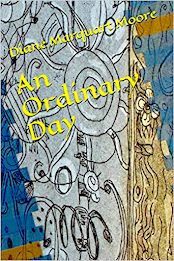
The above picture is a segment of a painting done by Paul Schexnayder of New Iberia, Louisiana for the cover of my book, Sophie’s Sojourn in Persia.