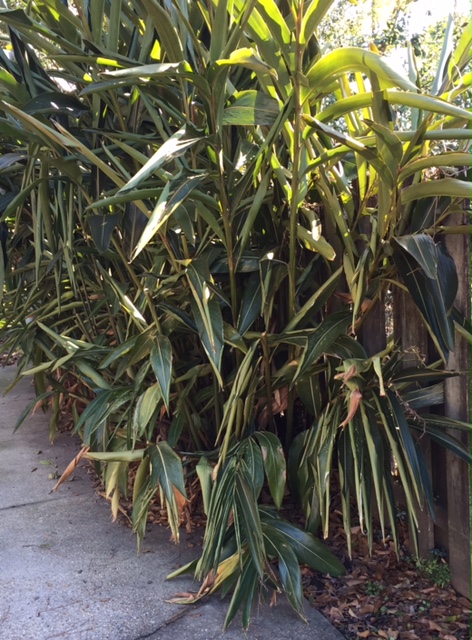
Twenty-six degrees outside. Winds out of the North at 15 mph. Icy rain. Wilted ginger leaves on the large plant beside the drive. We can always tell how severe the winter has been by the death of the ginger plant; the leaves curl up in protest against unusual Louisiana weather. We leave Sewanee, Tennessee every year in late October, migrating to Louisiana in anticipation of warm winters. And here we are, looking out at silver-topped roofs gleaming with frost and at a drooping ginger plant.
Fortunately, the ginger is easily resurrected. We often throw its dead leaves into the coulee behind the house, and when we return the following year, they have become themselves again. This year, a resurrected plant by the drive had overtaken our neighbor's fence by the time we arrived in late October. It is (was) such a beautiful proliferation we named the apartment beside our house "The Ginger House."
We also planted three orange trees that have been draped with white sheets for three days now and are either smothered or near death. I get up in the night and frighten myself by looking out the window at shrouded plants. I'm accustomed to seeing frozen vegetation and late snows many times when I return to Sewanee in early spring, but winter scenes here have become almost an outrage. I suppose this kind of weather drives Eastern snowbirds to lower climes like Florida. Friend Vickie's family lives in a town called Frostproof because temps there have been kind to family orange groves most winters.
I think of the winter I spent in Limestone, Maine, a town near the border of New Brunswick, Canada — of a night when the temps dipped to 52 below zero and broke the block of an old station wagon we left parked outside because we didn't have access to a garage or carport...of the heat supplied by an ancient oil stove in the living room, and a bathroom sans heat of any kind...of snow piled as high as telephone wires beside the farm road that led to our apartment. In my memorabilia I have a picture of me, fresh from the dry heat of El Paso, Texas, hanging out the washing in a Maine November, the washing stiffening as I attached each clothes pin to the line... of living on Aroostook County potatoes the entire winter, not just because they were accessible but because Army pay didn't cover sumptuous meals...of winds that howled under the eaves of an old farmhouse and swept in through the cracks of a makeshift stairwell leading from the outside to our upstairs apartment.
I often wondered why people chose to live in that remote part of the country. When people think of Maine, they usually visualize its jagged coast, the hub of fishing and tourist industries. The famous environmentalist Rachel Carson spent many summers in Maine as she was attracted to the plants and animals on the Maine coast, which she wrote about in her first book entitled The Edge of the Sea. It was based on the many hours she spent observing tide pools along the Maine seashore. Artists Andrew Wyeth, John Sargent, and Winslow Homer produced colorful seascapes while working on their art in Maine. Interestingly, about 900 years ago, pale-skinned Norsemen with blonde hair landed in a rocky inlet of Maine and frequented the coast for 300 years. They attempted to establish a colony but their demise has been attributed to disease or raids by Abenaki or Wabanaki Indians.
In my novel, The Maine Event, I included scenes about the northernmost community of Madawaska on the St. John River, a town that schedules an annual Acadian Festival celebrating with food and music much like we do in south Louisiana. Two of my favorite authors were inspired by life in Maine: Sarah Orne Jewett who wrote that she was proud "to have been made of Berwick dust" (Berwick, Maine)...of the love of friend for friend and the kindness of neighbor to neighbor in this beloved town..." and E.B. White, the famous essayist I admire who spent summers in North Brooklin on Penobscot Bay, Maine.
From the not-so-warm South today to memories of Maine's north woods, I might as well be in an Arctic museum or at the foot of Mount Katahdin in northern Maine, but I'm probably safer here in New Iberia, Louisiana where 72-degree days are forecast for next week.
Showing posts with label Mount Katahdin. Show all posts
Sunday, January 8, 2017
Wednesday, January 8, 2014
WHEN WINTER COMES...
During these wintry days of Arctic blasts and below freezing
temperatures, I think of the winter I spent in Aroostook County, Maine where
the average temps frequently reached 20 and 30 below zero. It was a long and
bitter winter that began in late October and ended in late May. We lived in the
second story of an old farmhouse in Limestone, Maine, a town in the heart of
potato-producing country not far from Madawaska. As I'm of Acadian descent and
lived near enough to Madawaska to enjoy the Acadian Festival held every year in
June, I've always regretted that we missed this festival because we beat a
hasty retreat in May, eager to leave the "winter of our discontent."
A lifelong southerner, I braved the first month of the
severe Maine winter in clothing fit for a Louisiana frost with bare legs, wearing
a lightweight coat, socks and loafers. I slipped on the ice twice before buying
my first and last pair of fur-lined, heavy-soled shoes, and I learned to go
outdoors with enough body coverings to ward off frostbite, even investing in
earmuffs. For those readers who enjoy trivia, the earmuffs were first designed
by a Maine resident named Chester Greenwood, a fifteen-year old boy from
Farmington, Maine. Greenwood patented the earmuffs in 1876 and they earned him
a comfortable living for the rest of his life. Farmington still honors
Greenwood and celebrates his "invention" at an annual festival.
Although we lived close enough to glimpse the aurora borealis, or northern lights, which are caused by electrical
charges in the atmosphere of the far north, we never saw this phenomenon that
occurs beyond the Arctic Circle and sometimes travels south to northern Maine. We
did claim the distinction of being able to celebrate the sunrise before any other state
because the sun rises first in this most northeasternly tip of the U.S.
Part of the Appalachian Trail actually lies in Maine, a
trail that winds for 2,000 miles through fourteen states, beginning near Mount
Katahdin in northern Maine and ending at Springer Mountain in Georgia. Because
of steep climbs and wild woods, the Maine climb of the Appalachian Trails is
reputed to be one of the most challenging trails for seasoned hikers. Hikers
and naturalists love Maine's natural beauty. At one time, John D. Rockefeller,
fearing that development threatened to destroy this natural beauty, purchased 11,000
acres of land and helped create Acadia National Park in Maine, laying out fifty-seven
miles of roads to be used only for horse-drawn vehicles. Today, cars are still
forbidden to travel those roads.
It's a human tendency to romanticize places that we've
visited or where we've lived that are located quite a distance from our roots,
but I find it difficult to romanticize that severe winter I lived in the northernmost
part of Maine. We heated the living room with an aging oil stove, kept the
kitchen warm by lighting the oven and opening its door, and almost suffered
frostbite in the bedroom and bath, which had no heaters. We survived with an
electric blanket, a small portable radio, a 45 rpm record player, two decks of
cards, books from the local library, and a set of Tchaikovsky's symphonies. Our
fare consisted mostly of pinto beans and the potatoes raised in sandy soil on
local farms that produced enough plentiful crops to place them sixth in potato
production in the U.S. I was nineteen years old, and despite the monotonous
fare and the frosty days I spent outdoors sledding and shepherding the
neighborhood children, I returned to Louisiana glowing with good health and an
appreciation for warmer climes.
I might add that Maine has a formidable list of Who's Who
poets and authors, including Sarah Orne Jewett, Stephen King, Henry Longfellow,
Edna St. Vincent Millay, Edward Arlington Robinson, and others.
Several years ago, I published a novel entitled The Maine Event, based in Aroostook County,
Maine where I lived, and although I don't know the identity of my readers, I
still sell a few copies of this book monthly and often wonder if these readers
are located in the Pine Tree State—perhaps live in the cold north woods near
Limestone, Maine.
Subscribe to:
Posts (Atom)