Showing posts with label Franklinton LA. Show all posts

Thursday, November 19, 2015

FAREWELL TO PINES

Every time I turn into my drive lately, three freshly-cut stumps reproach me. They are the remains of 75 ft. pine trees that had been in my front yard for thirty-seven years – tall, cheerful pines that survived several severe hurricanes with few scars to their scaly, alligator bark. I will miss their whispering voices when south winds blow in, but they shouldn’t have intruded on the plumbing in my home.

When we returned from The Mountain in Tennessee a few weeks ago, the roots of these straight-trunked, sun-loving beauties had extended their fingers across the entire length and width of the yard and reached deep into the maze of plumbing lines that ran under the front lawn. One of them had gradually overpowered the edge of the drive leading to the rear of my home as most of my friends enter by the back door, and I had begun to get serious complaints about their near-misses of the tree when they backed out.

 My tall, cheerful pines had to go.

Pine trees have always been part of my life. During my childhood in Franklinton, Louisiana, after we returned from a long summer trip gypsying in California, my mother was drawn back to the piney woods of southeast Louisiana where my grandfather had settled after he left Hazlehurst, Mississippi, another pine tree habitat.

My great-grandmother had been raised in the piney woods of Brandon, Mississippi where names like Pine Lake Road, Shady Pines RV Park, Pine Ridge Circle, and Southern Pine Electric Power abound. Residents in these parts, who already have thick stands of pines on their property, have been advised by experts at the Mississippi State University Forest and Wildlife Research Center to use herbicides to kill off the noxious weed forests of kudzu in that area and to replace them with more pine trees to increase land value. People in those parts seem to know how to live alongside pines without fear of hurricanes, plumbing failures, lawn damage, and I guess I should have taken lessons about pine location from my grandfather back when…
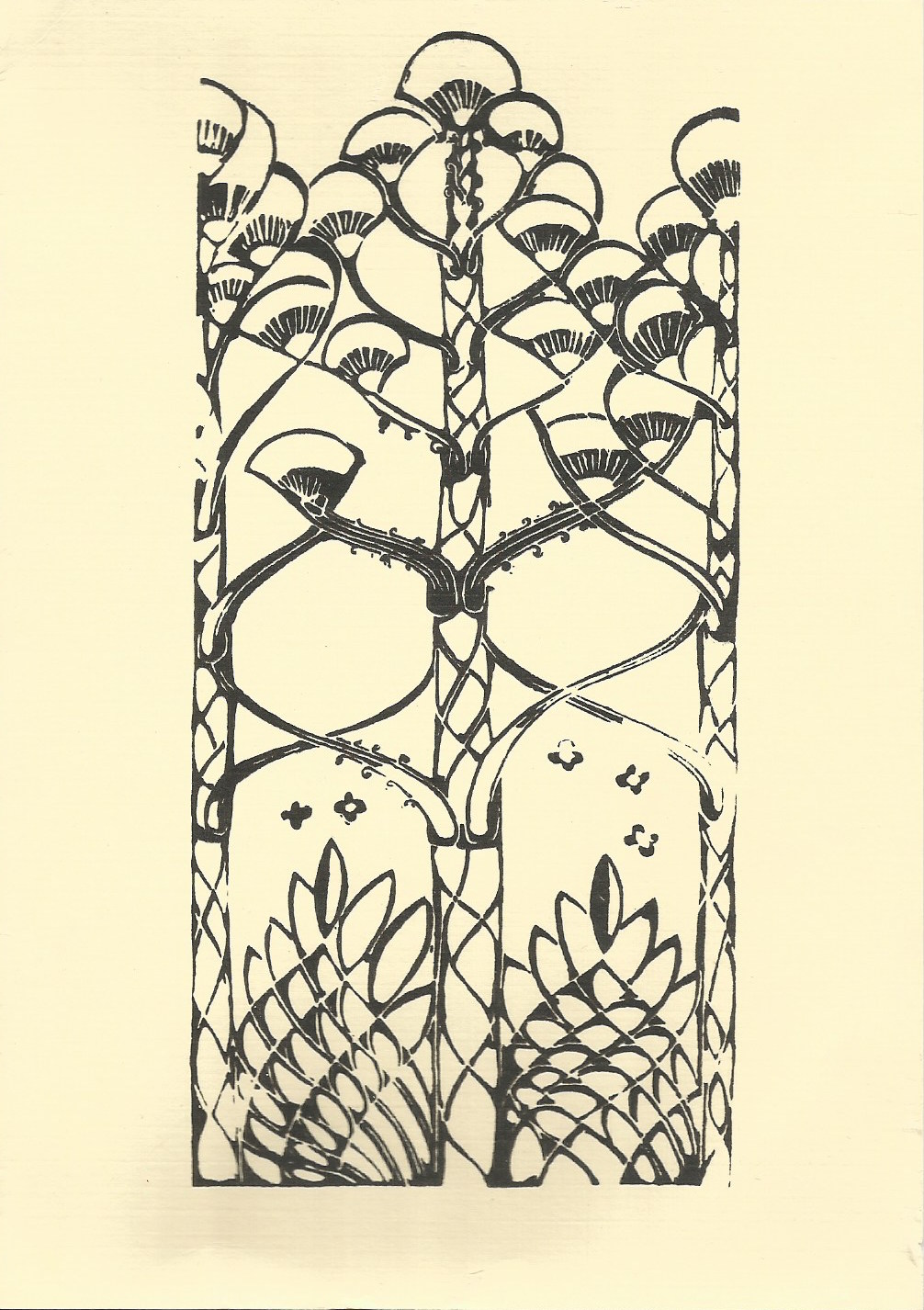
Walter Anderson's Etching: Concept of Pine
My trees were slash pines, and they were young compared to some venerable ones that live to be between 100 – 1000 years of a — they obviously tolerated the poorly-drained soil in my neighborhood, which most pines do not. One summer on a visit to California, my botanist friend, Vickie, and I turned off on a road leading to the oldest bristlecone pine tree in the U.S., an ancient specimen 4600 years old, but we were forced to turn around before reaching it after ten miles or so because of intense heat and no water in the car.

I will miss picking up the cones with my grandchildren who’ve always been attracted to them when they came to visit, filling their wagons and transporting their prickly cargo to the coulee behind my home. These pine cones are heavy with symbolism and are reputed to represent the Third Eye of the Soul and enlightenment, so I’ve slain some totems of spirituality by having cut down the trees that bear them. One legend attributed to pine cones is that they were actually the fruit from the Tree of Knowledge of Good and Evil in the Garden of Eden, so you can see I’ve really felled the bearers of true enlightenment. The Pope of the Roman Catholic Church, whose sacred staff has a pine cone atop it, might be appalled!


The sight of those tall beauties must have had some mystical influence on creativity because the Muse has not been visiting me so often since the demise of the pines, and I haven’t even been able to write a Eulogy for Pines. This is the best I can do for my old friends. I will miss the clean, sharp smell of pine needles that often energized me when all else failed and I stepped outdoors to breathe their scent … but, alas, I am inured to indoor plumbing.  

Monday, July 15, 2013

LABORERS IN THE VINEYARD

Shelling butter beans
The other day I walked into a vegetable market in Winchester, Tennessee and got excited when I saw a plethora of fresh vegetables and fruit– tomatoes, squash, corn, South Carolina peaches – fresh, mouth-watering food that made me think about my childhood visits to the home of my Grandfather and Grandmother Greenlaw in Franklinton, Louisiana where we had fresh vegetables, including fat butter beans, for lunch all summer. I didn’t see any speckled butter beans in the market, but I probably wouldn’t have bought a bagful because a particular memory of shelling them back in the 40’s suddenly assailed me. Here’s the memory in the form of a short-short vignette:

Grandfather set down two washtubs of speckled butter beans – a Mt. Hermon farmer’s harvest of plenty – on the back screen porch and grinned at us. He had a wide mouth, and his grin covered his entire face. He was hardly ever serious because he said he was a Greenlaw, a bona fide Scot, and Scots were known to be practical jokers.

“Fifty cents each to shell the whole bunch,” he said to me and my brother Paul, as he headed out to sell Fords at “The Garage,” a plebian name for a motor car business, also known as “Motor Sales and Service,” a moniker just a tad above “The Garage.”

In 1943, fifty cents looked like a good deal to us. Paul was ten; I was eight, and neither of us had earned over a quarter for doing chores in our household. We smirked at one another and began shelling.

Four red, sore fingers and four hours later, we had done one tubful. We worked steadily in a silence broken only by the buzz of the sawmill further up 10th Avenue. Our grandmother stayed in the kitchen next to the porch because she disapproved of Grandfather putting this Herculean project in our hands. The noon whistle whined and died, but no one called us in, and we plodded on, heaping shells on the green painted concrete floor of the porch.

At first, it had been fun to see the fat speckled bean pop out as we peeled back the shell, but amazement quickly turned to monotony. Mutual, fast shelling became a matter of who could lollygag the longest. After all, we were to be paid equal wages, so it didn’t matter who did the most work, Paul said.

My grandfather came home for lunch, patted us both on our damp heads and didn’t offer for us to stop working. I could hear my grandmother in the kitchen admonishing Grandfather about “child labor.” We had begun to sweat heavily, and the beans were early salted. When 4 p.m. showed on the Motor Sales clock that hung on a solid wall leading into the kitchen, we sat staring down at an inch of beans lying at the bottom of the second tub.

Grandfather came home early because he said he hadn’t sold anything except a handful of auto parts that day.

“Well,” he said to my Grandmother, who had finally decided to check on us, “do you need help canning these beans?” He gave us an evil grin.

My brother and I looked at one another and stood up, then left the porch, letting the screen door bang behind us and not looking back at the inch of beans on the bottom of the second tub.

“Fifty cents between you,” he called after us. ‘You didn’t finish the job.”

We sat under the pear tree in the side yard until dark when Grandfather came out to look for us.

“I shelled the rest,” he said. “And I paid myself twenty-five cents for finishing the job for you.” He didn’t bother to smile and turned to go inside where my grandmother was waiting supper on us. I heard him saying something about being a good Baptist and to remember the parable of the workers in the vineyard to my grandmother, who mumbled the words “proof texting.” I went to bed early, my heart filled with spite…and my stomach gnawing with hunger…but not for butter beans.

Paul ended up thanking him, but I quit going down to Motor Sales in the afternoons where I had worked the adding machine, pretending I was selling cars for my grandfather. I no longer wanted to be a businesswoman. It seemed like business people skimmed the best off the bottom of the tub and cheated the ones who did all the labor.

However, three years later, when I broke my front tooth playing croquet on my grandparent’s side lawn and Grandfather Paul had to witness me squirming in a dentist’s chair, he gave me $25 to spend on whatever I liked… and I didn’t have to perform any tasks to earn the money.  


But I have trouble digesting butter beans to this day, especially speckled ones.