Monday, November 5, 2018

IN THE TIME OF SHIMMER AND LIGHT


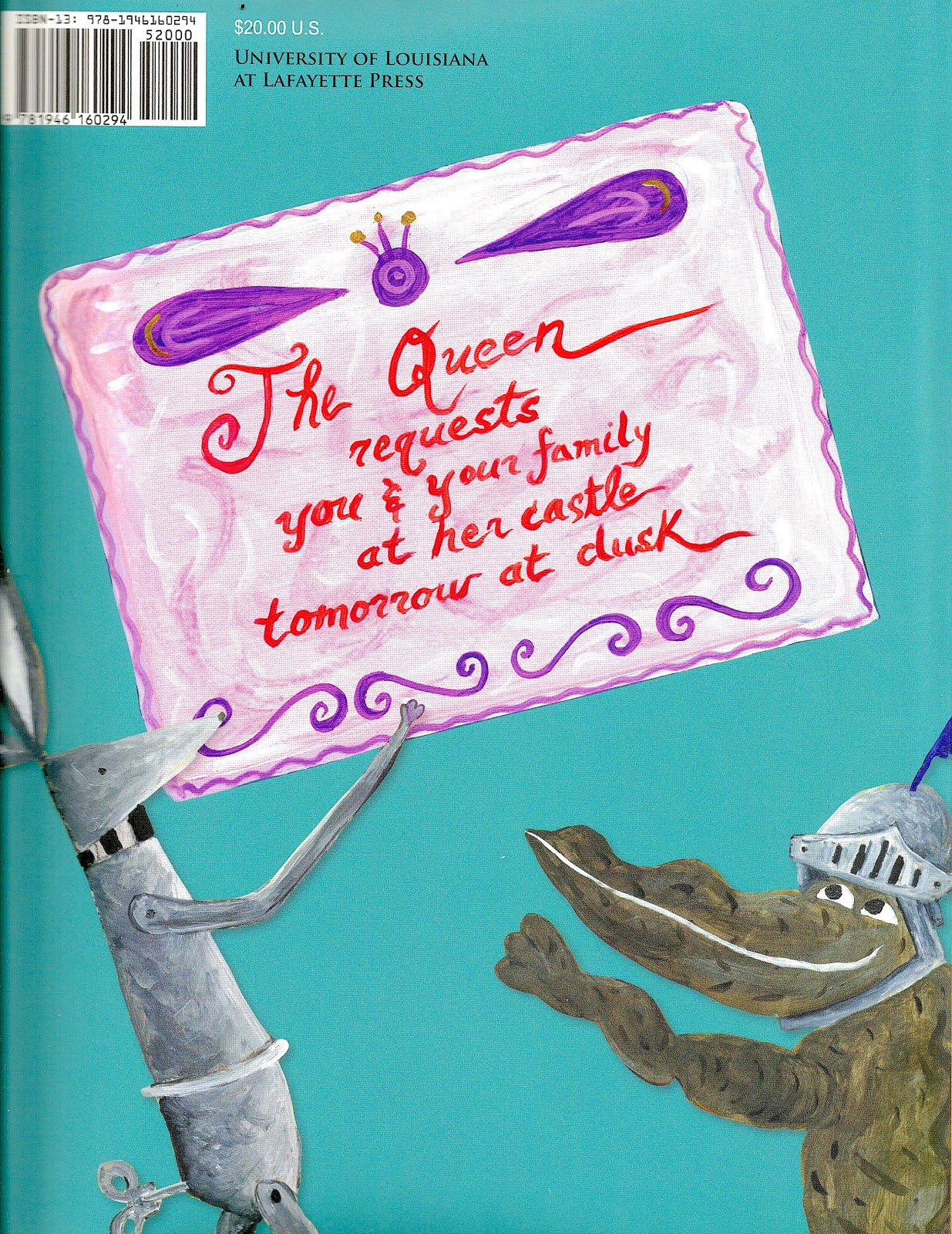
In this time of anxiety and darkness in our broken world, we can count on Paul Schexnayder, New Iberia, Louisiana artist, to gift us with his playful illustrations that always lift our spirits. In The Time of Shimmer and Light, the second book in a three-part series just released by University of Louisiana at Lafayette Press, will delight both young and adult readers. The story takes us to the happy island home of Sir Galatoire Gator, Tin Toy Hare and Queen Ida Peacock where the three critters vie for a dazzling doodad the Queen has found bobbing up and down on the water near their island home.

Schexnayder’s vivid acrylic paintings mesmerize readers, glowing with imaginative figures that “bumble, mumble, and grumble” until the Queen shows her critter friends the object she has discovered and placed in a brilliant red boat to dispel the disharmony developing amongst the friends. I won’t reveal the object or the end of the imaginative fable Schexnayder has created, but readers won’t be disappointed to find more serendipity in the work he offers.


A visit to Schexnayder’s gallery is an occasion of “joy and wonder, shimmer and light,” and visitors usually come away with an art object in hand. Lately, a visit reveals paintings of moss-covered kings who people one wall. The paintings depict mystical-looking beings who are a departure from his “Girth Series,” those kings with tiny heads and billowing robes that he initiated in 2016. “It takes awhile for patrons to get used to a new series,” Schexnayder explains. However, I've found favorable reviews of the new work on facebook and know that his followers will soon add them to their Schexnayder home galleries.

Schexnayder, who always discovers treasures to paint, has made memorable a simple red rowboat that provokes thoughts of optimism, and the word “joy” is frequently reflected in his books, as well as in his art. The mysterious factor in his paintings is that he’s color blind; however, his purples, reds, yellows, and blues leap from the walls and pages of his work after their birth in the colors of his imagination.

This notable New Iberia artist has created illustrations for at least three of my own books, and I often re-use them in blogs. The whimsy that Schexnayder conveys is infectious and his mission, a simple one — to recreate the Fruits of the Spirit, specially the one at the top of St. Paul’s List — JOY. His creations also emerge as acts of love, another outpouring of the Spirit.

Paul Schexnayder has a Bachelor of Fine Arts degree from Louisiana State University, has worked as an art teacher, serves as a member of the Society of Children’s Book Writers and Illustrators and owns an art gallery in New Iberia that he generously shares with regional artists and writers. Recently, he painted a mural depicting his “Girth Series” for the City of New Iberia. The mural emphasizes the idea that New Iberia is not only the “Queen City of the Teche”, as it is often called, it’s also the King City of Bayou Country.


Bravo, Paul, thank you for spreading joy and wonder, shimmer and light! 


Sunday, November 4, 2018

FESTIVAL OF WORDS


Friday evening, we traveled to St. Landry Parish to hear readings by three writers featured in the 11th Annual Festival of Words and were entertained for two hours by Jack Bedell, Louisiana Poet Laureate; Cornelius Eady, a musical theatre poet; and novelist Ladee Hubbard. The trio held creative writing workshops and drive-by poetry readings on Friday and Saturday, November 2nd and 3rd, but I was only present for the Friday reading at Chicory’s Coffee and Cafe in Grand Coteau, Louisiana. We usually migrate from Sewanee, Tennessee to home in New Iberia, Louisiana just in time to attend the Festival, and I’m always amazed at the literary stars that Patrice Melnick, Director of the Festival, attracts.

The Festival of Words is supported by a galaxy of arts organizations: the Louisiana Division of the Arts, Office of Cultural Development, Department of Culture, Recreation and Tourist in cooperation with the Louisiana State Arts Council as administered by the Acadiana Center for the Arts, and partners with the Acadiana Writing Project, Grand Coteau Cultural Arts Foundation, the Thensted Center, Nunu’s Arts and Culture Collective, Lyrically Inclined, Chicory’s, Giles Automart, St. Landry Parish Tourism and Arts and Writing supporters from throughout the U.S.

The three presenters enjoyed equal time as writers from diverse backgrounds, but “A Words Worth” can only accommodate showcasing one from the trio, and I decided to create press for the Louisiana Poet Laureate, Jack Bedell. He’s an engaging poet who teaches English at Southeastern Louisiana University where he edits Louisiana Literature and is director of the Louisiana Literature Press.

I was impressed by Bedell’s humility and what he calls his “simple lines” (from his inscription in No Brother, This Storm, the book I bought during break time at Chicory’s). An unassuming person, he was dressed casually, wore a baseball cap while he read, and delivered poems that reflected a devotion to family, capturing the audience with lyrics of grace and simplicity.

I particularly liked his voice in “First Kiss,” taken from No Brother, This Storm in which he displays his devotion to fatherhood through his daughter’s interest in baby frogs:

First Kiss

…She wants

to turn over every pot, pull back
the cover on the barbecue pit,
check each slat in the storm shutters.
She knows no crack is too small
for these frogs. They can flatten themselves
and get under anything. They fold their bones
and wait for her, each one a prince.

The eloquence in the last two lines evokes the image of an admiring father observing his daughter at play — a nurturing father portrayed in a powerful psalm. A childhood memory of learning “The Children’s Hour” by Longfellow in the third grade flashed through my mind and formed a cameo of the loving father surrounded by his adoring daughters.

I was drawn to all of Bedell’s poems about his daughter, and having written about a turtle yesterday, I revisited the following poem he presented at the Festival reading. These tender, soft-voiced lines resonated with me. 


Dead Turtle 

My daughter leaves the body
as it lies, will not disturb
the turtle’s last stretch
to position it with more grace.

She covers it with azalea petals
to cool its skin, outlines
its body in concentric circles
of branches, swatches
torn from magazines…

In some other place, she will find
song to hold all of this, enlaced. 


Bedell will present his work at the upcoming Louisiana Book Festival next weekend in Baton Rouge, and those who will participate and hear him for the first time can look forward to a time blessed with a wise and delightful reading from our state’s most hopeful poetic voice. 


Saturday, November 3, 2018

TURTLE SOUP

Art work by Paul Schexnayder

Yesterday, while riding along Hwy. 182 en route to New Iberia from Broussard, Louisiana, we whizzed past a ditch filled with water where a police car was parked. The police officer seemed to be arguing with a man holding a rope to which a turtle was tied. I only caught a glimpse of the turtle but could see the spiked shell and thick scaled tail of a huge alligator turtle. If I had satisfied my curiosity, I’d have asked the driver to stop, but thought I might get embroiled in some kind of endangered species argument. I’ve read that alligator turtles aren’t labeled as “endangered” in Louisiana right now, but they are over harvested for their meat. For all I know, the man holding the rope could have just caught his supper and was being chastised for fishing in a highway ditch. 

I’ve been interested in these primitive-looking turtles since I read that they were plentiful on Last Island during the 19th century and that their weight was reported to top 200-400 pounds. They also lived to be 50-100 years old. Several years ago, when I was writing The Kajun Kween, a young adult book, the alligator turtle became a challenge for Petite Marie Melancon, the heroine of a comic strip who caught one in a hoop net, and New Iberia’s famous local illustrator, Paul Schexnayder, painted a picture of her holding the critter by its tail.

Alligator turtles hardly ever come on land, except when the females want to lay their eggs, and November is the wrong season for egg laying, so I’m wondering why the turtle I saw ventured into a roadside ditch, unless the world was “too much with [her]” and she was near the 100-year old mark. After all, some hardy alligator turtles live to be several hundred years old, especially in southwest Louisiana.

According to Petite Marie, who read extensively before going on an adventure to catch an alligator turtle, in the 1800’s, a man named James Cathcart was sent to Last Island, Louisiana to survey timber suitable for making U.S. vessels, and he found fishermen catching 300-lb. turtles at the rate of five alligator turtles a day. They were selling them for $7 apiece and kept them in pens until buyers showed up. Petite Marie figured she’d be lucky if she caught a 50 pounder. However, she managed to net a huge one, and her fishing companions severed its head, placed it in a bucket of water, stuck a twig in its mouth, and the head clamped down on the twig. Petite tells us that the movement of the head was only a reflex but it must have been a frightening sight.

Of course, this is only a replay of a fictional account, but as we zoomed past the snapping turtle on a rope, I admit to being spooked enough not to turn my head for a backward glance. My mother often made turtle soup for her family of five children, but I think the turtle was probably a soft shell turtle my intrepid father had caught in the Bogue Chitto River and beheaded before he brought it home sans head for my mother to cook.