Monday, February 19, 2018

PEAFOWL


A lot of wildlife activity takes place in our backyard here in New Iberia, Louisiana during the day and more frequently at night — possums, coons, an armadillo, squirrels — and domesticated dogs and fat cats sometimes stroll through on a morning walk or an after-dark prowl. However, the other day when I had just emerged from illness, I was on the glass porch enjoying a rare sunshiny day and saw a huge bird with bright plumage sitting on the fence next door. For a moment I thought I was hallucinating as part of my recovery process. But no, it was a peacock or rather a peahen, and when I stepped outside, she, the peahen, flew down into my yard, then strutted through all the backyards lining the coulee —without showing her tail.

I began to read about this strange visitor and learned that she could be aggressive, so I had been wise in deciding not to try to chase the critter. A few moments later, a young girl appeared in my yard, and I went out to greet her. “Was that your bird that just flew by?” I asked. “No,” she replied, “but where did it go? Do you think it escaped from the Zoo of Acadiana?” She scurried off before I could explain that I thought the peafowl might be someone’s pet or give her a long description of the author Flannery O’Connor’s interest in, and rearing of, a yard of peafowl on her farm in Georgia. As O’Connor is one of my favorite authors, the young girl escaped a literary lecture I’m sure she wouldn’t have wanted to hear.

My godmother Dora who lived in Blacksburg, Virginia had a close friend named Elizabeth who married a Mr. Plank, and unbeknownst to Elizabeth, raised peacocks on his farm not far from Blacksburg. A town girl, Elizabeth knew very little about his farming operation, and I’m not sure where the peacocks were hiding when Mr. Plank brought her to the farm for the first time. Now, peacocks sing (?) a certain song that sounds like the scream of a person in serious trouble: “Help, help,” they sang out after Mr. Plank let them out on the lawn and departed for an errand in town. Elizabeth, hearing these blood-curdling screams, immediately dialed the Fire Department, then the police, and invited them out to investigate the high-pitched screams. By the time Mr. Plank returned from his errand in town, he found a crowd of firemen, policemen, frightened peafowl who were now “singing” without pause, and his bewildered wife who never established a friendship with the noisy creatures. And, I might add, she didn’t speak to Mr. Plank for several days because he had withheld knowledge about his “kept” birds.

The peafowl I saw didn’t scream or get in attack mode, but after I read about how these birds, if hungry, or mating, would sometimes attack humans, I was glad that she had continued her march through the backyards of my neighborhood. I did write the “snippet” below after she left the yard:

EMERGENCE

A peahen landed in the backyard,
air bubbling with the end of ice,
south winds blowing away mist.

The bejeweled creature, refusing to show her tail,
passed closed doors along the coulee
looking for a mate or food;

A brief glimpse of iridescent green, 
she stopped short of the neighbor's fence,
boards rotting from too much winter,

then lifted off before we knew 
whether it was spring arriving
or winter departing...


Sunday, February 11, 2018

IN PRAISE OF CORNISH HENS


I “chickened out” from eating quantities of chicken soup during a siege of upper respiratory infections this winter and turned to something with a bit more texture last week — still a chicken but one that ain’t an egg layer — the Cornish Hen. I know this small bird resembles a chicken that didn’t get zapped with growth hormones that commercial producers use nowadays but they’re tasty hens that took me over the line between wasting away and feeling better this week. Nothing smells better than the scent of a Cornish Chicken baking and breaking the barrier between congestion and good health. The scent alone is curative.

Cornish Hens are actually a hybridized breed developed for commercial production, and 
I don’t know that I’ve ever seen one in its feathered state, but I’ve read that they’re an English breed with either white, black or red feathers and that they stay in the same locale on someone’s farm so that they can thrive in a specified environment. These babies are slow to mature, so, of course, commercial farmers thought up another idea to raise a hen that is a breed between Plymouth Rock Chickens and Cornish Chickens, which are prized because they grow fast. That’s the bird you’ll find at the local grocery.

Jacques and Alphonsine Makowsky, a Connecticut couple, developed the Cornish Hen in the United States during the 1950’s by crossbreeding Cornish Game Cocks with Plymouth Rock Hens, and a Malayan Fighting Cock. Alphonsine Makowsky, a French woman who fled from Europe during WWII, must’ve eaten a lot of those plump hens she raised on Idle Wild Farm in Connecticut as she lived to be 92. At one time, the succulent bird she introduced to the U.S. was a gourmet dish at fine dining establishments in New York City; e.g., Club 21.

Cornish Hen and Wild Rice was a premier menu served by one of the former members of The Fortnightly Literary Club here in New Iberia and was the main course of five-course meals once served by this club. The hostess, “Bootsie” Trappey, served a whole bird to each member, and most members, myself included, would come away familiar with what we began to call “the groaning board,” stuffed to the seams from the five-course meal. Most of the Cornish Hens weighed in at 2 - 3 pounds, and by the time the bread pudding with white-topped meringue came around, we were ready to doze off during the book review program that was part of every meeting.

Of course, some readers may prefer the Capon, a huge, castrated rooster weighing in at 6-10 pounds with plenty of fat that may out-flavor the Cornish Hen, but I prefer the little hen that advanced my recovery!

Cornish hen photo from https://chickenbreedslist.com


Saturday, February 10, 2018

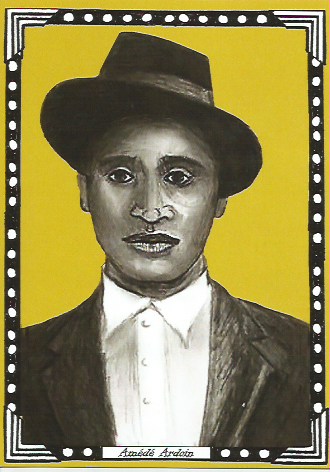
BRINGING AMÉDÉ HOME

Yesterday I received an invitation to an event my friend Darrell Bourque, former poet laureate of Louisiana, has been working on for at least two years — the unveiling of a statue and ceremony honoring the Creole musician, Amédé Ardoin, at the St. Landry Parish Visitor Center in Opelousas, Louisiana, March 11. This event marks the finale to a movement sponsored by Darrell Bourque and Acadiana area supporters commemorating Ardoin’s contribution to Cajun and Creole music.

Amédé Ardoin, at age 43, was beaten by a group of men, following a dance in St. Landry Parish at which he sang in his high-pitched voice, for using a white woman’s handkerchief to wipe the sweat from his brow. He suffered severe injuries, perhaps to his brain, and was committed to the State hospital in Pineville, Louisiana where he later died.

Bourque, who is among recipients of the Louisiana Folklife Award, was intrigued by the musician’s story and composed unrhymed sonnets written in the voices of people who knew Ardoin; e.g., the famous Cajun fiddler Dennis McGee. Bourque’s collection of poems are contained within his book, if you abandon me, comment je vas faire: An Amédé Ardoin Songbook, published by Yellow Flag Press in 2014. He donated a portion of the proceeds from this book to help launch the campaign to “Bring Amédé Home,” and has been tireless in his efforts to raise enough money to commission a sculptor to create a statue of this musician. He describes his work on the Ardoin project as one created for the vitalization of the Creole/Cajun culture.

One of Bourque’s sonnets that touched me with its poignancy, included in if you abandon me, describes Ardoin’s stay at the mental institution in Pineville, Louisiana:

Admissions-Medical Records Clerk: Case No. 13387:

He came to us on 9.26.42 and he couldn’t sign
his name. Didn’t talk anymore the family said. 
That’s why they brought him here. No eating
no sleeping, walking around at night, mumbling

to himself, and only 43. On the Medical Index Card
the most frequent entry is none, or something close
to none. Previous Attacks: None. Hereditary History:

None. Correspondent: None given. Discharged:
(blank). Died: 11.3.42. Disposition of body: (here),
here, an unmarked grave in the Pineville hospital yard.

His people quit coming to see him. He went through
the gates from time to time but someone always found
him and brought him back. His mumbling stopped.
He hummed quietly from time to time. He died alone. — Darrell Bourque —


Ardoin will be “brought home” at 4 p.m. Sunday, March 11, 2018, to the St. Landry Parish Visitor Center, 978 Kennerson Road, Opelousas, Louisiana.