Monday, January 18, 2021

DOGGONE


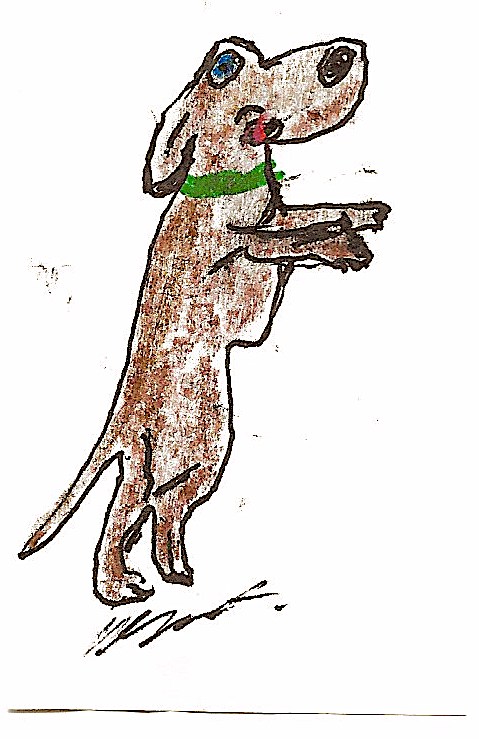
The morning begins with the case of two barking dogs behind the fence that separates our yard from the neighbor’s yard. I don’t know anything about hound dogs' hearing abilities, but when I approach my desk to write, those two hounds start barking. I also don’t know whether the yapping is a “get busy” signal for me, or the canines identify me as a wandering raccoon, or the armadillo that has grown so fat it can hardly climb out of the backyard coulee. In any case, as long as I’m working in the backroom office, the hounds yap.

According to Jean Houston’s book about mystical dogs, there’s a legend attached to the story about the expulsion of Adam and Eve in the Garden of Eden that says as they were leaving the Garden, the dog and cat, in particular, decided to follow them into their lonely exile. The animals agreed to be partners with the exiles, forever afterward promising to be loving companions that would share humans’ lives as “teachers and beloveds.” Houston relates that storyteller Joseph Bruchac suggests animals are wiser than human beings because they don’t forget how to behave.

Houston continues by saying when she loses perspective she looks into the eyes of Luna, her white German shepherd who holds out her paw to connect Houston to what is really important — friendship, love, the greater life of which we are part. She attributes that action as steadfastness. I wouldn’t go so far as to dub those barking dogs “holy guides,” as Houston does, but their barking is steadfast, and her treatise about mystical dogs is worth a read.

The Greenlaws, part of my bloodline, have been great dog lovers, and I’ve owned several canines in my life, the last being a German Shepherd. Her name was Tina, and when she barked at garbage collectors on the LSU campus back when (?), she was banished from the vicinity of GI housing where my husband and I resided for five years. She became a “country dog” but came to an unfortunate ending because she raided chicken houses.

My great Uncle Ed immortalized his terrier in Zip Greenlaw, a copy of which is in the LSU library archives, claiming that the dog’s habit of digging holes in the yard on West End Boulevard, New Orleans, Louisiana, was simply a matter of making holes to let something out and also making a way to let something in. The hole was a feature he could wiggle into but also could be forced out by larger creatures (maybe an armadillo ?). Unfortunately, someone put out poisoned meat for Zip, and he died. He was buried in one of the holes he had made in the backyard.

Back to Houston, who says that we have been on journeys with dogs for thousands of years “as hunters, companions of the road, friends at the hearth.” She says that in her next incarnation, she plans to be a dog, “the kind who lives an unscheduled life…who can sneak into its owner’s library when no one is looking and read a book…It is not inconsequential that the English language allows for the dyslexia of the spelling of the word dog: God spelled backward…”*

Well, I’m again alert to the barking next door as a beautiful cardinal lands on the patio, cocks his head, and appears to be listening to the music that I know will cease once I put “Finis” to this doggone story.
 
*Mystical Dogs, Animals as Guides to Our Inner Life by Jean Houston


Wednesday, January 6, 2021

WHAT BIG EARS YOU HAVE


A few years ago, I attended a lecture delivered by David Haskell, a biologist at Sewanee, Tennessee, who spent a year observing life in a square meter patch of Tennessee forest and writing a book about his observations in The Forest Unseen: A Year's Watch in Nature. I thought about him this morning as I arranged the books and papers on my desk to write about a plant that appears in a small patch 570’ x 130’ beside the door of the rental apartment adjoining our carport. It's an elephant ear, among my favorites in the plant world and one about which I’ve written numerous poems. I don’t know the plant heaven into which all the elephant ears in my garden by the glass porch disappeared. Still, I felt significant sadness for their departure — the absence of these friendly faces of former plants in my garden when I saw the one struggling elephant ear beside the renter’s door.

I consoled myself by reading about the giant elephant ears at Melrose Plantation memorialized by Francois Mignon in one of his columns and included in
Plantation Memo: Plantation Life in Louisiana: 1750-1970. The latter is a collection of Mignon’s columns written for The Natchitoches EnterpriseNatchitoches TimesAlexandria Town Talk, Opelousas World, and the Shreveport Times during the thirty-year period Mignon spent at Melrose. The book is a kind of chronicle about “The man who came to dinner” — Francoise Mignon appearing at Melrose following WWII and taking up residence in Yucca House at Melrose for three decades. Cammie Henry, the Mistress of Melrose, welcomed writers and artists during that period in Louisiana history if they produced art of some kind…if they didn’t work at their writing or art, they couldn’t stay. However, Mignon produced his columns almost daily and earned the right to remain.

During Mignon’s residency at Melrose, he wrote numerous columns about the plantation gardens. I found several passages about elephant ears in which he explained that for thousands of years the South Americans were in sole possession of “God’s gift to the New World, the plant everyone endearingly described as the elephant ear, and all its countless relatives embracing the caladium family…”

Although Mignon regarded the elephant ear as a “Divine gift,” he often entertained his readers with anecdotes about the plant and animal life at Melrose, relating a vignette about the large elephant ears planted at Melrose.

A hard-headed neighbor who visited Melrose between rain showers one day questioned the value of this “divine gift.”

“‘What earthly good is this thing called the elephant ear?’ the neighbor asked.

‘None whatsoever,’ Mignon replied, straightening up the great leaves sagging onto the gallery, greener, in fact, than Montezuma’s emeralds, its spindly, foot-long flower brighter than Inca gold.”

When the rain began again, and the visitor decided to depart, Mignon snipped off one of the huge leaves (three feet wide and four feet long) and handed it to the visitor to use as an umbrella, somehow putting Mignon’s mind to rest since the ear “really did prove to have some pragmatic virtue if only to keep someone dry.”*

The weatherman says we’ll have rain today, but alas, my renter’s elephant ear isn’t large enough to put into use as an umbrella. However, just across Darby Lane near our home, I know where there are several of “God’s gifts to the New World”…hmmm.
 
Photograph by Victoria I. Sullivan


Saturday, January 2, 2021

POSTCARDS FROM THE PAST


J. R.Willis was a reporter for the Atlanta Constitution who migrated to the western United States and set up a photography studio in Gallup, New Mexico, during the mid 20th century. His photographs of the landscapes there look like paintings, and he supplied them for postcards published back in the 1940s, some of which I own because my mother collected these beautiful cards during a trip West with my family in 1946. I keep them in a small black notebook, and on wintry days, like this morning, I take them out and revisit the desert, thinking of warmer days.

My mother appreciated fine art and recognized that Willis wasn’t just someone who snapped a photograph and sold it to a postcard company in Chicago to make a few dollars. He was a notable artist. I have several of Willis’s postcards that she collected and kept in an old red purse that I discovered after her death. Although the cards may be worth money as genuine “collectibles,” I wouldn’t part with them for big dollars.

On gray winter days, I revisit the postcards and travel to Arizona, New Mexico, and California, making the trip that my mother, Dorothy Marquart, regarded as the high-point of her life following WWII. She loved landscape paintings on postcards and newspapers she collected in small towns of the West, including one of Copperas Cove, Texas that she kept for years and a younger brother destroyed. We made many stops in a bright blue Ford that fumed through the West so she could collect the cards and newspapers, but we children enjoyed the hiatus from constant travel—day and night—for two months!


Another collectible was a postcard featuring Twenty-Nine Palms in Palm Springs, California, the work of Stephen Willard. Willard was recognized as a noteworthy artist by Curt Teich, producer of postcards during the 20th century. Willard’s vintage photographs, postcards, and 16,000 items are featured in the Palm Springs Desert Museum. Like many western photographers, he spent summers in the mountains and winters in the desert.

I don’t often include poems within my blogs because I revise them frequently. Besides, every spontaneous poetic thought that enters my mind doesn't deserve publication. This is the snippet I wrote when I viewed the postcards a while ago, and I have returned to work on it again and again. It’s one for Dorothy.

DESERT MEMORIES

If you go too far into memory
you run into shadows,
places where sun rays
have been harsh,
absent of connection and variance.
But the air of too much winter
points you toward barrel cacti,
latticed spines diffusing sun rays,
organ pipes, like you,
struggling for life,
long stretches without oasis.