Friday, June 5, 2009

LOUISIANA CHRONICLER – HARNETT T. KANE


Last Sunday when we breakfasted at St. Mary’s Convent, Sewanee, following 8 a.m. services, Fr. David Kearley, who had celebrated at the Eucharist, sat down next to me, and we began to trade stories about our backgrounds. Fr. Kearley is retired, like most clergy here on The Mt., and is the quintessential southern gentleman. He began to tell me about growing up in Mobile, AL and working in a bookstore as a teen-ager. At a book-signing during that time, he met Harnett T. Kane, the author of approximately 32 books about my native state. However, David confessed that he couldn’t remember the names of the books that had been displayed at the signing. I told him about a copy of THE BAYOUS OF LOUISIANA I happen to have with me, one of the few volumes from my Louisiana collection in New Iberia that I brought along for my sojourn on The Mt. I promised to loan it to him because I always like to promote bayou country.

Harnett T. Kane is one of those “undersung” authors of Louisiana topics who knew his state well and chronicled the landscape, the people, and the culture better than any Louisiana author I’ve read. I’ve used his books when researching information to create background for several of the YA books of fiction I’ve written about Louisiana. His writing has often been criticized as it does not resemble the spare journalistic prose of contemporary newswriters, but I think that he is unsurpassed for description, concrete detail, and for conveying the voices of people who live in “a place apart…bounded on one side by the Gulf, on the other three sides by men as different from him as are their territories from his…” (taken from THE BAYOUS OF LOUISIANA).

Perhaps Kane’s most famous book was LOUISIANA HAYRIDE: The American Rehearsal for Dictatorship, 1928-1940, an unsympathetic account of Huey Long’s rise to power in Louisiana and an expose of corruption in the state. One of my favorite Kane books is DEEP DELTA COUNTRY, advertised for $88 on Amazon.com… a volume too rich for my pocketbook! Kane died in 1984 at the age of 73 and had suffered from Alzheimer’s for seventeen years, but he had been prolific since the beginning of his career when he worked for “The New Orleans Item” while attending Tulane. He worked as a reporter for this newspaper for several years and also wrote for “The New York Times,” “The Reader’s Digest,” “National Geographic,” and “The Saturday Review of Literature.”

My mother once met Kane at a women’s gathering, I think it was a social involving the women parishioners of St. James Episcopal Church in Baton Rouge, Louisiana, and she described him as “arrogant and rude” because he snapped at one of the women oozing flattery about his books. However, her description didn’t daunt me in later years when I began to consult his works to “beef up” the background I used in books of fiction about the state.

Every time I read THE BAYOUS OF LOUISIANA, I experience an attack of rampant nostalgia, particularly when I read the chapter in “Part III. Garden of Eden,” entitled “The Opulent Teche” and turn to a photograph with the caption: “The Teche is the most handsomely endowed of the bayous.” Here is one of the sentences describing the place where I live part of the year, an example of that so-called overdone prose Kane penned: “The Teche country gives the impression that it has labored and fought and conquered, with great reward, during a crowded morning; now, in the deepening light of the day, it remains among its trees, and remembers, and reminisces of other times…”

Photo of a Louisiana bayou by Dr. Victoria I. Sullivan

Thursday, June 4, 2009

FARDA, THE NIGHTINGALES WILL SING


A few years ago, I read an article about one of my favorite poets, Naomi Nye (author of NINETEEN VARIETIES OF GAZELLE POEMS OF THE MIDDLE EAST). The article, written by Robert Hirschfield in “The Progressive” magazine, mentions that Nye, who is American-born but of Palestinian descent, writes poetry that reflects a deep listening quality. He also talks about Nye’s admiration for Shirin Ebadi, Iran’s Nobel Prize winner, and he quotes Ebadi: “When countries are in conflict, political conflict, it is more important than ever to share culture, to share literature.”

Nye’s postscript to this remark is simple counsel: “Read Rumi…poetry humanizes us in a way that news or even religion has a harder time doing…” I’ve read and re-read those lines many times, and a short time ago, inspired by Nye's comments, I wrote a volume of poetry about my sojourn in Iran during the 70’s. I had written two other books about my two-year experience there, but this was the first collection of poetry about this mideastern country that I had composed.

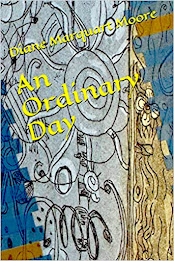
Next month, Border Press will issue a new chapbook of poetry entitled THE HOLY PRESENT and FARDA, two collections in one volume; the latter one being the book of poetry about Iran. Again, the cover of the book is a painting rendered by my brother Paul and designed by my grandson Martin. The painting above is by Oscar Ortiz and is actually the cover of my first book, IRAN: IN A PERSIAN MARKET (now out of print).

Here is a foretaste of my new chapbook, the last poem that appears in FARDA:

AT SADI’S TOMB

Sa’Di retired on the hill of Pahandez,
orator, poet, pilgrim to Mecca,

twice smashing idols in temples there,
not unlike His Holiness Christ in Jerusalem,

and not unlike St. Francis
he fed the poor, birds, and animals,

yet, was adored by Shiraz princes.
His mausoleum destroyed and built again,

a compound, underneath flowing
spring water as pure as his moral counsel,

pumped to the surface for his rose garden.
Sa’Di, an Isaiah of Persia,

chiding the kings to show justice and equity,
spoke with the heart of a deacon,

serve humankind, he exhorted,
protect the weak and oppressed,

penning 1300 pages of ethical verse,
moral excellence,

studied by Indian and Turkish monarchs,
proclaiming in intrepid lyric,

if we are unaffected by the afflictions of others,
we are not worthy to be called human.


As I write this, a news alert from "The Washington Post" informs me that President Obama, now in Cairo, says that "America and Islam share common principles of justice, progress, tolerance and the dignity of all human beings." Shades of Sa'Di?

Tuesday, June 2, 2009

THE FAMILY BUSINESS


For forty years, my Grandfather Paul Greenlaw, owned and operated a firm called Motor Sales and Service, a Ford truck and car enterprise, beginning with the advent of Henry Ford’s Model A and ending in the period following WWII when he was too ill to continue with the Ford franchise. I guess that cars are “in my blood” as I’ve always liked them, especially classic cars – and particularly Fords of the 1939 – 1947 vintage. As I’ve mentioned in a former blog, in 1946 our family traveled to Diddy Wah Diddy (California) in a 1941 sky blue Ford coupe, complete with waterbags on the hood for driving through the desert and with enough room to accommodate six people – two adults and four children, not to mention a cocker spaniel that lay at my feet the entire trip. When I look at pictures of that coupe online, I wonder how we all fit in, but photos of the back seat reveal a lot of space under that rear hump on the back of the coupe.

My father sold the coupe in 1949 when the style of the Ford became square, and none of us ever liked the ’49 car as much as the old hump-backed coupe. Nowadays, I could purchase a replica of the ’41 coupe for approximately $38,000, but I don’t love the car THAT much and will just have to live on the memory of it by attending movies such as “Walker” starring a red ’41 Ford coupe. Those wide whitewall tires take me back because my brother Paul and I, as teen-agers, once spent a lot of time scrubbing them white before we were allowed to use the car for double dates in Franklinton, Louisiana.

As far as I can tell, from stories told by my mother, my grandfather sold more Ford autos when the Model A was introduced. It’s reputed to have had streamlined Lincoln-like styling and a four cylinder engine, with prices beginning at $460. Nearly 5,000,000 of this model were sold until the production of it ceased in 1932. A dozen years later, I discovered an old gramophone in my grandfather’s attic and spent hours listening to a thick-bodied record of “Henry’s Made A Lady Out of Lizzie,” the promotion song for the wonderful Model A.

When business at Motors Sales and Service waned during WWII, I can remember going down to the office with my grandmother every afternoon around 3 p.m. -- after we had a nap and when we had bathed and dressed properly for “town.” In the office, I was allowed to run tapes on the sale of non-existent cars, write letters on the company stationery, and roam around in the shop attached to what we called “The Garage.” The aroma of oil and gasoline are still pleasing to me and are redolent of a family business that finally failed due to the hiatus in WWII car production.

Today, I feel relieved that Ford has avoided the bankruptcy of GM by mortgaging its assets to borrow 25 billion dollars and stay afloat. It’s the sole automaker to survive the economic downturn without government help and remains the healthiest Detroit automaker. I wish them continued health – although I have to admit, I drive a sky blue hybrid Honda! Below are the last two verses of a snippet about cars from a poem entitled “Classic Car Show” in my chapbook SOARING:

“The motors are noisy,
vrooming loudly,

overlaying everything,
the engine messaging,

Don’t stop until you reach central Texas,
climb above Buchanan Dam again,

retrace your childhood,
not regressing but recapturing innocence,

and perhaps that’s what classic cars are:
recapturing innocence.

Classic cars, a sheen so bright,
road dust a sacrilege,

rain an impiety,
evangelizing so well

the mission of adventure,
advertising leave it all behind,

just go and find
the soul complete…

in a V-8 engine.